Cleanroom class ratings are ISO 14644-1 designations, running from ISO 1 to ISO 9, that set the maximum concentration of airborne particles allowed in a cubic metre of room air at a stated particle size. Lower numbers mean cleaner rooms. That is the whole idea of cleanroom classification, and everything else is detail built on top of it.
Here are cleanroom class ratings explained in plain terms, then mapped to real wafer fabrication and packaging steps. You will also see why a fab often certifies a tool enclosure rather than the room around it, and what a class number deliberately leaves out.
- Lower number, cleaner room. ISO 5 permits one tenth of the particles ISO 7 permits at or above 0.5 microns.
- The unit matters. ISO limits count particles per cubic metre. US legacy names such as Class 100 count per cubic foot, which is why the numbers look unrelated.
- State matters. A room classified at rest can fail while people are working in it.
- A class is not a process guarantee. It says nothing about humidity, chemistry, electrostatic control, vibration or yield.
Updated for October 2026.
Table of Contents
- What Are Cleanroom Class Ratings?
- Cleanroom Class Ratings at a Glance
- How ISO Class Numbers Translate to Particle Limits
- What Does Each Cleanroom Class Mean for Semiconductor Work?
- Photolithography and mask handling
- Etching and deposition
- Chemical mechanical planarization
- Metrology and inspection
- Advanced packaging and die attach
- Failure analysis
- Why fabs certify the tool, not the room
- Cleanroom Class Ratings Explained by Industry Application
- ISO Cleanroom Classes vs. Other Cleanroom Labels
- Federal Standard 209E legacy names
- EU GMP Annex 1 Grades A to D
- Internal cleanroom categories
- How to Verify a Cleanroom’s Class Rating
- Identify the governing standard and edition
- Confirm the scope of the classification
- Check the occupancy state
- Check the particle sizes and sample locations
- Check the instrument and its calibration
- Know the difference between monitoring and classification
- Check the reclassification interval
- Questions to ask before you accept a facility
- Why Cleanroom Ratings Are Only One Part of Contamination Control
- Gowning and personnel flow
- Material transfer and airlocks
- Airflow pattern, air changes and filtration
- Filter grade is a separate specification
- Viable versus non-viable contamination
- Equipment maintenance and chemistry
- Defect density and yield
- Frequently Asked Questions
- Is class 7 or class 8 cleanroom better?
- What does class 100 and class 1000 cleanroom mean?
- What is a class 5 cleanroom?
- What is a class 7 cleanroom?
- What is the difference between a class 10,000 and a class 1000 clean room?
- Is ISO 7 equivalent to grade B?
- Conclusion
What Are Cleanroom Class Ratings?
Cleanroom class ratings describe airborne particle concentration inside a controlled space under specified test conditions. An optical particle counter draws a known volume of air, counts the particles above set thresholds, and the result is compared against the ISO 14644-1 table for that class and particle size. Lower numbers mean cleaner rooms, which is the convention that trips up almost everyone new to the topic.
ISO 14644 is the standard family behind the ratings, and the parts matter when you are reading a report or writing a specification.
- ISO 14644-1 sets the classification scheme, including the class number limit table.
- ISO 14644-2 covers monitoring to demonstrate that a classified room stays classified between formal tests.
- ISO 14644-3 covers the test methods, which is the part to cite when you dispute how a room was measured.
- ISO 14644-4 covers design, construction and start-up of cleanrooms.
- ISO 14644-14 covers suitability for specific applications, which is the bridge between a class number and a production decision.
Cleanroom class ratings also apply to things that are not rooms in the building sense: a lithography bay, a process tool enclosure, an isolator, a laminar flow canopy over a bench. The same table applies, measured at the same working height, because the number describes an environment at the point where work happens rather than a room outline.
Separate the class rating from broader facility and process labels. A facility can be a fab, a GMP suite, a hospital department or a lab. A process can be qualified to SEMI, USP, EU GMP or PIC/S rules. None of those labels is a cleanroom class, and a space can hold a class without holding a compliance certificate.
Cleanroom Class Ratings at a Glance
The numbers below are the maximum concentration of particles at or above 0.5 microns permitted per cubic metre, taken from the ISO 14644-1 classification table.
| ISO class | Max particles at or above 0.5 um per m3 | Plain-English reading | Typical semiconductor or industrial use |
|---|---|---|---|
| ISO 1 | 3,530 | Near-particle-free air | Extreme cases: semiconductor wafer stages for advanced EUV work, 200 mm and smaller critical layers, optics and precision optics assembly |
| ISO 2 | 29,300 | Microelectronics manufacturing environment | Wafer stages for 150 mm and 200 mm critical lithography layers, high-purity chemical handling |
| ISO 3 | 70,700 | Fine electronics and pharmaceuticals | Etch and deposition areas in advanced fabs, reticle handling, precision optics |
| ISO 4 | 70,600 | Controlled environment | Deposition and planarization tool enclosures, high-end optical assembly, advanced packaging |
| ISO 5 | 3,520 | Very clean, commonly met behind a canopy | Photolithography areas, mask and reticle handling, sterile compounding under unidirectional flow |
| ISO 6 | 3,520 | Clean room, and the hardest to hold while people work | Etch and deposition sub-areas, die attach and bonding, precision electronics |
| ISO 7 | 352 | Clean room, the most commonly specified class | General fab bays, packaging lines, metrology rooms, PCB assembly, electronics manufacturing |
| ISO 8 | 35 | Base clean room, an entry-grade space | Wafer handling and stocker areas, assembly floors, component preparation |
| ISO 9 | 3.5 | Least stringent class | Utility and support spaces, controlled corridors, less critical prep areas |
Two things stand out. First, the step between classes is roughly a factor of ten at 0.5 microns, so the gaps are large in engineering terms. Second, the classes actually used day to day in fabs are far fewer than the table suggests.
For semiconductor work the practical working set is usually ISO 7 for the bay, ISO 6 around a sensitive process step, and ISO 5 or better inside a lithography area or a tool enclosure.
The ISO 14644-1 table lists limits at several particle sizes, and for a fab the two columns that matter most are 0.5 and 1.0 microns. Here they are for the classes you will actually meet.
| ISO class | Particles at or above 0.5 um per m3 | Particles at or above 1.0 um per m3 |
|---|---|---|
| ISO 4 | 70,600 | 14,100 |
| ISO 5 | 3,520 | 832 |
| ISO 6 | 3,520 | 293 |
| ISO 7 | 352 | 29 |
| ISO 8 | 35 | 3 |
| ISO 9 | 3.5 | Not classified |
Note that ISO 5 and ISO 6 share the same limit at 0.5 microns and separate only at smaller sizes. That is not a typo in the standard; it is exactly why a specification that only names 0.5 microns fails to distinguish two very different environments.
How ISO Class Numbers Translate to Particle Limits
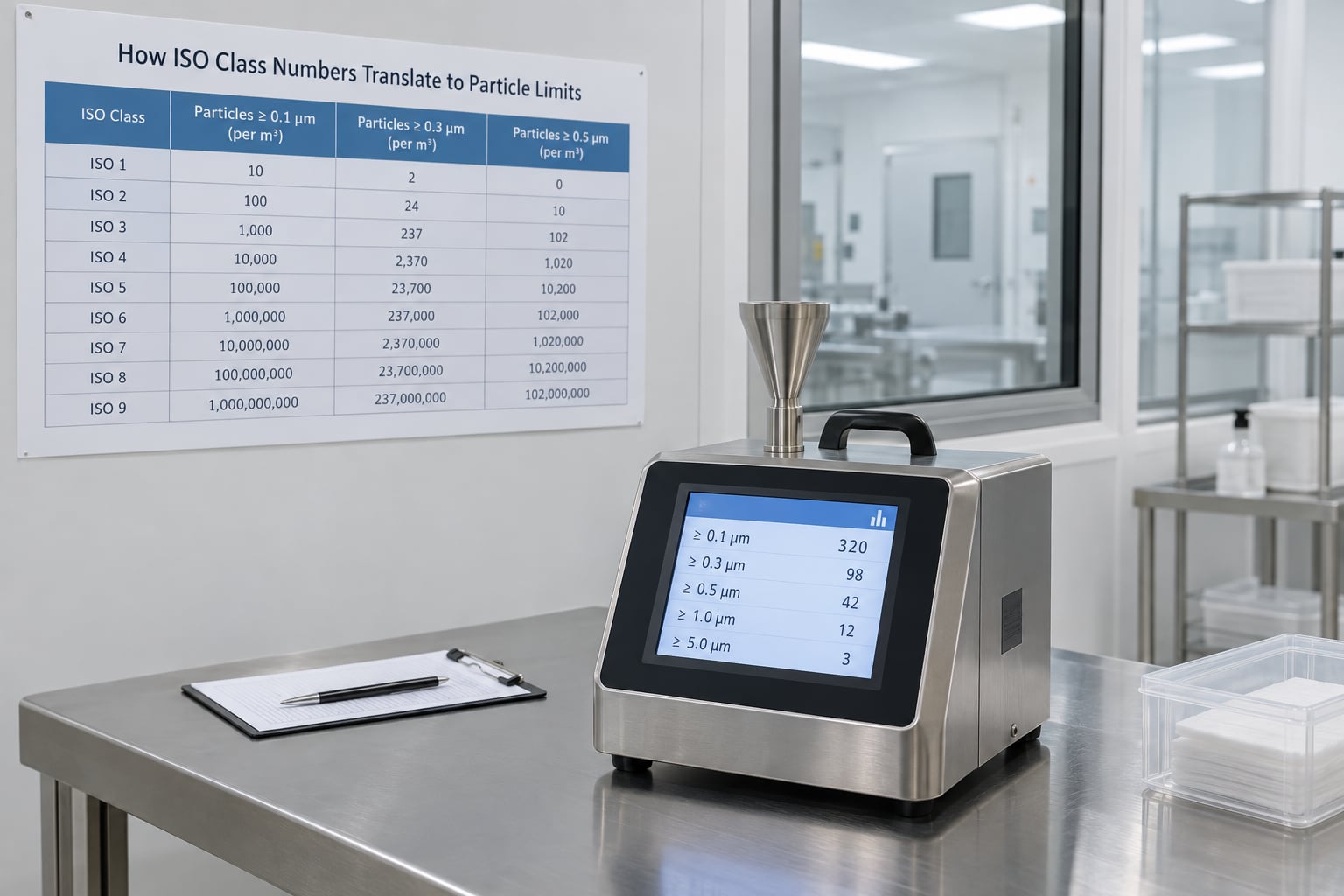
Concentration is simple arithmetic. Take the count of particles above a given size, divide by the volume of air sampled in cubic metres, and you have a concentration. Compare that number with the class limit for the same particle size.
As a worked example, if a counter draws 1.0 cubic metre of air and registers 2,900 particles at or above 1.0 micron, the concentration is 2,900 particles per cubic metre. That sits above the ISO 7 limit of 29 by a wide margin but well below the ISO 5 limit of 832, so the room is out of specification for ISO 7 and comfortably inside ISO 5 at that particle size.
Particle size is not decoration on the table, it changes the answer. A counter that sees 800 particles per cubic metre at 0.3 microns is reporting a different air quality from one that sees 800 particles at 1.0 micron, and a room can sit comfortably inside ISO 5 at 1.0 micron while failing badly at 0.3 microns. Small particles come from process equipment, condensation and combustion; large particles come mostly from people, materials and wear.
There is also a statistical limit. Below roughly a thousand particles per cubic metre, the number of particles actually captured in a one-cubic-metre sample becomes so small that a single extra particle swings the result wildly. The current revision of ISO 14644-1 leaves those table cells deliberately empty rather than print a number that cannot be measured reliably.
What the class number does not measure is worth stating plainly. It says nothing about temperature or humidity, nothing about chemical contamination such as molecular residues or outgassing, nothing about electrostatic charge, nothing about vibration, nothing about floor flatness, and nothing about whether the process in front of you actually produces good die. A perfectly classified room can still ship a bad wafer.
What Does Each Cleanroom Class Mean for Semiconductor Work?
Class choice in a fab follows the step, not the building. Different process steps have different particle sensitivities, and no single class is automatically right for a process. The mapping below is a starting point, not a rule.
Photolithography and mask handling
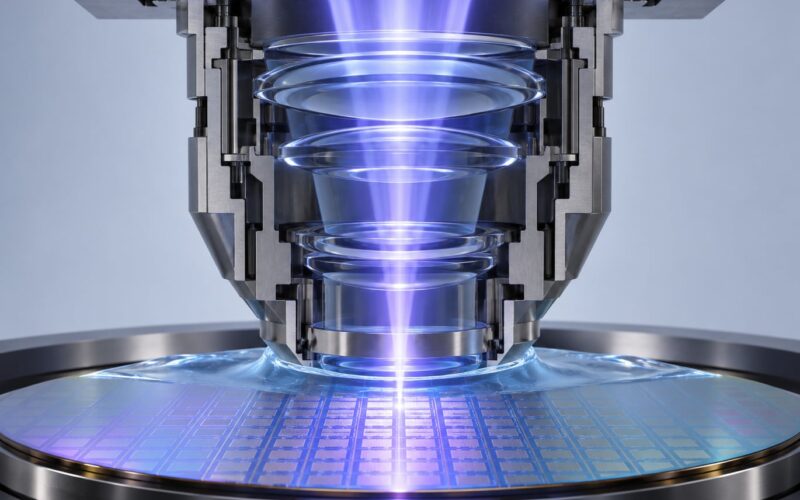
Lithography is where particle control matters most. A single particle landing in a resist layer prints a defect that survives etching and shows up as a failed die at final test. Wafer stage areas therefore run at ISO 1 through ISO 3, and resist apply and develop tracks are normally inside ISO 5 environments with unidirectional airflow. Reticle and mask storage and handling add their own class requirements because a defect on a reticle repeats across every exposure field.
Etching and deposition
Etch and deposition steps are less sensitive than lithography but still expose a surface directly. Bay areas are commonly ISO 7 with ISO 6 or ISO 5 inside tool enclosures. Gas delivery, abatement and chemical supply interfaces generate particulate, so a chemical supply room is usually a step cleaner than the bay it feeds, not a step dirtier.
Chemical mechanical planarization
CMP is a wet chemistry step and a particle generator at the same time. Slurry delivery, slurry blending and post-CMP cleaning are usually held at ISO 6 to ISO 7 because the process works with abrasive particles by design and the real risk is foreign particulate redepositing onto a wafer after a clean step.
Metrology and inspection
Measurement bays are often specified around the sensitivity of the tool rather than the cleanliness need of the measurement. A defect inspection tool or an electron microscope counts or images single particles, so it wants an environment where the sample is not being altered before it is examined. ISO 5 to ISO 7 is typical. Engineers working in low-criticality metrology sometimes question whether their inspection bay needs a formal class at all, and for some CMM and dimensional work the honest answer is that a controlled environment beats a classified one.
Advanced packaging and die attach
Packaging brings together parts from many sources, so contamination sources multiply even as feature sizes grow less demanding. Wafer sort, die attach, wire bond, flip chip and inspection areas typically sit at ISO 6 to ISO 7 with local ISO 5 coverage over the bonders and the inspection stations.
Failure analysis
Failure analysis labs are a special case because the work deliberately brings contamination in. Deprocessing and layer delamination happen at lower classes, and clean sample prep happens under a canopy or in a Class 5 or Class 100 bench environment. The class requirement follows the step being performed, not the room the sample starts in.
Why fabs certify the tool, not the room
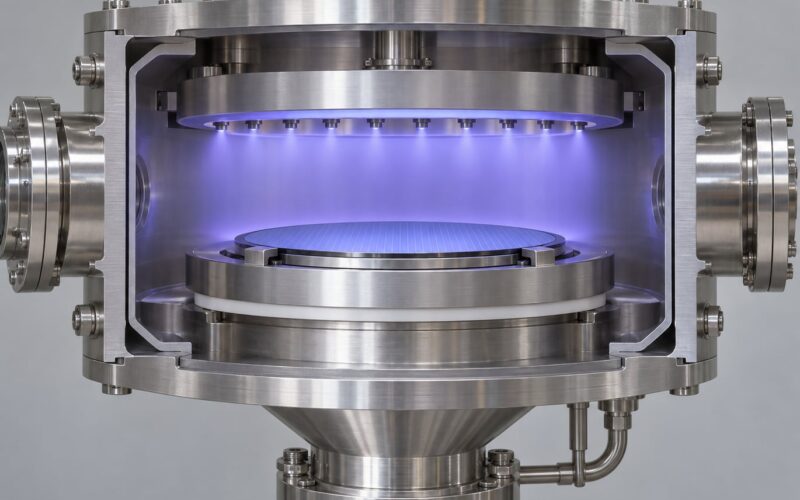
This is the piece most general cleanroom explainers miss. In a modern fab, the room is usually ISO 7 and stays ISO 7. The ISO 5 or ISO 4 condition exists inside a mini-environment: an enclosure over a tool load port with its own filtered supply, its own exhaust plenum and its own particle monitors. The tool enclosure is classified and certified on its own schedule, independent of the bay.
That model exists because it is cheaper to filter a few square metres than to filter an entire building, and because an enclosure can hold its class with people working at the load port, which a room at that class often cannot. If you are evaluating a supplier’s facility, ask which spaces carry a formal classification and which conditions are local enclosures.
Cleanroom Class Ratings Explained by Industry Application
Once you know how the numbers work, the practical question is which class a given application needs. The answer depends on three things: how sensitive the process is, what the product specification requires, and what contamination sources are actually present in the space.
| Application | Typical class | What drives the requirement |
|---|---|---|
| Semiconductor wafer fabrication | ISO 7 bay, ISO 5 to ISO 3 in lithography, ISO 6 to ISO 5 in tool enclosures | Feature size and the direct exposure of active surfaces |
| Advanced IC packaging | ISO 7 to ISO 6, ISO 5 over bond and inspection stations | Fine interconnect pitch plus material variety |
| PCB assembly | ISO 8 to ISO 7 | Handling quality rather than pattern criticality |
| MEMS and photonics | ISO 6 to ISO 5 locally | Moving parts, release processes, optical surfaces |
| Pharmaceutical sterile manufacturing | Grade A and B under EU GMP, which map to ISO 5 locally and ISO 7 at rest | Regulatory specification plus viable contamination limits |
| Medical device manufacturing | ISO 8 to ISO 6 | Product specification and packaging exposure |
| Cell and gene therapy | ISO 5 locally, ISO 7 background | Open process handling and viable contamination risk |
| Optics and precision manufacturing | ISO 5 to ISO 4 locally | Surface finish specifications with no defect tolerance |
| Research and teaching laboratories | ISO 8 to ISO 7 | Sample protection rather than production yield |
| Aerospace and defence assembly | ISO 7 to ISO 6 | Reliability requirements and long field lifetimes |
Note the last two rows. Labs and metrology spaces often get specified far cleaner than the work requires, which is a common source of both budget complaints and gowning fatigue. If you are choosing a class for a space, work from the process sensitivity first and the habit second.
ISO Cleanroom Classes vs. Other Cleanroom Labels
Plenty of specification documents mix frameworks, and that is where cleanroom class ratings get misread. A tender that says Class 100 in one paragraph and ISO 5 in the next is not necessarily wrong, but it is not a document you can check compliance against without knowing which measurement condition applies.
Federal Standard 209E legacy names
US Federal Standard 209E classes count particles at or above 0.5 microns per cubic foot. ISO 14644-1 counts the same size threshold per cubic metre. Since one cubic metre is about 35.3 cubic feet, the legacy numbers are numerically unrelated to ISO numbers even where the environments are the same.
| FS 209E name | Particles at or above 0.5 um per cubic foot | Equivalent ISO 14644-1 class |
|---|---|---|
| Class 100 | 100 | ISO 5 |
| Class 1,000 | 1,000 | ISO 6 |
| Class 10,000 | 10,000 | ISO 7 |
| Class 100,000 | 100,000 | ISO 8 |
So Class 100 means 100 particles per cubic foot at or above 0.5 microns, which is 3,520 particles per cubic metre, which is the ISO Class 5 limit. Class 1,000 maps to ISO 6 and Class 10,000 maps to ISO 7, a ten-fold difference in permitted concentration between the two. Treat any legacy label as a cross-reference, not as an equivalent, and always confirm the particle size and the edition of the standard the document was written against.
EU GMP Annex 1 Grades A to D
EU GMP uses letter grades rather than ISO numbers, and it states two particle limits for each grade: at rest, meaning the room is equipped and unoccupied, and in operation, meaning the room is working with personnel present. That second column is the one people forget.
| Grade | At rest, particles at or above 0.5 um per m3 | In operation, particles at or above 0.5 um per m3 | Viable limits, 90 mm settle plate, 4 hours |
|---|---|---|---|
| A | 3,520 | 3,520 | No growth |
| B | 3,520 | 352,000 | 10 at rest, 100 in operation |
| C | 352,000 | 3,520,000 | 100 at rest, 1,000 in operation |
| D | 3,520,000 | Not predetermined | 200 at rest, 2,000 in operation |
ISO 7 is not equivalent to Grade B as a room requirement. Grade B is ISO 5 at rest and only ISO 7 in operation, so the moment people are working in the room the acceptable particle load rises by two orders of magnitude. Two things follow from this. A Grade B suite runs an unidirectional airflow background so the occupied state can still meet the local Grade A conditions where product is exposed, and any comparison between an ISO class and a GMP grade has to name the occupancy state or it is meaningless.
USP 795, 797 and 800 work the same way for sterile compounding in the United States, using their own category and environment tables rather than ISO class labels directly. US 21 CFR 211.46 and 211.192 appear in federal inspection records as the requirement behind a room classification. If you work in pharma, the governing document is the one your regulator inspects against.
Internal cleanroom categories
Many fabs and contract manufacturers define their own internal tiers, things like controlled, controlled plus, or critical. These are useful internally and useless externally. Always ask what ISO class an internal tier corresponds to, under which occupancy state, and who verified it last.
How to Verify a Cleanroom’s Class Rating
A classification report is not a certificate of quality, it is a measurement with a scope. Here is how to read one properly.
Identify the governing standard and edition
Check the report names ISO 14644-1 and states the edition or year. Limits and sampling requirements have changed between revisions, and an old report tested under a superseded method may not match a current specification.
Confirm the scope of the classification
Ask exactly what was classified: the room, a zone within the room, a workstation, or a tool enclosure. A report covering a 3 square metre local containment does not tell you anything about the 400 square metre bay.
Check the occupancy state
The report should say whether the room was classified at rest or in operation, and if in operation, the number of personnel and their activity level. This is the single most useful field on the document, and the one most often missing. Engineers distrust a certificate that does not state the occupancy state, the particle size and the number of sampling locations.
Check the particle sizes and sample locations
Confirm which particle size thresholds were tested, usually 0.5 microns plus one or more smaller sizes, and how many sample locations were used. Older reports may still cite the square root of floor area as the sample count rule; that rule has been withdrawn and replaced by a statistical lookup table, so a report using it is old.
Check the instrument and its calibration
Verify the particle counter used, its calibration date, and the flow rate and sample volume. A light scattering optical particle counter is the normal instrument, and results depend on the flow rate and the threshold settings, not just the model.
Know the difference between monitoring and classification
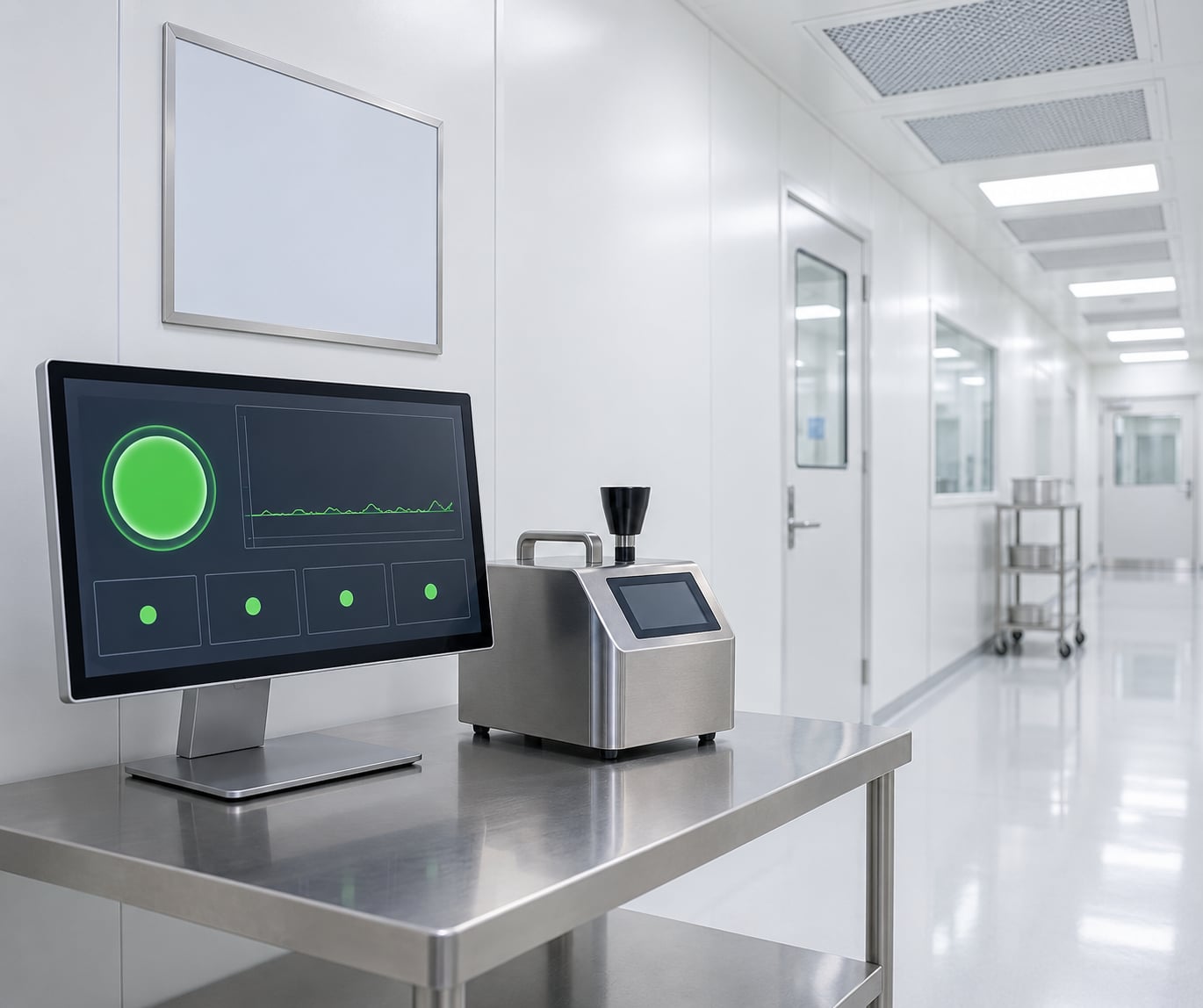
A classification test is a formal, one-off demonstration against the standard. Monitoring under ISO 14644-2 is continuous or periodic evidence that the room has stayed within limits between classifications. Vendors sell monitoring, buyers ask for classification, and they are not interchangeable.
Check the reclassification interval
Ask how often the room is formally reclassified and who performs it. Most fabs reclassify tool enclosures and critical bays on a schedule set by risk, and often with internal technicians working to an external standard rather than an outside laboratory.
Questions to ask before you accept a facility
- Which ISO 14644-1 edition was used, and at which occupancy state?
- Which particle sizes were measured, and how many sample locations?
- Are the classified spaces whole rooms or tool enclosures?
- What is the reclassification interval and who signs the report?
- What do the viable monitoring results look like, for pharma work?
- What is the recovery time after a door opening or a material transfer?
Why Cleanroom Ratings Are Only One Part of Contamination Control
A class rating is the scoreboard, not the game. Two rooms with identical ISO 7 classifications can behave very differently depending on everything the standard does not cover.
Gowning and personnel flow
Gowning sequence, gown change frequency and the number of people allowed in a room drive the in-operation particle count more than any other variable. Class 5 is the hardest class to actually hold once people are in the room, and the gap between at-rest and in-operation numbers is where practitioners feel that problem daily.
Material transfer and airlocks
Every entry point dilutes a clean space. Airlocks and ante-rooms exist so that entering adds one controlled step rather than a jump in class. A common rule of thumb is not to skip more than one class when passing from a corridor into a clean room, which is why ISO 8 to ISO 5 needs a cascade of airlocks rather than one.
Airflow pattern, air changes and filtration
Air changes per hour, unidirectional versus non-unidirectional airflow, and pressure differentials between adjacent spaces decide whether particles are swept out or merely mixed. Unidirectional flow is what makes ISO 5 achievable over an open work area; non-unidirectional flow with sufficient air changes is how ISO 7 is met in practice.
Filter grade is a separate specification
Room class and filter class are independent requirements that people routinely conflate. Filters are graded under EN 1822 by efficiency at the MPPS, the most penetrating particle size, which sits around 0.3 microns for HEPA-class media and shifts higher for ULPA grades. An H14 or U15 filter does not create an ISO 5 room by itself, and an ISO 7 room can be built with perfectly adequate filters that simply are not rated that high. Filter integrity testing, whether an installed scan, a DOP test or a leakage test, is a third requirement on top of class and filter grade.
Viable versus non-viable contamination
An optical particle counter counts non-viable particles only. Bacteria and spores are alive, they are much larger than the thresholds that drive particle limits, and they are what kills patients and contaminates biologics. That is why GMP adds viable monitoring with settle plates, air samplers and contact plates on top of the particle class, and why a fab can sit at ISO 7 without ever addressing microbiology.
Equipment maintenance and chemistry
A tool opened for a PM in an ISO 7 bay will spike the count for a while. Recovery time is the measure of how fast the room returns to class, and it is a better indicator of real performance than a single at-rest number. Chemicals, cleaning agents and materials brought into the room set the floor that no amount of filtration will fix.
Defect density and yield
Class choice ultimately shows up as yield. In patterned processes, defects per square centimetre of wafer maps directly onto the defect-sensitive area of a die, and cost per good die rises as that number climbs. This is why a fab will spend heavily on an ISO 5 environment at a single lithography step and be content with ISO 8 in a utility corridor, even though the corridor has more people walking through it.
Frequently Asked Questions
Is class 7 or class 8 cleanroom better?
Neither is better in absolute terms. ISO 7 permits 352 particles per cubic metre at or above 0.5 microns, while ISO 8 permits 35, so ISO 7 is ten times cleaner at that particle size. Choose ISO 7 when the process is moderately sensitive, such as general fab bays and packaging, and ISO 8 when it is not, such as corridors and less critical prep areas. The step costs roughly a tenfold increase in filtered air supply and a longer entry cascade.
What does class 100 and class 1000 cleanroom mean?
Class 100 and Class 1,000 are US Federal Standard 209E names that count particles at or above 0.5 microns per cubic foot of air. Class 100 allows 100 particles per cubic foot, which is 3,520 particles per cubic metre and therefore matches the ISO Class 5 limit. Class 1,000 matches ISO Class 6. The names look unrelated to ISO numbers only because the units differ: one cubic metre is about 35.3 cubic feet.
What is a class 5 cleanroom?
ISO Class 5 permits a maximum of 3,520 particles per cubic metre at or above 0.5 microns, 832 at or above 1.0 micron and 353,000 at or above 0.2 micron. It is normally achieved with unidirectional airflow, either as a room or as a local enclosure over a work area. In semiconductor fabs, ISO 5 environments protect lithography steps and resist tracks where a single particle prints as a defect.
What is a class 7 cleanroom?
ISO Class 7 permits a maximum of 352 particles per cubic metre at or above 0.5 microns and 29 at or above 1.0 micron. It is the most commonly specified cleanroom class because it is achievable with non-unidirectional airflow and a sensible air change rate rather than unidirectional flow. In a fab you will see ISO 7 for general process bays, packaging lines, metrology rooms and PCB assembly.
What is the difference between a class 10,000 and a class 1000 clean room?
Class 1,000 corresponds to ISO Class 6 and Class 10,000 corresponds to ISO Class 7, so the ten-fold difference in the names is real: about 3,520 particles per cubic metre against about 352 at or above 0.5 microns. In practice the class also sets the entry cascade. A Class 1,000 room needs an airlock step that a Class 10,000 room can do without, and the air change rate roughly doubles between them.
Is ISO 7 equivalent to grade B?
Only at rest, and only partly. EU GMP Grade B is ISO 5 at rest and ISO 7 in operation, so ISO 7 does not describe the occupied condition of a Grade B suite. A Grade B background area runs an unidirectional airflow grade A condition where product is actually exposed, which is how the room holds its required cleanliness with people working in it. Any comparison that does not name the occupancy state is misleading.
Conclusion
Cleanroom class ratings explained in one sentence: they are particle concentration limits, and nothing else. The practical decision rule follows from that. Start with how contamination-sensitive the process is, identify the ISO class that sensitivity requires, then confirm that the facility’s classification report, operating procedures and monitoring programme actually support the work you intend to do. The class number is the first conversation, not the last one.
Your first action is concrete: take the process step with the worst particle risk in your own flow, find its particle size threshold, and check which class and which occupancy state currently protect it. If nobody in the room can answer that, that is the gap to close first.