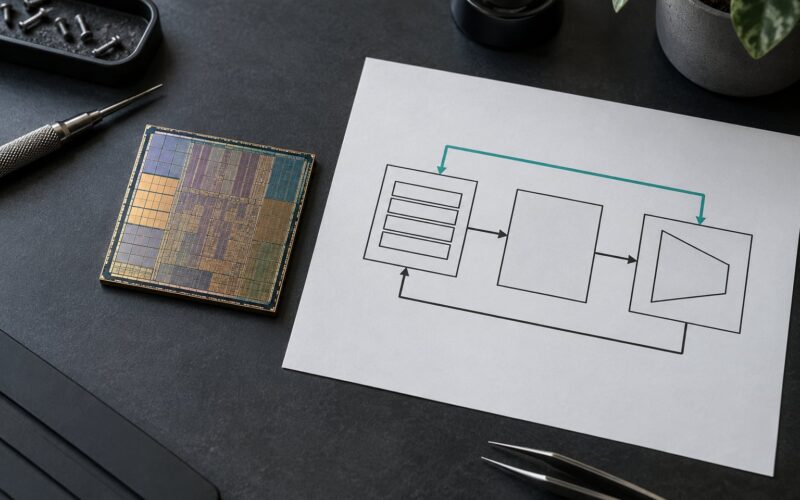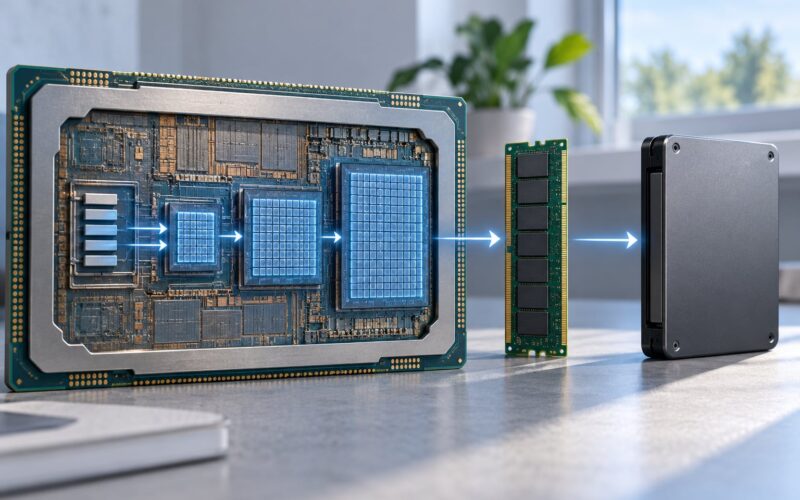
RISC-V (pronounced “risk-five”) is a free and open instruction set architecture (ISA) built on reduced instruction set computer principles. It defines the instructions a processor executes, not the processor itself: hardware teams choose which extensions to implement, and software runs on any design that implements the same set.
That distinction trips up almost everyone who meets RISC-V for the first time. An ISA is a contract between software and hardware, and this guide walks through what is in that contract, how a processor executes it, and what it takes to turn it into a chip that boots.
If you are new to processor architecture, the rest assumes no background. If you are picking an ISA for new silicon, the RV32/RV64 and extension sections are the ones to bookmark.
Table of Contents
- What Is RISC-V Architecture?
- ISA, processor core, and chip are three different things
- What Problem Does RISC-V Solve?
- How the RISC-V Instruction Set Is Organized
- RISC-V Architecture Explained Through the Fetch-Decode-Execute Cycle
- How one instruction actually executes
- What Are RISC-V Base ISAs and Extensions?
- What Are RV32 and RV64?
- How Does RISC-V Handle Privileges, Memory, and Interrupts?
- Which RISC-V Processor Designs Exist?
- How Does RISC-V Software Work?
- Where Is RISC-V Used in Real Products?
- What Are the Main Advantages and Tradeoffs?
- Frequently Asked Questions
- What does the V in RISC-V stand for?
- How many instructions and registers does RISC-V have?
- Is RISC-V faster than ARM or x86?
- Does the open RISC-V standard mean commercial cores are free to use?
- Is it worth learning RISC-V as a developer or student?
- Conclusion
What Is RISC-V Architecture?
RISC-V architecture is the set of rules describing what instructions a processor is allowed to execute, how registers and memory are addressed, and how the processor signals errors. It is a published specification maintained by RISC-V International, a non-profit organization headquartered in Switzerland.
The name is the part worth getting right. RISC stands for reduced instruction set computer, a design philosophy rather than a product. The V is the fifth generation of that research effort, begun at UC Berkeley around 2010 by a team including Krste Asanovic, David Patterson, and Andrew Waterman. It does not stand for vector, and it does not stand for anything else.
What RISC-V architecture explained in practice comes down to is this: nothing in the specification tells you how wide the pipeline is, how many stages it has, whether it caches, or how much power it burns. Those are implementation choices. The specification only says what the software may ask the hardware to do.
ISA, processor core, and chip are three different things
An ISA is the instruction vocabulary. A processor core is one implementation of that vocabulary, described in hardware description language such as Verilog or SystemVerilog. A chip, or SoC, is a core or several cores wired together with memory controllers, peripherals, and accelerators, then fabricated.
The same RISC-V base ISA can sit under a microcontroller that costs a fraction of a cent and under a server-class core in a data center part. Nothing about the instruction set forces either outcome.
What Problem Does RISC-V Solve?
Historically, building a processor meant paying someone for the right to use an instruction set. ARM charged license fees per chip shipped, and x86 was tied to a handful of companies through cross-licensing agreements. RISC-V removes that constraint: the specification is free and royalty-free for commercial, research, and educational use.
That matters because the ISA layer is the most expensive thing to replicate from scratch, and the least differentiated. Once software has been written and debugged for an instruction set, switching means recompiling everything, retesting drivers, and rebuilding tooling. It is the same lock-in problem as any standard, only it sits at the bottom of the hardware stack.
The motivations behind the open standard fall into a few groups. Customization: a designer can add an instruction for a cryptographic primitive or a signal-processing kernel and keep it out of everyone else’s core. Research: academic groups can modify the architecture and publish results without negotiating access. Education: the full specification is public and complete, with no omissions to work around. Supply-chain control: companies building silicon want an ISA they can implement without depending on a single licensor’s business decisions.
How the RISC-V Instruction Set Is Organized
RISC-V splits into a mandatory base and optional extensions. The base covers integer arithmetic, shifts, loads, stores, branches, and system instructions. Everything else is a letter.
| Part | Name | What it adds |
|---|---|---|
| RV32I / RV64I | Base integer ISA | Mandatory. 47 instructions, 32 registers, branches, loads and stores |
| M | Integer multiply and divide | Hardware multiplication and division instead of a software routine |
| A | Atomic operations | Atomic memory instructions needed for locking across cores |
| F / D | Single / double precision floating point | FP registers and arithmetic, often paired as FD |
| C | Compressed instructions | 16-bit encodings for common operations, shortening the code stream |
| V | Vector operations | Data-parallel vector unit with its own register file |
| B | Bit manipulation | Bitfield extract and insert, count leading and trailing bits, byte and halfword permutes |
| K | Scalar cryptography | AES and SHA-256/SHA-512 instructions for encryption at the core |
Extension letters are functional groupings, not product generations. Nothing about the alphabet implies age or importance, and an implementation is free to combine them. The V extension in an ISA string refers to the vector extension, not to the fifth RISC generation. Even that dual use of the letter trips people up.
RISC-V Architecture Explained Through the Fetch-Decode-Execute Cycle
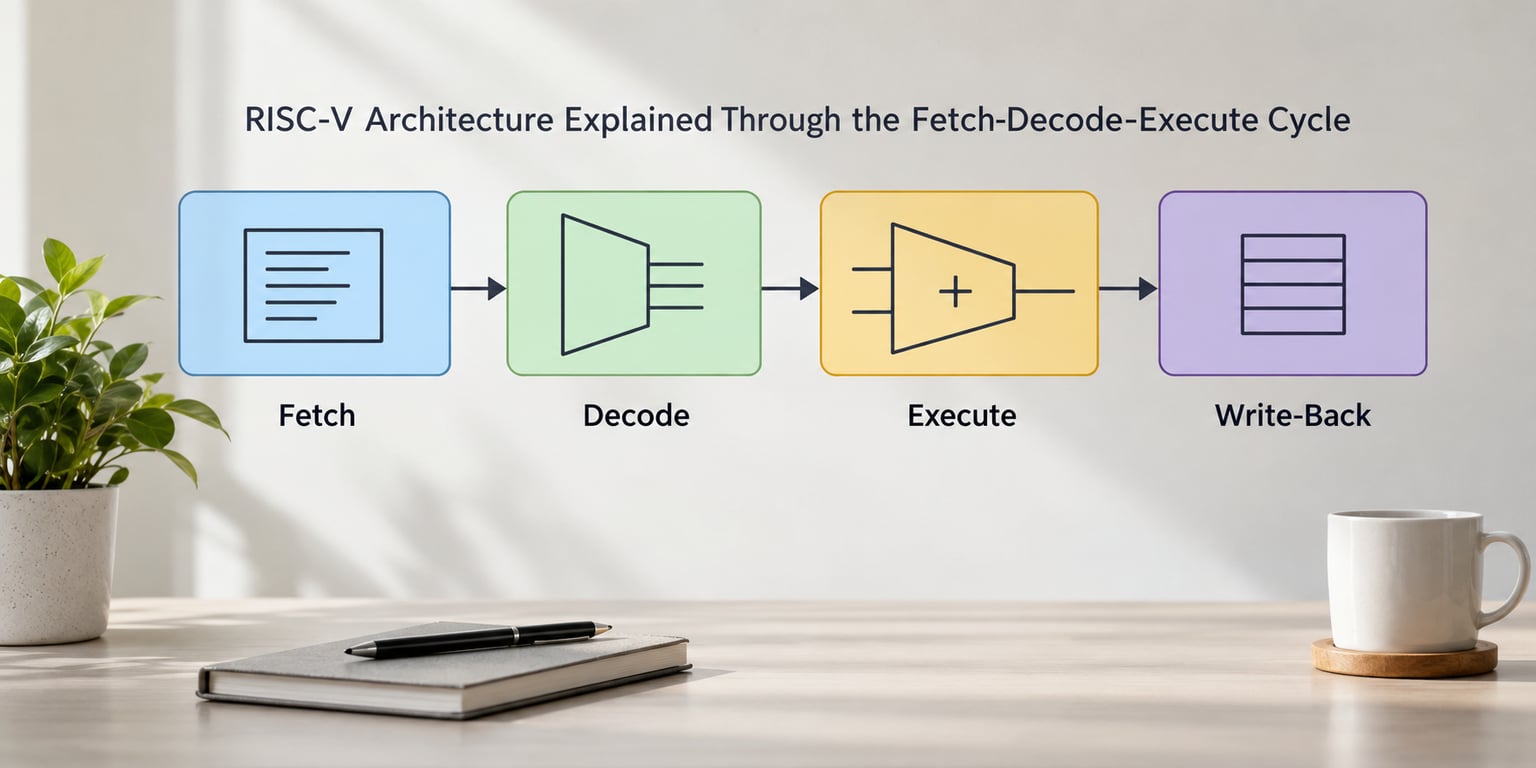
Every processor, RISC-V or otherwise, runs the same fundamental loop. The program counter holds the address of the next instruction, the fetch unit reads it from memory, the decode unit breaks it into an opcode and operands, the execution units do the work, and the result goes back into a register.
RISC-V is a load-store architecture, and that one design choice shapes the loop. Arithmetic instructions operate only on values held in the 32-entry register file. Only load and store instructions touch memory. That means the number of memory operations is small and predictable, which is why a simple RISC-V core can be compact and easy to verify formally.
How one instruction actually executes
Take add x5, x5, x6 as a walkthrough:
- Fetch. The program counter points at the address of the instruction. The fetch unit reads those bytes, and the program counter advances by the instruction size, usually 4 bytes, or 2 with compressed instructions enabled.
- Decode. The decoder splits the bits into opcode, destination register, source registers, and control fields. The control unit uses those fields to tell the rest of the core what this instruction does.
- Read operands. The register file supplies the current values of x5 and x6. x0 always reads as zero, which makes moving a zero cheap and predictable.
- Execute. The ALU adds the two values. Nothing is written to memory at this stage, because this is not a memory instruction.
- Write back. The sum is written into x5, and the new program counter value becomes visible for the next cycle.
What makes RISC-V different is not the loop but what surrounds it. XLEN sets the register width to 32 or 64 bits. Privileged modes determine which software layer the core is currently running. Interrupt and exception inputs can divert control to a trap handler at any cycle boundary, and precise traps guarantee the handler sees a well-defined architectural state.
Extensions attach at named points in that loop. Multiply-divide gets its own unit. Vector work goes to a separate vector register file. A custom extension can plug a dedicated datapath in beside the ALU.
What Are RISC-V Base ISAs and Extensions?
An implementation must include one base ISA, RV32I or RV64I, and then chooses which extensions to add on top. A washing machine controller might implement only the base, saving area and power. A network storage processor needs M, A, and often C. A machine learning accelerator wants the vector extension.
Because a core reports its implemented set as an ISA string, an implementer never has to guess. RV64GCV means RV64 base, the general-purpose collection G (which bundles M, A, F, D, and C), and the vector extension V. Any toolchain can read that string and target exactly those instructions.
Profiles go one step further and package a tested combination of extensions for a class of systems, with rules on which extensions are mandatory, which are optional, and which combinations are illegal. Boards and chips built to the same profile can rely on a common baseline of software support, which reduces the fragmentation risk that comes with completely free-form extension choices.
This is the practical meaning of modularity: one instruction set, many processor shapes. A microcontroller with 16 KB of memory and a 16-core server part can both be RISC-V, because what is mandatory stayed small and what is optional was chosen deliberately.
What Are RV32 and RV64?
The prefix in an ISA name states XLEN, the register width and pointer width in bits. Everything else about the base integer ISA is identical between them.
| Attribute | RV32 | RV64 |
|---|---|---|
| Register width (XLEN) | 32 bits | 64 bits |
| Addressable memory | 4 GB address space | Exabyte-scale virtual and physical space |
| General registers | 32 integer registers plus optional floating point | 32 integer registers plus optional floating point |
| Best suited to | Microcontrollers, sensors, cost-sensitive control | Linux-class systems, storage, networking, compute |
| Power and area | Smaller datapath and smaller buses, lower power | Larger registers and load/store unit, higher power |
| Typical applications | IoT wearables, industrial control, automotive subsystems | Edge gateways, storage controllers, SBCs, data center silicon |
RV64 is not faster than RV32 by specification. It is more capable, because pointer arithmetic, large data sets, and modern compilers assume 64-bit address spaces. A 32-bit design also keeps memory cheaper, which is exactly why plenty of connected devices stay 32-bit.
How Does RISC-V Handle Privileges, Memory, and Interrupts?
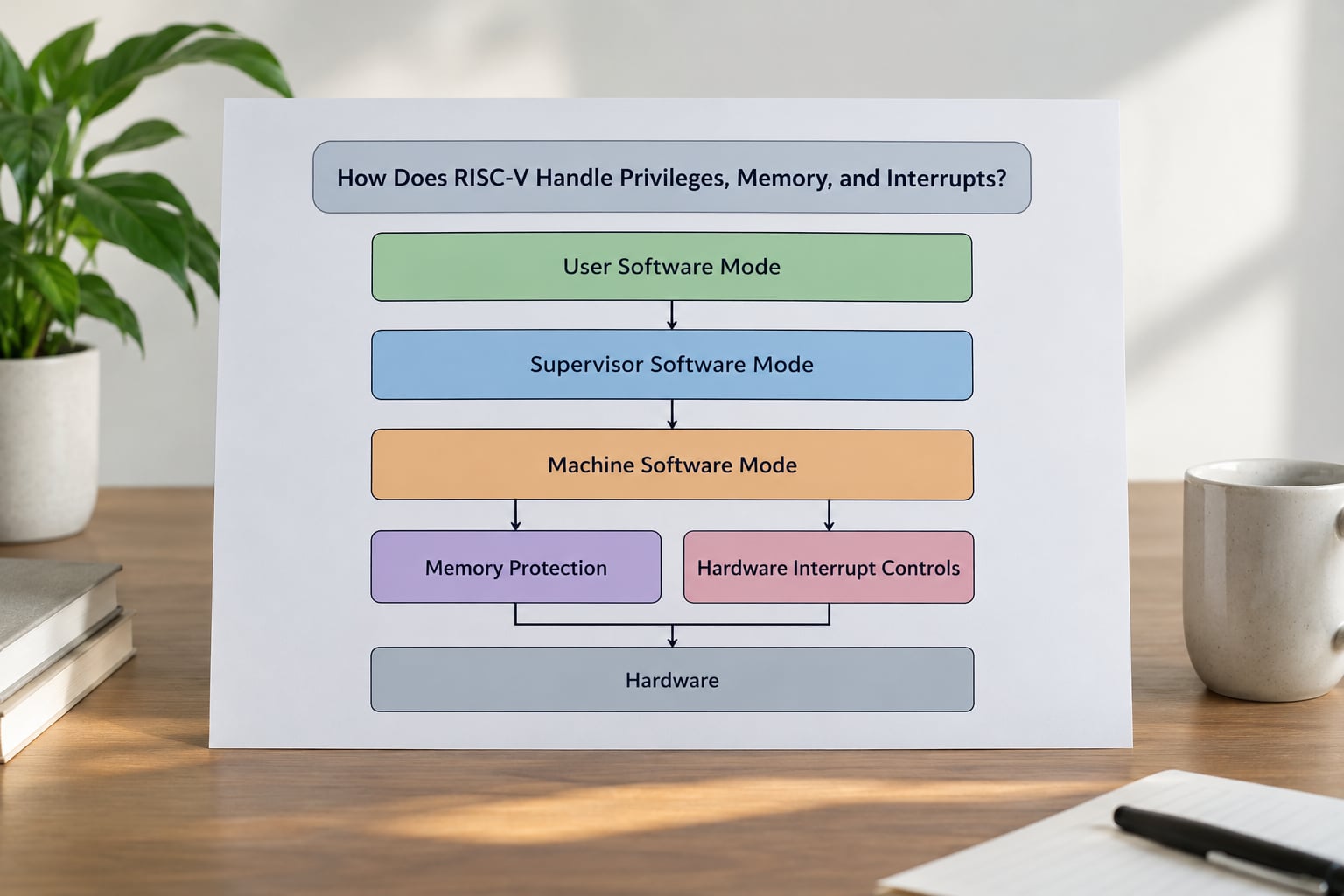
The privileged architecture defines a small set of privilege modes. Machine mode is the most privileged and is where firmware and machine-mode handlers run. Supervisor mode hosts an operating system kernel. User mode is where applications run, and a misbehaving application cannot touch hardware state or another process’s memory.
Memory protection is built on page tables. Each process gets its own mapping, so the same virtual address points at different physical memory in different processes. A page-table entry carries permission bits, so a region can be marked readable, writable, or not present at all.
Traps are the single mechanism that handles both faults and interrupts. When an instruction faults or an interrupt arrives, the processor saves the current program counter in a control and status register, records the cause, and jumps to the handler address set in the trap vector register. Machine-mode handlers can delegate interrupts to supervisor mode, and machine-mode code runs ahead of supervisor code. Returns use dedicated instructions so the previous mode and state are restored exactly.
What makes this tidy for implementers is that there is no hidden architectural state and no separate privileged instruction encoding. Privilege checks live in one place in the decoder.
Which RISC-V Processor Designs Exist?
RISC-V processor designs fall into four categories, and mixing them up is the most common source of confusion in search results on this topic.
The ISA itself. A specification document. It produces no silicon and no performance on its own.
Open-source cores. Verilog or SystemVerilog implementations published under permissive licences, usable as a starting point or as a complete design for small parts. These are popular in education and research.
Core families. Parameterized designs that a licensee scales up or down by adding pipeline stages, caches, vector units, or extra cores. This is where most production silicon comes from.
Commercial chips. A finished part built from one of the above and fabbed. Vendors in this space include SiFive, Andes Technology, Espressif Systems, T-Head, StarFive, Ventana, and Codasip, plus large system-on-chip companies that build RISC-V cores internally for control functions.
One more distinction worth stating plainly: an open ISA does not mean every RISC-V core is free. Commercial RISC-V IP is licensed by vendors for a fee, and that fee is one of the reasons the “RISC-V is free” claim gets oversimplified in blog posts.
How Does RISC-V Software Work?
The toolchain side is where RISC-V looks most mature. GCC and LLVM both support RISC-V targets well, so cross-compiling from a Linux workstation to a RISC-V target is routine. Mainline Linux runs on RISC-V, and distributions publish RISC-V builds, which is what makes Linux-class software possible on application-class cores.
Embedded runtimes follow the same pattern as other architectures: a real-time kernel or a vendor SDK, a C library, and a board support package. Simulators make hardware work cheaper to try: Spike is the reference simulator that ships with the specification, and QEMU models common RISC-V system configurations for full software stacks.
Two mechanisms matter for anyone combining extensions. Platform specifications describe the memory map, interrupt controller, and timer for a class of devices, so that one operating system image can boot across many designs. And when software uses an instruction the hardware does not implement, the environment traps the attempt and emulates the instruction instead, which keeps a binary running on a smaller core than it was compiled for.
That trap-and-emulate path is also why ISA strings and profiles matter so much to application developers. They tell a toolchain exactly what the target can execute natively.
Where Is RISC-V Used in Real Products?
RISC-V deployment is uneven across segments, and it helps to separate what is established from what is still developing.
| Segment | Status | What RISC-V is used for |
|---|---|---|
| Education and research | Established | Teaching computer architecture, prototyping, formal verification research |
| Embedded and IoT | Established | Microcontrollers for consumer electronics, sensors, smart home devices |
| Storage and networking | Established | Storage controllers, network processors, baseboard management controllers |
| Automotive | DevelopingSafety-domain controllers and subsystems, where qualification cycles are long | |
| AI and edge accelerators | Developing | Custom instruction and coprocessor designs built around the modular ISA |
| Data center and HPC | Early | Classwide software stacks being validated on high-performance cores |
| Developer boards and SBCs | Established | Low-cost hardware for learning, porting, and hobby projects |
Large system-on-chip companies use RISC-V cores internally for control and management functions, which is the highest-volume application of all and rarely shows up in marketing material. Consumer-visible devices sit mostly in the embedded and IoT rows.
What Are the Main Advantages and Tradeoffs?
The advantages start with the license model. No per-chip royalty, no licensor approval, and no dependency on one company’s roadmap. Modularity means a design pays only for the extensions it uses, which usually wins on power, area, and cost in constrained systems.
Customization is the argument the chip-design world cares about most. Because the specification reserves space for non-standard extensions, a design team can attach a domain-specific instruction without permission. For cryptography, compression, or AI workloads, that can beat a general-purpose unit outright.
Education and verification benefits follow from the same openness. The specification is complete and free, so a student can read the whole thing in an afternoon. Small, regular instruction encodings make formal verification of a core tractable, which is one reason RISC-V shows up in verification research.
The tradeoffs are equally real. Software maturity is the biggest one. Existing RISC-V development boards sit in a lower performance tier than comparable ARM and x86 hardware, and multi-core support has been a persistent area of active work in the community. Porting effort can also be higher, because more combinations of extensions exist than for a single ARM flavor.
Fragmentation is a design tradeoff, not a bug. Modularity gives flexibility and takes away uniformity, and profiles exist to manage that. Verification and performance work stays with each implementer, because the open ISA only standardizes the instructions. And an open ISA does not make implementations free, as the commercial IP licensing market makes clear.
None of this means RISC-V is wrong for a design. It means the decision depends on whether your bottleneck is licensing cost, silicon customization, or software readiness. Those three rarely point the same direction.
Frequently Asked Questions
What does the V in RISC-V stand for?
The V stands for the fifth generation of the Berkeley RISC research project, which began at UC Berkeley around 2010. It is not an abbreviation for vector, and it does not expand to a word at all. Vector support exists in RISC-V, but it lives in the separate V extension, which appears as a letter in an ISA string such as RV64GCV. The name is pronounced risk-five.
How many instructions and registers does RISC-V have?
The mandatory base integer ISA, RV32I or RV64I, defines 47 instructions and 32 general-purpose registers. The multiplier and divider extension M adds 8 more. Floating point brings its own register file and instructions on top of that. Register x0 is hardwired to read as zero, which makes it useful for moving a constant zero and for encoding unused fields without ambiguity.
Is RISC-V faster than ARM or x86?
The ISA does not decide that. Performance comes from the implementation: pipeline depth, branch prediction, cache hierarchy, memory latency, and process node. A poorly built RISC-V core will lose to a mature ARM core, and a well built one can match it. What the ISA does influence is cost and design freedom, since there is no per-chip royalty attached to implementing RISC-V.
Does the open RISC-V standard mean commercial cores are free to use?
No, and this is the most repeated misconception. The specification itself is free and royalty-free for anyone, including commercial products. Processor cores that implement it are a separate matter: vendors such as SiFive, Andes Technology, and Codasip license their designs for a fee. That per-design licensing cost is far lower than a per-chip royalty model, but it is not zero.
Is it worth learning RISC-V as a developer or student?
For students, yes, and it is becoming the default choice in many computer architecture courses, because the complete specification is public and fits in an afternoon of reading. For working developers, it depends on your target market. If you write for microcontrollers or embedded systems, the learning curve is modest and the ecosystem is real. If your career is tied to x86 or ARM server software, RISC-V is worth understanding but is not yet a routine deployment target.
Conclusion
RISC-V architecture explained in one sentence: an open instruction set contract, split into a small mandatory base and optional extensions, that lets any team design processors without negotiating a license.
If you are learning this for the first time, three ideas carry most of the weight. An ISA is a specification, not a chip, so nothing about it tells you how fast a processor will be. Extensions add capability in named blocks, and an ISA string like RV64GCV is how a toolchain learns exactly what a core implements. And a real product needs much more than the ISA: hardware design, software ports, verification effort, and an ecosystem that someone maintains after the first hundred engineers have moved on.
Read the base ISA and one extension list first. Everything else, from profiles to custom instruction space, becomes easier to place once those two are clear.