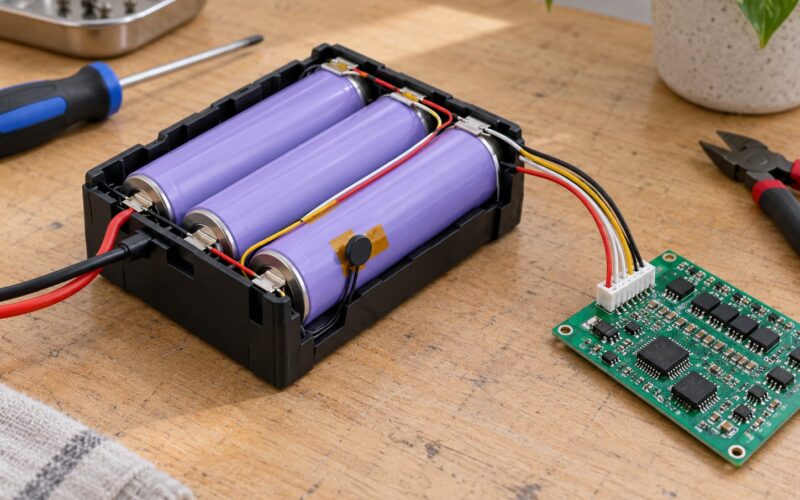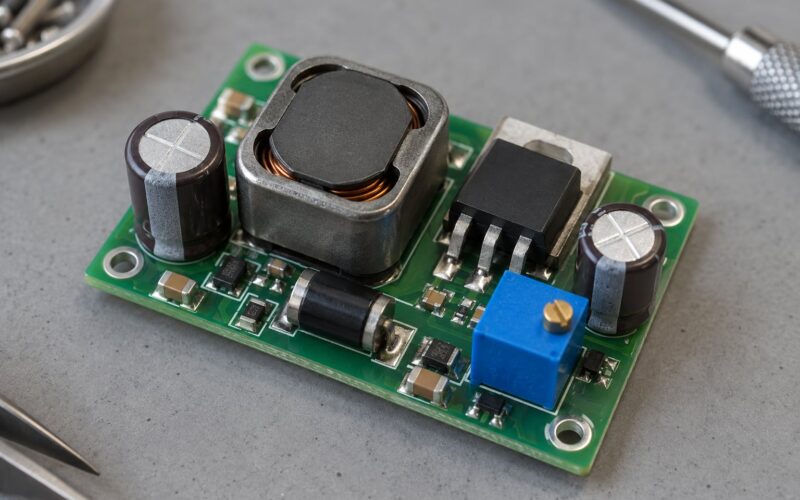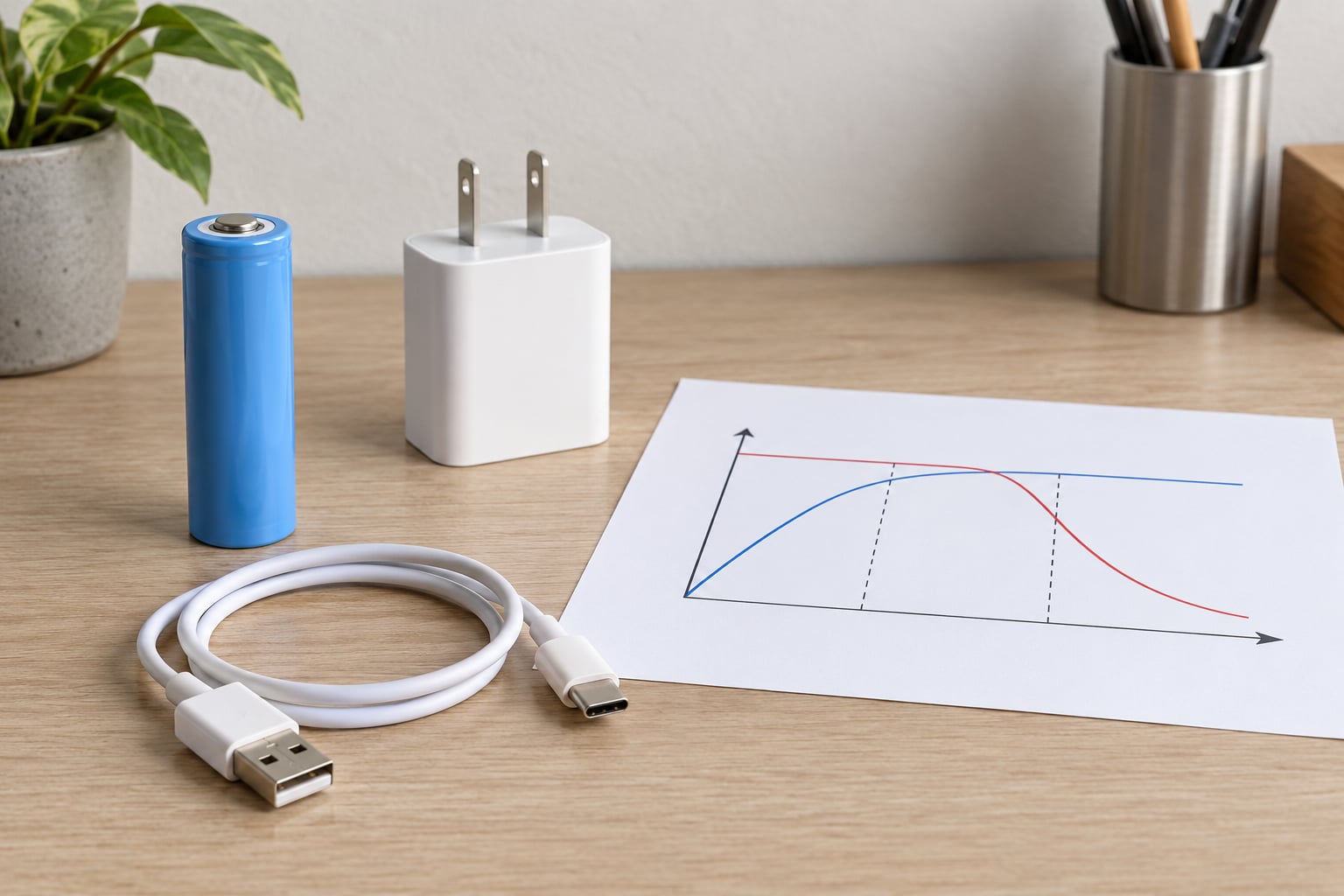
A lithium-ion battery charges in two stages. The charger pushes a fixed current into the cell until it hits the maximum voltage for that chemistry, then holds that voltage steady while the current tapers down to almost nothing and the charge stops. That process is called CC-CV, and understanding it is the fastest way to answer most lithium battery charging questions.
This guide is written for people who charge things: a phone overnight, a laptop on the couch, a drill in the garage, an e-bike in the shed. It is also useful if you specify charger integrated circuits for a living, since the control loop described here is the same one you would find on the evaluation board.
Table of Contents
- Key takeaways for charging lithium-ion batteries
- How Does a Lithium Battery Charge?
- What Voltage Should a Lithium Battery Be Charged At?
- What Are the Stages of Lithium Battery Charging?
- How Do CC and CV Charging Stages Work?
- What happens in the taper, and how do you know charging is nearly done?
- Can You Charge a Lithium Battery Overnight?
- Should You Charge a Lithium Battery at 100%?
- Does Fast Charging Damage a Lithium Battery?
- What Chargers Are Safe for Lithium Batteries?
- What Charging Habits Can Damage a Lithium Battery?
- How Do You Store a Lithium Battery Safely?
- What Signs Mean a Battery or Charger Is Unsafe?
- Lithium Battery Charging Basics Explained: Quick Reference
- Frequently Asked Questions
- How long should you charge a lithium-ion battery?
- Is it okay to leave a lithium battery charging overnight?
- Can I use a different charger for my lithium battery?
- Does charging a lithium battery in a hot car cause damage?
- Can I charge a lithium battery with a power bank?
- What should I do if a lithium battery becomes swollen?
Key takeaways for charging lithium-ion batteries
- Charge current first, voltage second. Every lithium charger runs constant current, then constant voltage, then stops.
- Match the charger to the cell, not the other way around. A lead-acid charger on a lithium pack is one of the fastest ways to ruin a battery.
- Heat is the real enemy. Fast charging is mostly a question of how warm the cell gets.
- Never charge a lithium pack below freezing. Cold plus high current causes lithium plating, which is permanent damage.
- There is no float or trickle stage. Once termination happens, the charger stops pushing current in.
- Leave it plugged in overnight if you want to. Modern devices stop charging on their own and trickle a tiny amount back when the pack drops.
How Does a Lithium Battery Charge?
Charging a lithium cell means moving lithium ions back into the anode, where they were during discharge. The charger forces current through the cell from an external circuit, and those ions travel through the electrolyte from the cathode to the anode. Nothing is scraped off and replaced, which is why the cell can be cycled thousands of times before it wears out.
Take a phone battery as the example. A wall adapter converts mains power into a controlled DC output, the USB-C cable carries it to the phone, and a power-management integrated circuit on the phone decides how much of it the cell receives. That chip watches cell voltage, current, temperature and time, then closes or opens the path to the battery. The battery management system on the phone works the same way, and a second layer of protection sits inside the cell itself.
So the charger does not simply push electricity into a battery. It negotiates with two independent safety layers, one on the board and one inside the pack, and it only fills the cell as fast as those layers allow.
What Voltage Should a Lithium Battery Be Charged At?
There is no single answer, because lithium is a family of chemistries with different voltage windows. The rule is simple: the device’s own specification always wins over any number you find on the internet, including this one.
| Chemistry | Typical use | Nominal per cell | Full-charge per cell | Where you see it |
|---|---|---|---|---|
| LiFePO4 (lithium iron phosphate) | Solar, RVs, e-bikes, stationary storage | 3.2V | 3.60V to 3.65V | A 12V pack charges to roughly 14.2V to 14.6V |
| NMC and LCO (cobalt blends) | Phones, laptops, power tools, EVs | 3.6V to 3.7V | 4.20V | The 4.2V figure people mean when they say “4.2 volts” |
| LTO (lithium titanate) | High-rate, high-cycle applications | About 2.3V | About 2.85V | Bus, forklift and some grid applications |
Nominal voltage is the average a cell sits at during normal use. Cut-off voltage is where charging stops, and it is the number that matters for safety. Charging a 4.2V NMC cell to 4.5V is not a slower charge, it is a damaged cell.
How much capacity you get depends on where you stop. A lower cut-off gives you a longer, gentler charge and less stress, but you leave usable energy behind.
| Cut-off per cell (NMC) | Approximate capacity reached | Effect on charging time |
|---|---|---|
| 3.80V | About 40% | Short, easy on the cells |
| 4.00V | About 65% | Adds roughly a third more time |
| 4.10V | About 80% | Most of the daily range, well short of full |
| 4.20V | Full, 100% | Long CV taper at the end |
Those percentages are typical for a healthy cell near room temperature, not a guarantee. An ageing cell has more internal resistance, so it reaches a given voltage with less stored energy and takes longer to get there.
What Are the Stages of Lithium Battery Charging?
Charging happens in three readable phases: constant current, constant voltage, and termination. A fourth, optional phase exists for balancing, but most people never see it.
In the first phase the charger fixes the current, usually at 0.5C to 1C, where C is the cell’s rated capacity. A 5Ah battery charging at 0.5C takes about two hours of bulk current. Cell voltage climbs steadily during this stage, usually with a visible kink partway through as the internal resistance drops.
In the second phase the charger holds the target voltage and lets the cell decide how much current it wants. That number falls steadily because the cell’s ability to accept charge drops as it fills. The last 10% of the gauge can take as long as the first 90%.
Termination is the moment current falls below a small threshold, often around 5% of the bulk current. The charger switches off, the protection circuit settles, and the pack is done. If you want to know what a charger integrated circuit is really doing during these seconds, it is the termination comparator and the current-sense amplifier doing the deciding.
How Do CC and CV Charging Stages Work?
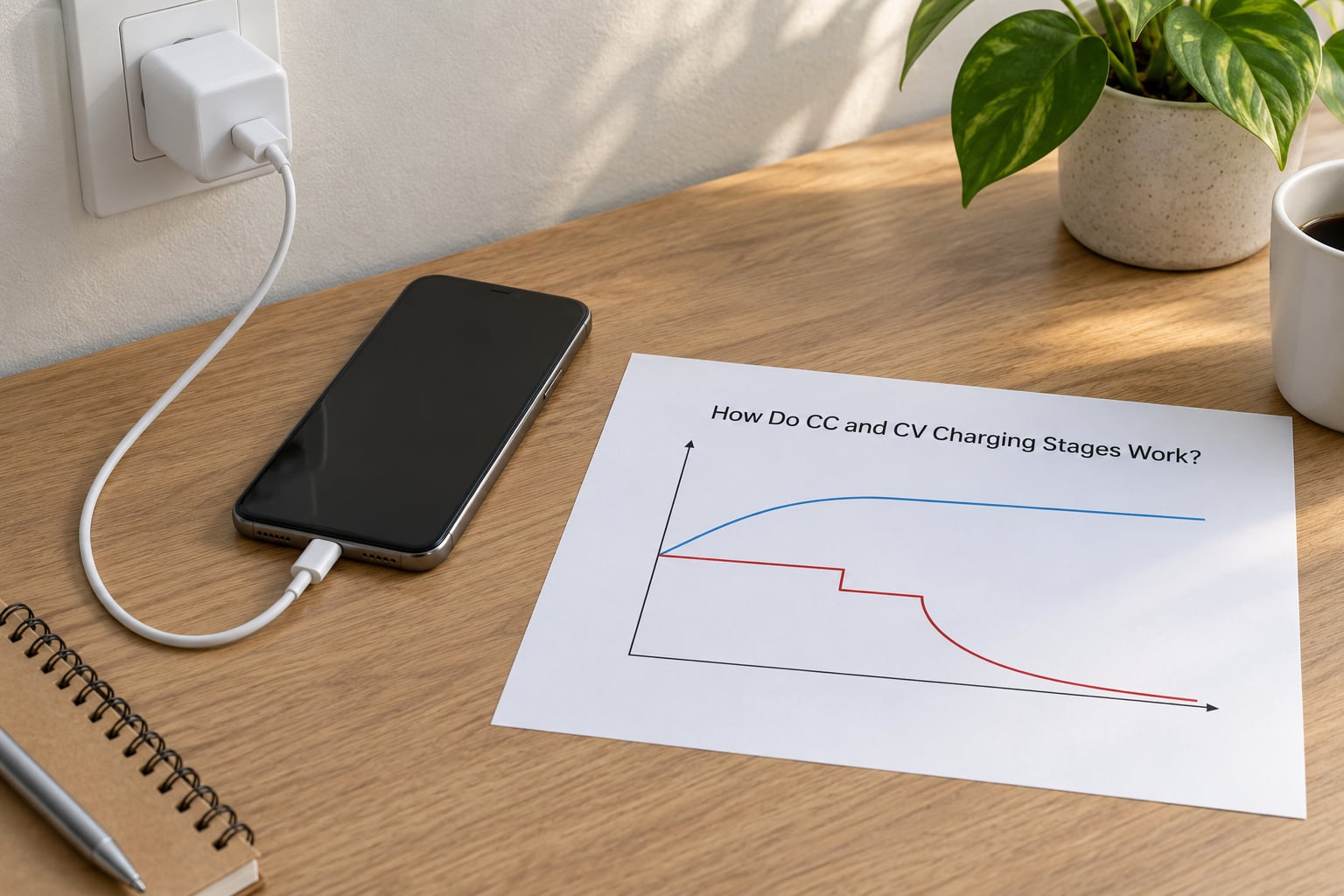
Constant current means the charger behaves like a current source. It measures the voltage across the cell and adjusts the drive to keep the amps exactly where it was told to stay. As the cell fills and its internal resistance rises, more voltage is needed to push the same current, so the measured voltage rises in step. Most of the energy goes into the cell during this phase.
Constant voltage means the charger flips roles. It now regulates the voltage, and the current falls on its own because a nearly full cell cannot accept more. In practice the handover tends to happen a little below the target, around 4.1V per cell on a typical phone pack, and charging visibly slows from that point onward.
The handover is managed by the CC error loop, an amplifier comparing the sensed current against a reference from a DAC or a resistor divider. As cell voltage approaches the target, that loop’s authority gives way to a voltage-regulation loop with a tighter error band, and the current command falls. There is no relay clicking between stages. It is one controller changing which variable it holds.
Behind all of it sits an NTC thermistor pressed against the cell. Its resistance falls as the cell warms, and the charger reads that as a temperature signal. If the cell goes outside its allowed window, the charger reduces current, pauses, or refuses to start. That is also why a phone left in a cold car might show a charging symbol for twenty minutes and then sit at 1%.
What happens in the taper, and how do you know charging is nearly done?
The tail of a charge is easy to recognise once you know what to look for. Current falls in a smooth curve rather than stopping abruptly, the phone or charger feels cooler than it did twenty minutes earlier, and the gauge moves more slowly than the numbers suggest. Some devices show a full icon while still taking a trickle of current, which is normal.
Longer than expected charge times on an older battery are usually not a charger fault. Higher internal resistance means more of the input becomes heat, less goes into stored energy, and the CV stage stretches out to compensate.
Can You Charge a Lithium Battery Overnight?
Yes, on any modern phone, laptop or tablet. Overnight charging is safe because the charger stops on its own, and the protection circuit will not allow current to flow into a full cell.
What happens after that depends on the device. Most pull essentially zero current and only wake up periodically to top the pack back up if it has dropped, which is a small number of very shallow cycles. A few laptop and power-bank designs hold a low trickle indefinitely, and that trickle is the one part of overnight charging worth knowing about.
The overnight charge is not the risk people think it is. Heat under a pillow or inside a soft case is a far bigger problem, and so is an ageing device with a swollen cell, which is a fire risk with or without a charger attached.
Should You Charge a Lithium Battery at 100%?
Charge to 100% when you need the full day’s range or runtime. For long-term battery life, staying below 100% is a little easier on the cells, mostly because a full cell sits at high voltage and high voltage accelerates calendar ageing.
There is a second effect people rarely think about: a full battery is a battery with no safety margin. If you are one year into a two-year-old phone, running it down to 5% every night costs you far more usable capacity than the small longevity gain from topping out at 80% would give back.
The honest answer is that 100% charging does not ruin a lithium battery. Hundreds of full cycles are routine and expected. What shortens life is heat, high state of charge held for a long time, and deep discharge, not the occasional trip to full.
Does Fast Charging Damage a Lithium Battery?
Fast charging adds stress, but the damage comes from heat and sustained high current rather than the word fast. A modern charger negotiates a power contract over USB-C, and the phone’s own management chip decides how much of it the cell gets. The negotiated 5V, 9V or 20V profile sets the ceiling; the battery decides the reality.
Charging at 1C is generally considered a good balance. Going to 2C or beyond raises internal temperature during the bulk stage, and a cell that is warm ages faster. The effect shows up in cycle life data, where high-rate charging gives up some of the thousands of cycles a 0.5C charge would deliver.
Fast charging in cold weather is the combination to avoid. Cold slows the chemical reaction, so current that would be absorbed at 20°C pushes ions onto the anode surface instead of into the graphite. They deposit as metallic lithium in a process called lithium plating, and the dendrites that form can eventually punch through a separator and short the cell. That damage is not reversible.
Good chargers inhibit charging below roughly 0°C, or warm the pack first. If a phone charges oddly in a cold garage, that inhibit is usually working correctly.
What Chargers Are Safe for Lithium Batteries?
A safe charger supplies the right voltage, refuses to exceed the current limit, monitors temperature, and stops cleanly. For anything you own, the original charger or a certified replacement is the low-effort answer.
- USB wall chargers. Certified units negotiate the power contract with the device, so the phone draws what it can accept rather than what the adapter can supply.
- Proprietary chargers and power tools. Multi-cell packs, including 18V and 20V tool packs, carry their own BMS and are designed for a specific charger platform. Match the platform.
- Wireless charging. Convenient and thermally gentle, but slower and no more accurate than a cable.
- Power banks. Fine for phones, provided the bank itself has a proper BMS and a recognised safety certification such as UL 2054 or IEC 62133.
- Off-grid solar. An MPPT controller harvests more from the panel and runs a proper absorption stage; a PWM controller simply reduces to the panel’s voltage.
Never charge a lithium pack with a lead-acid charger unless the charger has a lithium-specific profile. A flooded lead-acid charger holds an absorption voltage well above the lithium cut-off and will cook the pack, and the BMS may not save you.
What Charging Habits Can Damage a Lithium Battery?
Most battery damage comes from a short list of habits, and none of them are subtle once you know them.
- Charging below freezing. Lithium plating, and it cannot be undone.
- Heat. A phone under a pillow, a battery in a hot car, or a pack left in direct sun raises temperature faster than any charge rate could.
- Overcharge. Pushing past the cut-off voltage forces parasitic reactions and gas generation inside the cell.
- Physical damage. A dropped, dented or crushed pack is a hazard even if it still powers a device. Stop using it.
- Deep discharge. Sitting empty for months stresses the cell, and a fully discharged lithium pack can drop below its safe recovery voltage.
- Unregulated chargers. A cheap adapter with no voltage regulation is the most common route to a swollen cell.
- Storing a full or empty pack indefinitely. High voltage and low voltage are both poor places to park a cell for a year.
Two persistent myths are worth clearing out. Lithium batteries do not need to be fully discharged before charging, and they do not need a slow trickle top-up. There is no memory effect to reset.
How Do You Store a Lithium Battery Safely?
Store lithium cells around 40% to 60% charge, in a cool, dry place, away from direct sun. That mid-range state ages slowest, and the chemistry is why: high state of charge accelerates calendar ageing, and a deeply discharged cell keeps slowly self-discharging toward a point of no return.
Advice on this genuinely conflicts, and the conflict is usually about different problems. Some vendors say store at 100% for storage batteries, because their real concern is avoiding a deep discharge on a battery nobody will check for months. Others say store near 50%, because they are talking about the cell sitting on a shelf with no maintenance at all. For a battery in your garage or a storage unit, mid-range charge and a check every few months is the defensible answer.
For phones and laptops, put the device in airplane mode so it does not drain the pack, and top it up partway through any long absence. Keep removable cells in their original packaging or a proper case, never loose in a drawer with keys and coins, and never in a vehicle over a long period. If you are storing a power tool pack, remove it from the tool.
Some systems that pair a battery with a heating load deliberately hold bulk charge near the top of the range rather than backing off. Kept at a temperature around 20°C, that practice holds the cell out of the cold state-of-charge region, and it is a real technique rather than a mistake.
What Signs Mean a Battery or Charger Is Unsafe?
Stop using the device and move it away from anything flammable if you notice any of these. A lithium failure is usually a gas and heat event, and small warning signs are your only chance to act early.
- The screen, back cover or battery compartment bulges, or a phone no longer sits flat on a table.
- Unusual heat during charging, especially heat that persists after you unplug.
- A hissing, crackling or sizzling sound, or a sweet chemical smell.
- Leaking fluid, white crusty residue around the terminals, or visible corrosion.
- A charger that is hot, buzzes loudly, smells burnt, or shows scorch marks.
- A battery that has been dropped, crushed or punctured, even if it still works.
Swelling happens because repeated overcharge or heat drives parasitic reactions that generate gas inside a sealed cell. The volume cannot change, so the can bulges. A swollen cell has no recovery path and should be replaced, and it is a fire risk in a bag, a drawer or a bin. Terminals on lithium cells carry a great deal of energy, so treat any pack that has ruptured as something a fire service should collect rather than something you should carry to a recycling point yourself.
For a device that feels wrong but shows nothing dramatic, stop charging, let it cool, and have it inspected. Swelling is a normal end-of-life symptom on devices a decade old, and it is not worth negotiating over.
Lithium Battery Charging Basics Explained: Quick Reference
Here is the whole guide on one page. The left column is the rule, the right column is why it exists.
| Rule | What to do and why |
|---|---|
| Charger matching | Use the specified charger, or a certified replacement with the same voltage and protocol. Never a lead-acid charger on a lithium pack. |
| Temperature | Charge between roughly 0°C and 45°C. Never charge a lithium pack below freezing. |
| Charge limits | 80% for everyday use, 100% when you need full runtime. The device’s own software usually handles this. |
| Overnight charging | Safe on modern devices. Keep the device uncovered and out of soft bedding. |
| Storage | 40% to 60% charge, cool and dry, checked every few months. |
| Damaged batteries | Swollen, dented, leaking or hot means stop using it. Do not charge it, and do not puncture it. |
| Charging while in use | Generally fine, but the heat from sustained load shortens cycle life. |
| Deeply discharged cells | Give them a slow, supervised charge. A deeply discharged cell needs pre-charge current before it accepts its normal rate. |
Frequently Asked Questions
How long should you charge a lithium-ion battery?
It depends on capacity and charge rate, not on the chemistry alone. A 5Ah battery on a 1C charge takes about five hours from empty, and two to three hours from the 40% level you normally start at. Most of that time is the constant-voltage taper at the end, which is why the last 20% feels much slower than the charge rate suggests. Charging slower, at 0.5C, roughly doubles the time but is gentler on the cells.
Is it okay to leave a lithium battery charging overnight?
Yes, on any modern phone, laptop or tablet. The charger stops when the pack reaches its cut-off voltage, and the protection circuit will not let current flow into a full cell. Some devices draw a tiny amount back in when the pack drops, which amounts to very shallow cycling. The genuine risk is not duration but heat, so never charge under a pillow or inside a case that traps warmth.
Can I use a different charger for my lithium battery?
Only if it supplies the same voltage, the same connector and a regulated current at or below the cell’s limit. USB-C chargers that negotiate the power contract are the safest substitute, because the device sets the actual current. A lead-acid charger is the one combination to avoid: its absorption voltage sits above the lithium cut-off and will damage the pack. When in doubt, use the charger the device shipped with.
Does charging a lithium battery in a hot car cause damage?
Yes, and a parked car can exceed the safe charging window quickly, particularly in direct sun. Above roughly 45°C a lithium pack ages faster and produces more gas, and many devices will refuse to charge at all until the pack cools down. If a charger is left plugged into a vehicle socket it may also trickle current into a hot pack. Bring the device inside, and if it stopped charging, let it cool before trying again.
Can I charge a lithium battery with a power bank?
Yes, as long as the power bank has a working battery management system and a recognised safety certification such as UL 2054 or IEC 62133. Charging works through the same CC-CV path either way, and the phone still limits what it draws. Cheaper banks without proper protection are the ones that cause swelling, since an unregulated output is exactly what a lithium pack cannot tolerate. Many banks also stop output when their own cells are full.
What should I do if a lithium battery becomes swollen?
Stop charging it and stop using the device. Swelling means gas has built up inside a sealed cell, usually from overcharge, heat or age, and it will not go down on its own. Move the device away from anything flammable, do not puncture or squeeze it, and do not try to charge it to see if it recovers. Have it replaced or taken to a proper collection point, and tell whoever uses the device next, because a swollen phone is easy to miss when it is back in a pocket.
If you take one thing from this: use the charger that came with the device, keep the pack out of the cold and out of a hot car, and treat swelling as a stop sign. Everything else in lithium battery charging is a refinement of that.
The one habit I would change first is overnight charging under bedding, not the overnight charging itself. The battery handles the charger fine. The blanket does not.