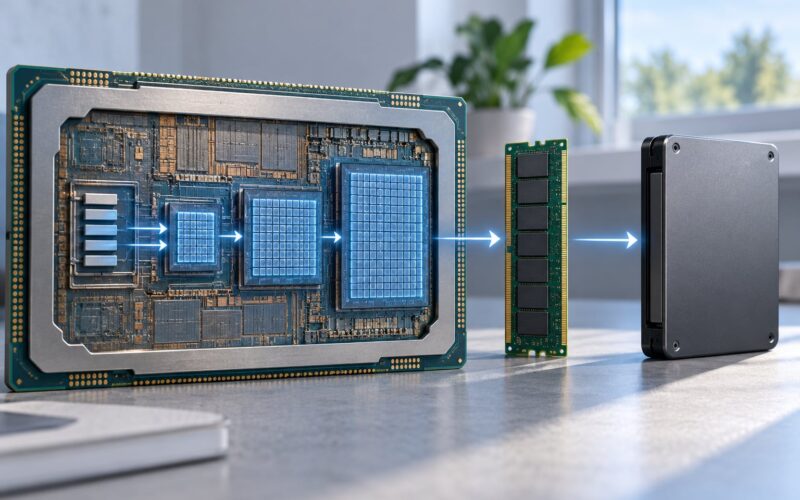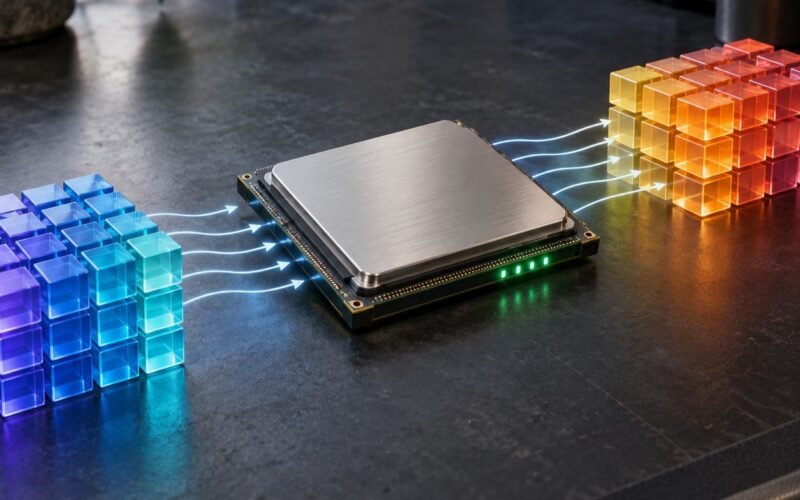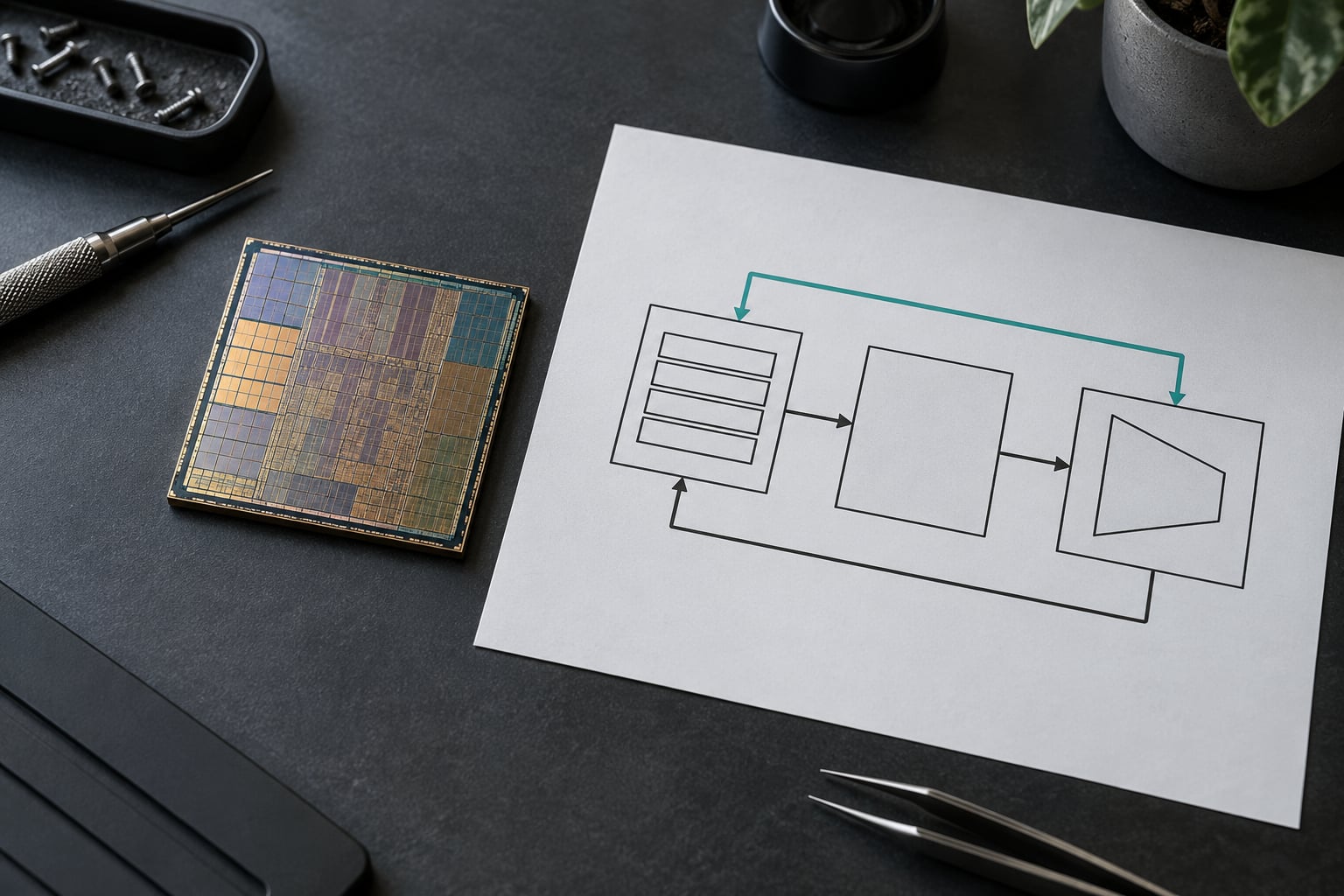
Instruction set architecture explained in one line: it is the agreed contract that tells software which instructions a processor can execute, how those instructions are encoded as bits, and what each one means. It is the vocabulary and grammar of a CPU, not the chip itself.
If you have ever compared two processors and wondered whether they are “the same” because both run x86-64 code, the ISA is what makes that question answerable. Two chips can share an ISA and behave nothing alike, and two chips can look nothing alike on a die photo while remaining strictly binary compatible.
Table of Contents
- Instruction Set Architecture Explained: The Software-Hardware Contract
- What Does an ISA Specify?
- Instruction Set Architecture Explained Through Its Main Parts
- ISA vs Microarchitecture: What Is the Difference?
- How RISC and CISC Instruction Sets Differ
- How to Read an ISA Manual
- RISC-V, ARM, and x86: A Practical Comparison
- What Tradeoffs Shape ISA and CPU Design?
- How an ISA Reaches Silicon
- Frequently Asked Questions
- Is an instruction set architecture hardware or software?
- Is RISC always faster and more efficient than CISC?
- Can two processors with the same ISA have different performance?
- Does the ISA determine a processor instruction set width?
- Why do programs compiled for one ISA need recompilation for another?
- What does binary compatible with an ISA mean?
- Conclusion: Where to Start With an ISA
Instruction Set Architecture Explained: The Software-Hardware Contract
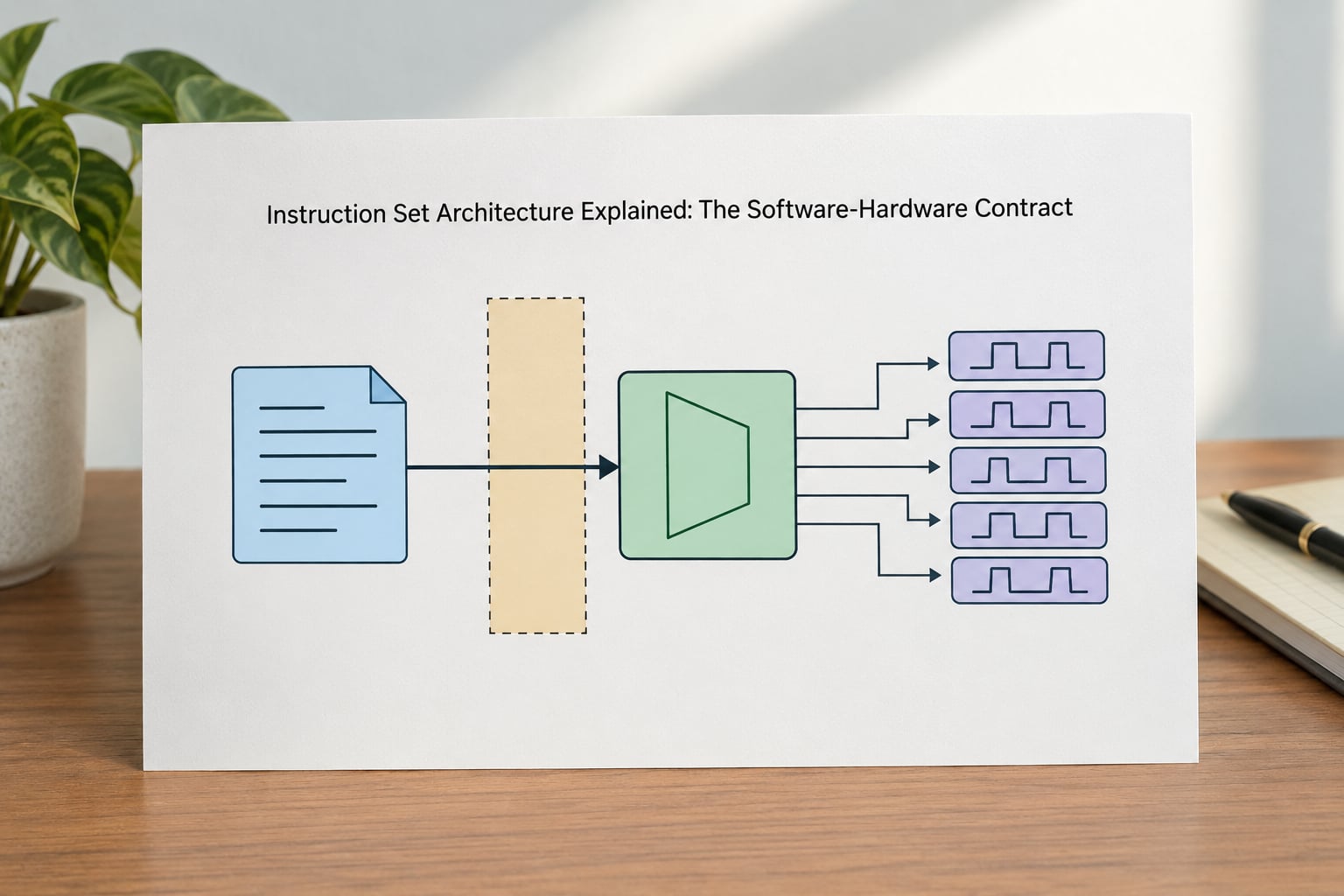
Put simply, an instruction set architecture defines the instructions a processor can execute, how those instructions are encoded as bits, and how software and hardware exchange information. Everything a programmer or compiler is allowed to observe about a processor belongs here.
The word “contract” matters. A specification document commits two parties to a shared agreement: the hardware team must implement every instruction with the exact behaviour written down, and the software side must only emit instructions the document permits. Nothing in the contract says how many cycles an instruction takes, how wide the arithmetic units are, or how many execution units exist.
A concrete example makes the boundary obvious. Consider a simple load-immediate instruction:
MOV X1, #42The ISA specifies that there is an opcode field, a destination register field, a 12-bit immediate field, and a defined encoding for that combination. It specifies that after execution, X1 holds the value 42 and that flags are updated in a stated way. It says nothing about whether the value came from a decoder ROM, a hardwired decode network, or a small sequencer running microcode. That choice belongs to the implementer.
The most common confusion here comes from treating the ISA as a computational model. It is not a Turing machine description. It does not define how memory is built, how much of it exists, or what happens on a power fault. It defines the programmable interface, and everything else is implementation.
What Does an ISA Specify?
An ISA specification covers seven areas, and a good one defines each precisely enough that two independent implementations are interchangeable.
Instruction Set Architecture Explained Through Its Main Parts
Instructions and operation codes. Every operation the processor can perform gets a defined operation code: addition, subtraction, branch, load, store, bitwise logic, system calls and so on. The set is closed and enumerable, which is exactly what makes decoding tractable.
Instruction formats. Instructions have a bit layout. A 32-bit format might split into a 7-bit opcode, a 5-bit source register, a 5-bit destination register and a 15-bit immediate. The format defines where each field sits and how the bits are interpreted.
Registers and data types. The ISA names the architectural registers: how many general-purpose registers exist, which are 32-bit and which are 64-bit, which hold floating point or vector data, and what the special-purpose registers such as a program counter or stack pointer do. It also fixes which integer widths, floating point formats and vector lengths are legal.
Addressing modes. How an instruction names its memory operands is part of the contract. Immediate, direct, indirect, register-indirect, scaled-index, stack-relative and PC-relative addressing all appear somewhere in the ISA families you will meet, and each one shapes how compilers generate code.
Control flow and exceptions. Unconditional branches, conditional branches, calls, returns, traps and interrupts are defined along with their precise effects on the program counter and status registers. The exception model states what happens on divide by zero, on an illegal instruction, on a page fault, and on a supervisor call.
Memory model and state conventions. The ISA fixes endianness for loads and stores, whether instructions and data share a single address space, how virtual memory and privilege levels work, what user mode and kernel mode may each touch, and what happens on a context switch.
Extensions. Modern ISAs reserve part of the encoding space for optional features. The base document defines the common subset, and separate extension documents add vector, cryptographic, atomic or bit-manipulation instructions.
Here is a compact example of what the contract looks like from a compiler’s point of view:
ADD X3, X1, X2      ; X3 = X1 + X2
LDR X4, [X5, #16]   ; load 64 bits from address X5+16
BEQ X3, #0, label   ; branch if X3 equals zero
A compiler can emit all three knowing only the encoding, the semantics and the effects on flags. It never needs to know the pipeline depth or the cache size.
ISA vs Microarchitecture: What Is the Difference?
Microarchitecture is the implementation of an ISA inside silicon: how decode, execution units, caches and pipelines are arranged. The ISA is the specification; the microarchitecture is one particular way of building hardware that satisfies it.
The table below separates the layers engineers routinely blur together.
| Layer | What it fixes | Who decides | Can it change without breaking software? |
|---|---|---|---|
| ISA | Encodings, operands, semantics, privilege levels, exception model | Architecture owner and its licensees | No, not without a compatibility guarantee |
| Microarchitecture | Pipeline depth, execution unit mix, branch prediction, cache hierarchy, decoding strategy | The CPU design team | Yes, freely |
| Implementation | Register file size and ports, physical design, clock domains, power management | Back-end and physical design engineers | Yes, freely |
| Process technology | Transistor dimensions, available standard cell libraries, memory compilers | Foundry | Yes, freely, and has no bearing on the ISA |
Two AArch64 cores from the same architecture version can differ enormously in branch predictor design, cache size, execution unit count and achievable clock, while remaining interchangeable at the binary level. That interchangeability is the whole point of binary compatibility: software written once keeps running as the hardware underneath it improves.
Process node deserves a direct correction. A core built on an older node and a core on a newer node execute the same instructions identically. The node changes what you can build and how fast it runs, not what the software is allowed to ask for.
How RISC and CISC Instruction Sets Differ
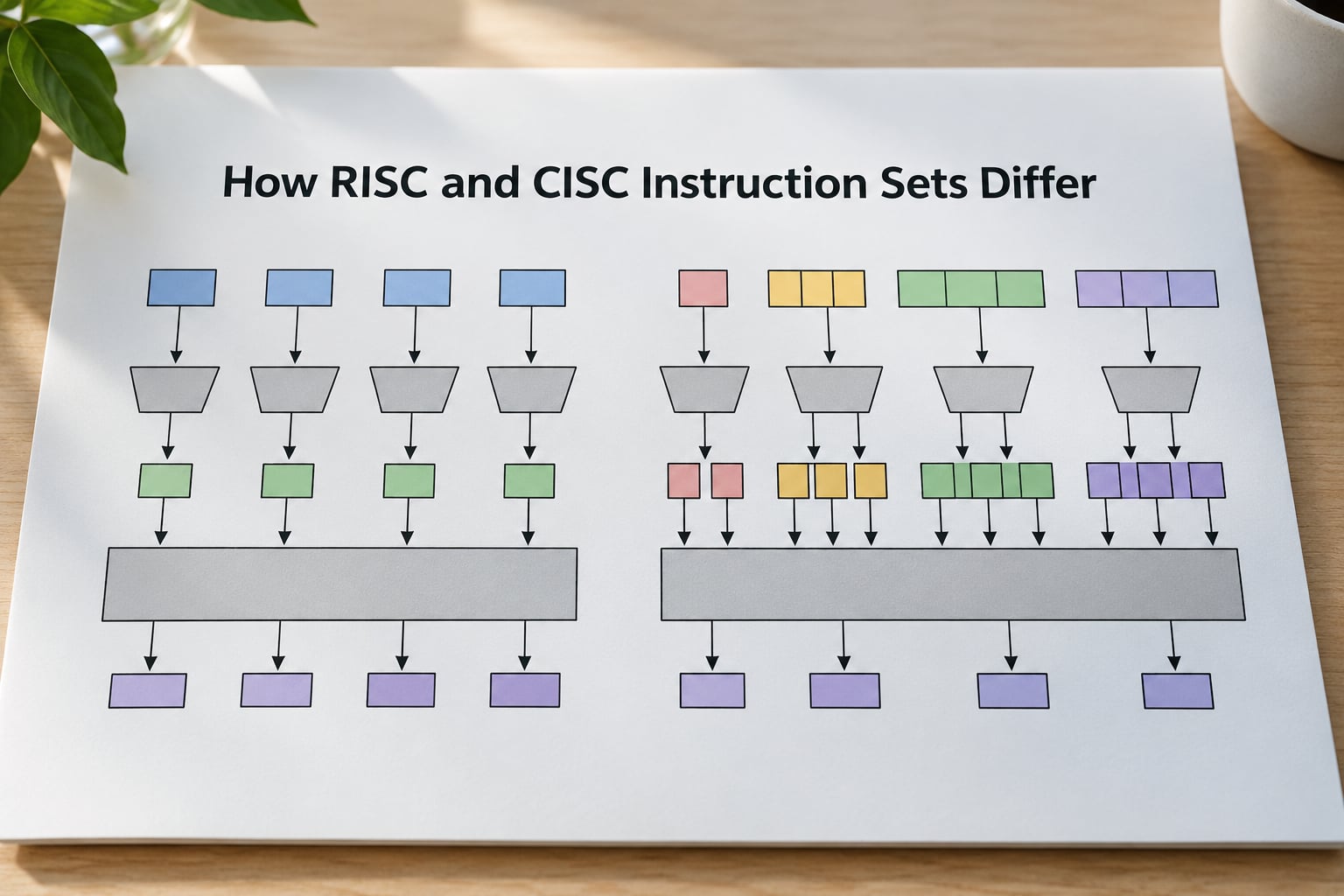
RISC instruction sets use a small, regular set of instructions that operate mainly on registers, with memory touched through dedicated load and store instructions. CISC instruction sets offer richer instructions that can combine multiple operations, including memory references, in a single encoding.
| Family | Instruction length | Memory operands | Decoding | Real examples |
|---|---|---|---|---|
| RISC | Usually fixed, for example 32 bits | Only load and store | Regular, easy to pipeline | Arm AArch64, RISC-V, MIPS, SPARC, Power |
| CISC | Variable length | Many instructions take them directly | Complex, often decoded into micro-operations | x86, Motorola 68000, x86-64 |
| VLIW | Fixed bundles | Varies | Explicit parallelism in the encoding | Original Itanium, some DSP architectures |
| Stack machine | Typically compact opcodes | Operands come from a stack | Very simple | Java virtual machine, .NET Common Language Runtime bytecode |
The traditional claim that RISC is always faster and CISC is legacy does not hold up. Modern x86 cores decode complex instructions into micro-operations and feed them to wide superscalar execution back ends, and modern AArch64 cores use sophisticated prediction and out-of-order scheduling. The real differences are about what each design chose to make easy.
Fixed-length encodings make decoding and instruction prefetch predictable, at the cost of code size, since every operation reserves the same number of bits. Variable-length encodings give better code density, which matters when instruction fetch bandwidth is the bottleneck, at the cost of a far more involved decoder. Neither wins in the abstract; the workload decides.
How to Read an ISA Manual
ISA manuals run to well over a thousand pages. Nobody reads them front to back, and you do not need to. Start from the section you need and work outward in a fixed order.
Begin with the architectural state description, which lists every register and what it holds. Next read the instruction format diagrams, because they show every field position the decoder must resolve. Then find the instruction you care about in the per-instruction reference, which lists the operands, the encoding, the pseudocode for the operation, and the exceptions it can raise.
The pseudocode section is the one that settles arguments. It states, in a restricted C-like language, the exact order of operations, what happens on overflow, and what each status flag becomes. Implementations write their hardware from this text, and so should you when you are reasoning about behaviour.
Trace one instruction all the way through as an exercise. Take a branch instruction, find its format, note which bits encode the condition, note the range and alignment rules of the target address, read the pseudocode for what happens to the program counter, then check the exception list to see under what conditions it traps. Twenty minutes of that beats skimming two hundred pages of overview.
Finally, read the sections on memory ordering and atomic operations. They define what your multi-threaded code is allowed to assume, and getting them wrong produces bugs that pass functional tests and fail under load.
RISC-V, ARM, and x86: A Practical Comparison
These three dominate engineering work today, and they fail and succeed on different grounds.
Arm and AArch64 is a licensed RISC architecture used across mobile, embedded and increasingly server and desktop silicon. Its design philosophy favours efficiency per watt, and its extension model is mature: base architecture plus optional floating point, vector, cryptographic and memory-management extensions, with named architecture versions such as Armv8 and Armv9. A license lets a company build a core without designing an architecture, and it pays royalties per shipped chip.
RISC-V is an open standard. The base integer instruction set is small enough to learn in an afternoon, and everything above it, from floating point to vector units to hypervisor support, is added through named extensions that a vendor chooses to implement. Because no licence fee attaches to the architecture, companies build custom extensions and even their own instruction encodings for accelerators, provided they stay within reserved encoding spaces.
x86 and x86-64 is a CISC lineage that has absorbed enormous complexity over four decades, from segmentation in the original 8086 through vector registers and privilege rings. Its instruction length is variable, and legacy requirements back to the original 8086 mean it cannot be cleanly simplified. That history is a liability for designers and an enormous asset for software compatibility, which is why the installed base is so hard to displace.
Compare the three on the axes that matter when you are choosing or reviewing a core.
| Criterion | Arm AArch64 | RISC-V | x86-64 |
|---|---|---|---|
| Design philosophy | Efficiency per watt, large embedded and mobile ecosystem | Minimal base, extensibility by design | Legacy compatibility, huge software base |
| Register model | 31 general purpose plus zero register | 32 general purpose, x0 hardwired to zero | 16 general purpose in 64-bit mode |
| Typical encoding | Fixed 32-bit | Fixed 32-bit | Variable length, up to 15 bytes |
| Extension mechanism | Named mandatory and optional extensions | Named single-letter extensions such as M, A, F, D and C | Successive feature sets from SSE through AVX generations |
| Licensing | Architecture license plus royalties | Open, no license fee | Proprietary, cross-license available |
| Typical use | Mobile, embedded, cloud servers | Embedded, teaching, custom accelerator silicon | Desktop, laptops, gaming PCs |
None of these choices determines performance. What determines performance is how well the implementation executes the instruction stream, and how good the compiler is at scheduling for that stream.
What Tradeoffs Shape ISA and CPU Design?
Every architectural decision pushes on one of a few balances, and understanding which balance is moving helps you read a specification critically.
Code density versus decode simplicity. More bits per instruction means fewer bytes to fetch, which helps bandwidth-bound code. Fewer bits per instruction means a decoder that is cheap, regular and easy to pipeline. The x86 length ceiling of 15 bytes versus the fixed 32 bits of AArch64 is this tradeoff made permanent.
Register pressure. Compilers want many general-purpose registers, since keeping values in registers avoids memory traffic. More registers means a larger register file, more read and write ports, more energy per access and a longer critical path. This is why register count stops growing at some point even though nothing in the ISA forbids more.
Latency versus throughput. A microarchitecture can make one instruction finish quickly, or finish many instructions per cycle. Both matter for different workloads: interactive code feels latency, throughput-bound servers feel throughput. The ISA usually does not dictate this, though instructions with unusual latency, such as divide or a slow memory access, shape how the pipeline must handle them.
Compiler support. An ISA that compilers can schedule well beats a theoretically elegant one they cannot. Irregular encodings, hidden state and unpredictable instruction timing all push work onto the compiler instead of the hardware.
Extension cost. Every reserved encoding you hand to a vector or cryptographic extension is an encoding a future revision cannot reuse. Reserving space costs nothing today and constrains you permanently.
Security surface. Speculation controls and cryptographic instructions are architectural now, which means they are part of the contract and part of the compatibility story. Adding them late is harder than defining them early.
How an ISA Reaches Silicon
The path from a document to a working chip is where the separation between ISA and microarchitecture becomes obvious, and it is the part most glossed over in explainers.
Step one is the specification itself, written in prose, diagrams, encoding tables and executable pseudocode. Step two is register transfer language, where each pseudocode block becomes a set of datapath operations on named signals. Step three is RTL, where that RTL is expressed in hardware description language and elaborated into gates, flip-flops, memories and the clock tree.
Control comes in two flavours. A hardwired design derives decode signals combinatorially from the instruction bits. A microcoded design holds a writable control store that sequences a sequence of micro-operations for complex instructions. Which one you choose is a microarchitecture decision, and x86 implementations commonly do both, using microcode for the hardest instructions and hardwired decode for the rest.
Step four is verification, and it is where most of the schedule goes. Because binary compatibility means any deviation from the specification is a bug that may not appear until someone runs decade-old software, implementations are checked against the spec’s own test suites, against differential tests that compare two implementations instruction by instruction, and against formal proofs for the trickiest corner cases.
Step five is physical design, where the RTL becomes a placed and routed layout with timing closure, power and area targets, and then signoff, tape-out and fabrication. Step six is bring-up and validation on first silicon, where real hardware finally meets a specification that was written years earlier.
A CPU IP vendor sells you the result of that pipeline. What you license is typically an already-hardened core plus the documentation needed to integrate it: the register file, decode, execution units, caches and the privilege and exception handling, plus whatever subset of the ISA it implements and the simulation models to verify your SoC around it.
Frequently Asked Questions
Is an instruction set architecture hardware or software?
An ISA is neither hardware nor software. It is a written specification, but it has the force of law: it defines exactly which bit patterns are legal instructions and what each one does. Software is written against that specification, and hardware is built to satisfy it. The specification itself is a document; the chip that implements it is hardware; the compiler that targets it is software.
Is RISC always faster and more efficient than CISC?
No, and the claim has not been true for decades. Both families can be built with deep pipelines, wide superscalar issue and aggressive speculation. What differs is what each design made easy: fixed-length RISC encodings simplify decoding, while variable-length CISC encodings improve code density. Measured performance comes from the microarchitecture and the workload, not from the label on the instruction set.
Can two processors with the same ISA have different performance?
Yes, and they routinely do. They may share an architecture version and differ in pipeline depth, cache hierarchy, execution unit mix, branch prediction, process node and power limits. They remain binary compatible, meaning one runs the other software correctly. Two chips with identical clock speeds can still differ substantially in instructions per cycle, which is why instructions per cycle matters as much as frequency.
Does the ISA determine a processor instruction set width?
The ISA fixes the widths of its data types and registers, such as 32 or 64-bit general purpose registers, and it constrains instruction encoding length. A 32-bit architecture typically uses fixed 32-bit instructions. A variable-length architecture such as x86-64 defines a maximum instruction length of 15 bytes and encodes shorter operations in fewer bytes, while still exposing 64-bit data types to software.
Why do programs compiled for one ISA need recompilation for another?
Because a compiled program is a sequence of machine code instructions, and each ISA has a different encoding, a different register file and different instruction semantics. There is no universal machine code format to compile once. The usual approach is to build the same source against a different compiler backend, or to emulate or binary-translate at run time, which carries a performance cost.
What does binary compatible with an ISA mean?
Binary compatibility means a program compiled for one implementation runs correctly and without modification on another implementation of the same ISA. The second processor may be physically different, built on a different process node, or designed by a different company, yet the observable behaviour of every instruction matches. That guarantee is what allows hardware to improve underneath software that was written years earlier.
Conclusion: Where to Start With an ISA
An instruction set architecture is the line between what software may ask for and what hardware must deliver. Once you can find that line in a specification, most confusion on the topic resolves: anything the document states is contractual, and anything it leaves open is a design choice.
Start with the instruction table and the encoding rules, then trace a single instruction through the format diagrams and the pseudocode. From there, read the extension and privilege sections, because those are what determine compatibility in practice. When you are ready to look at hardware, the microarchitecture material becomes far easier once the architectural contract is already clear in your head.