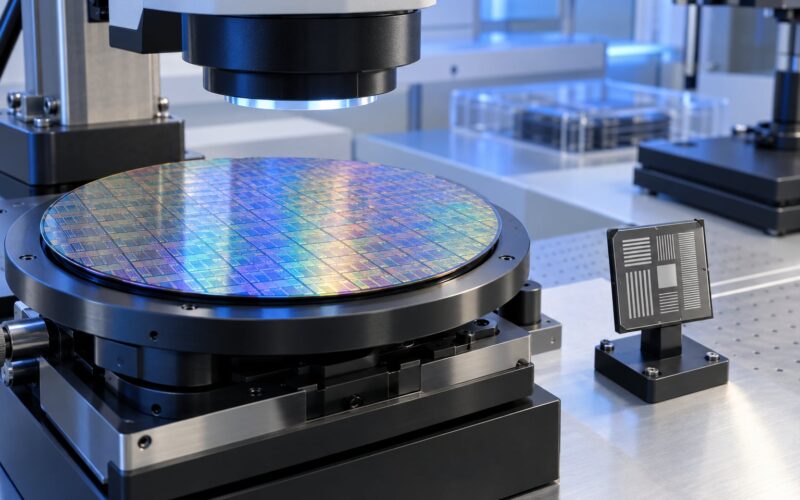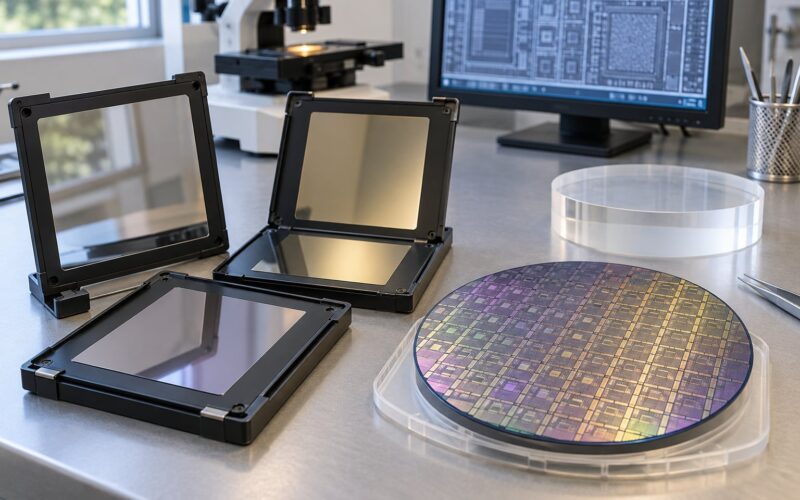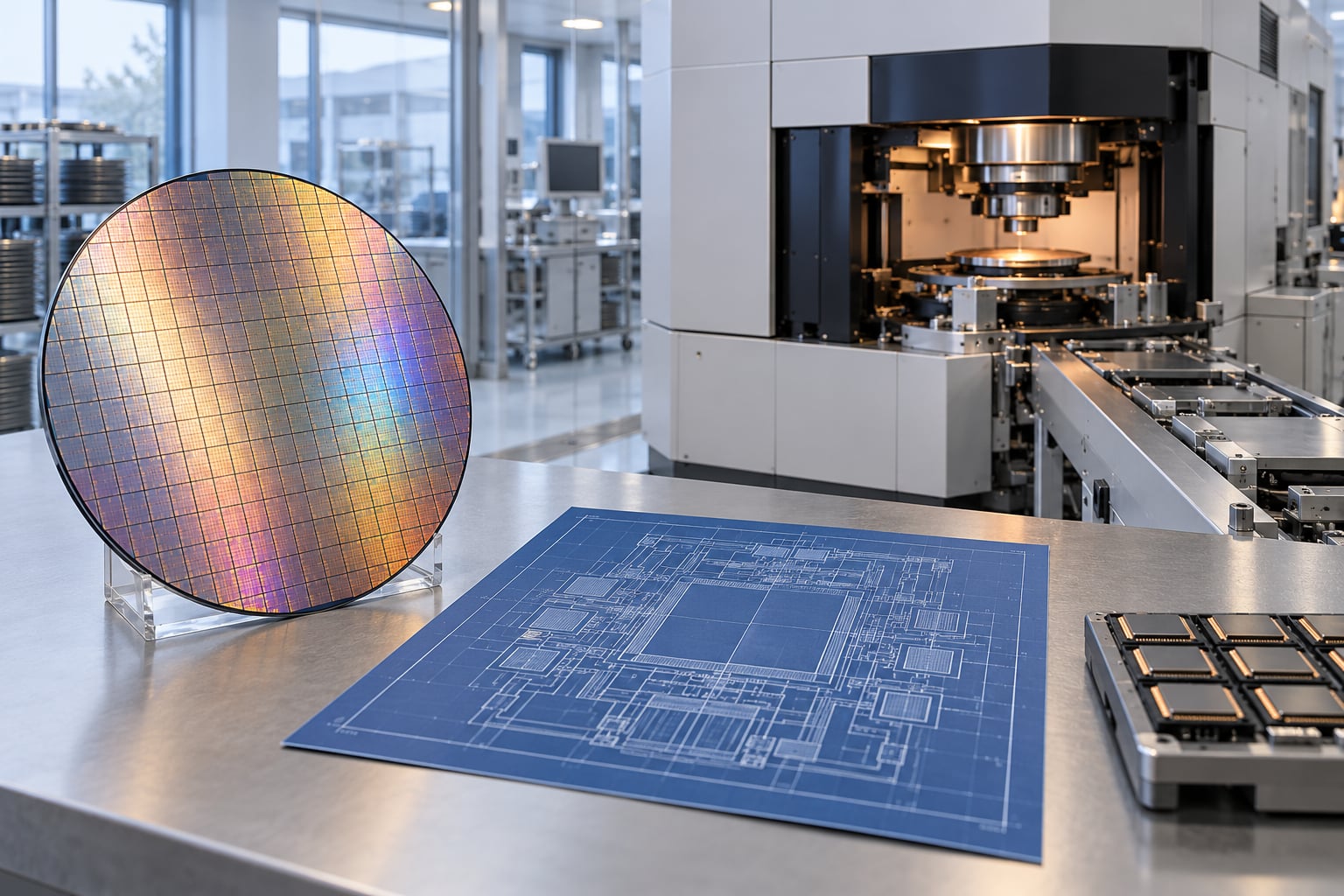
A foundry builds chips that other companies designed, a fabless company designs chips but owns no factory, and an IDM does both under one roof. That single structural choice decides where the margin sits, who carries the risk of an empty fab, and how fast a product can ship.
Below is the foundry vs fabless vs IDM business models explained in plain terms, hybrids included, with the capital and margin reality behind each box. One warning before you start: the word fab gets used three different ways in this industry, and most of the confusion on this topic starts there.
Table of Contents
- Foundry vs Fabless vs IDM Business Models Explained at a Glance
- What Is a Semiconductor Business Model?
- How Do the Three Models Fit Together?
- Foundry Business Model: Manufacturing Without Owning the Chip Product
- Fabless Business Model: Designing Without Operating a Fab
- IDM Business Model: Integrating Design and Manufacturing
- How Do Ownership, Capital, and Control Differ?
- The economics of each model at a glance
- How Do the Models Handle Risk and Time to Market?
- Which Model Is Best for a Chip Company?
- Which Should You Choose?
- The foundry vs fabless vs IDM question in five questions
- Frequently Asked Questions
- Is TSMC a foundry or an IDM?
- Is NVIDIA fabless or a foundry?
- What are the key differences between an IDM and a foundry?
- What is the fabless semiconductor business model?
- What are the top 5 semiconductor foundries?
- Which fabless semiconductor companies are the biggest?
- Conclusion: Start with the Right Ownership Model
Foundry vs Fabless vs IDM Business Models Explained at a Glance
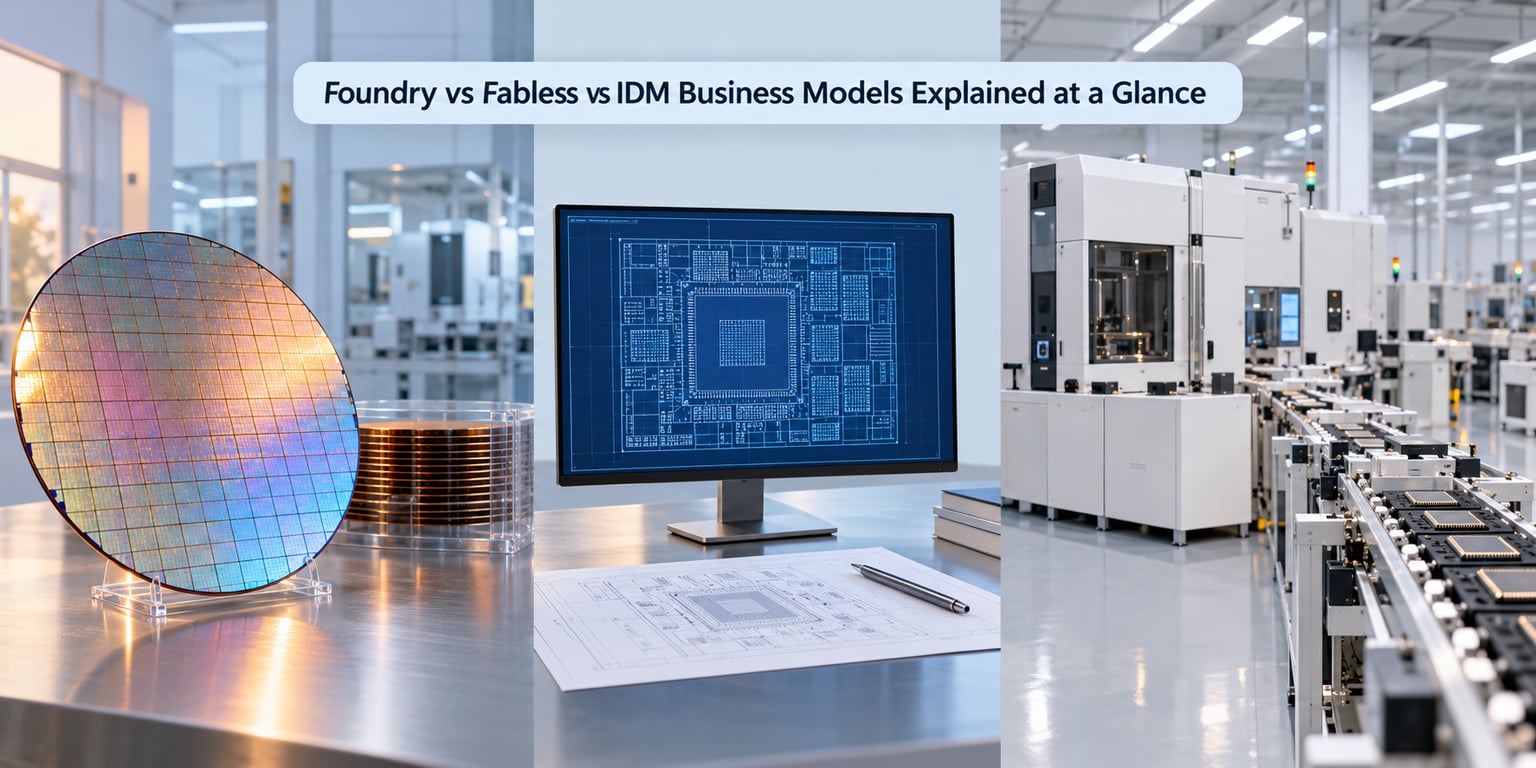
Three companies split the work of building a chip. A foundry owns the factories and manufactures chips designed by many customers. A fabless company owns the design and pays others to manufacture. An IDM, an integrated device manufacturer, designs its own chips and makes them in its own fabs.
| Criterion | Foundry | Fabless | IDM |
|---|---|---|---|
| Designs chips | Usually not for customers; runs a small custom or legacy line | Yes, that is the whole company | Yes, for its own products |
| Owns fabs | Yes, that is the whole company | No | Yes |
| Typical gross margin | Roughly 30 to 55 percent | Roughly 50 to 75 percent | Roughly 25 to 50 percent |
| Capital intensity | Extreme, tens of billions per leading-edge fab | Light, mostly EDA tools, IP and engineering payroll | Heavy, carried for the whole product life |
| Revenue driver | Wafer starts, process services, mask and NRE work | Chip average selling price and design wins | Chip price, plus in-house cost transfer |
| Utilization sensitivity | High, empty fabs burn cash | Low, cost flexes with design activity | High, and the company cannot walk away |
| Examples | TSMC, UMC, GlobalFoundries, Samsung Foundry | NVIDIA, AMD, Qualcomm, MediaTek, Broadcom | Texas Instruments, Infineon, STMicroelectronics, onsemi, Micron |
| Primary risk | Under-loaded tools and node migration cost | Capacity allocation, wafer pricing, schedule | Fixed-cost drag on a cyclical downturn |
Those margin bands are typical ranges reported for each model, not guarantees. Any single company can sit outside its band in a given quarter, and hybrid players sit in two bands at once.
What Is a Semiconductor Business Model?
A business model in this industry is simply the answer to one question: which links of the chip supply chain does the company own, and which does it buy?
The chain has five main links. Design is where engineers turn an architecture into RTL and verify it, usually using EDA tools from Synopsys or Cadence plus licensed IP blocks. Tape-out is the point where a finished design is frozen and handed off to be printed. Wafer fabrication is the fab itself, where masks are used to etch patterns onto silicon wafers. Packaging and test is where individual dies get mounted, connected and electrically checked, work often done by an OSAT such as ASE or Amkor. Distribution and product sales sit at the end, where the chip reaches the device that uses it.
Pick one model and you have decided who carries inventory, who waits for capacity, and who eats the cost of an idle machine. That is why investors screen by model before they screen by product.
How Do the Three Models Fit Together?
Most chips are made by a mixed cast, and the models are less rivals than neighbours along one line. A fabless designer defines the architecture, licenses IP, writes verification and software, then tapes out to a foundry. The foundry runs wafers, then hands finished dice to an OSAT for packaging and test before they travel to a device maker.
A one-line taxonomy that circulates in industry forums captures the split neatly: the foundry makes it, the IDM makes and designs it, the fabless company designs it, and the OSAT packages and tests it.
Then there are the tiers that belong to none of the three. ASML, Applied Materials and Lam Research sell the tools that fabs run on. Synopsys and Cadence sell the software that designs run on. Neither designs nor manufactures chips, and both profit regardless of which model wins.
Hybrid players blur the line further. Samsung designs and manufactures its own logic and memory and also sells foundry capacity to outside customers. Intel has run an internal foundry for its own processors for decades while attempting to sell leading-edge capacity to fabless rivals. Texas Instruments keeps an internal captive line for its analog products. Practitioners often describe a fourth practical category: design house plus captive internal foundry.
Foundry Business Model: Manufacturing Without Owning the Chip Product
A pure-play foundry owns fabs and equipment, runs processes customers pay to use, and sells wafer capacity rather than chips. Its customers bring the design; its revenue comes from wafer starts, mask sets, non-recurring engineering work and long-term capacity agreements.
The economics are dominated by two things: how full the fabs are, and how much the next node costs. Tool sets and cleanroom capacity are expensive to build and expensive to keep running at a profit when the order book thins. TSMC is the canonical example, with UMC, GlobalFoundries and Samsung Foundry covering different mixes of leading-edge and mature-node work.
Because customers commit capacity months ahead, a foundry’s revenue is more forecastable than a chip vendor’s. That predictability is the trade: guaranteed volume in exchange for whatever price the fab sets.
Fabless Business Model: Designing Without Operating a Fab
A fabless company owns architecture, RTL design, verification, software enablement and product management, and buys wafers, packaging and test from partners. NVIDIA, AMD, Qualcomm, MediaTek, Broadcom and Apple’s in-house silicon teams all work this way.
The handoff that confuses newcomers is tape-out. Before fabrication, a fabless company taps out against a process design kit from the foundry, which encodes the design rules for one process node. Change a block, and the design must be verified again because the foundry’s kit is the contract.
Once qualified, a design can move to another foundry on a similar node, which is genuinely useful for supply planning. Moving to a leading-edge node is much harder, because the new kit exposes new constraints that force real design rework.
IDM Business Model: Integrating Design and Manufacturing
An IDM designs and manufactures its own chips, so it keeps both the design margin and the manufacturing margin in-house. Texas Instruments, Infineon, STMicroelectronics, onsemi and Micron are IDMs, and so is Samsung on the logic and memory side.
The payoff is process optimization. When the same company designs the cell library and runs the line, a transistor tweak reaches customers quickly and can be exploited across many products. Analog and power suppliers lean on this hardest, because their products depend on many distinct process variations rather than on density alone.
The bill is that the company carries the fabs through good years and bad ones. A downturn that cuts revenue by a third leaves the depreciation running, which is exactly the pressure that pushed the industry toward the pure-play split in the first place.
How Do Ownership, Capital, and Control Differ?
Ownership is the whole argument, and it shows up in two numbers: what you spend up front and what you keep per unit. Fabless companies spend on engineers and tools and keep the larger share of each sale. Foundries and IDMs spend on buildings and machines first and recover it slowly through volume.
The economics of each model at a glance
| Factor | Foundry | Fabless | IDM |
|---|---|---|---|
| Where the capital goes | Cleanrooms, lithography, etch and deposition tools | EDA licences, IP royalties, headcount, mask costs | Fab tool sets plus design organization |
| Typical gross margin | Roughly 30 to 55 percent | Roughly 50 to 75 percent | Roughly 25 to 50 percent |
| Depreciation life of an asset | Years of a shortened useful life, refreshed at every node | Three to five years for most design assets | Same heavy fab burden, self-inflicted |
| Utilisation swing impact | Severe, fixed cost over fewer wafers | Mild, spend follows headcount | Severe, and no external customer to fill the gap |
| Bargaining power on supply | Sets wafer terms to a long queue of customers | Depends on design win size and node scarcity | Captive capacity, but no spot market access |
| Time to volume | Longest, node qualification is the bottleneck | Fastest, tape-out to first revenue in quarters | Long, but each fab step is in-house |
Nobody in this business keeps the margin the headline suggests forever. A fabless company with a single taped-out product has no margin at all, and a foundry running below its breakeven utilisation rate will spend that quarter losing money.
How Do the Models Handle Risk and Time to Market?
Fabless trades factory risk for schedule risk. Capital commitments shrink dramatically, but the company now waits in someone else’s queue, absorbs the foundry’s price increases at renegotiation, and cannot guarantee capacity in a shortage. SemWiki forum threads about Intel’s foundry push keep circling the same worry from the other direction: a foundry that competes with its own customers raises questions about who gets the good slots.
IDMs hold the schedule risk. They control their own ramps, so an IDM can pull a node migration forward if its own product roadmap demands it. The exposure is that a failed product leaves very expensive silicon that only the company itself can sell.
Policy now cuts across all three models. Export controls decide which customers a foundry may serve and which tools it may install, and CHIPS Act subsidies push companies toward domestic capacity without removing the underlying economics. A foundry can be capacity-rich and revenue-poor if the rules block its customers.
Which Model Is Best for a Chip Company?
The right model follows the product, and the product usually dictates the fab. In practice:
- AI accelerators and high-end processors go fabless. The differentiation sits in architecture and software, and leading-edge capacity is scarce enough that owning it would tie up capital better spent on design.
- Smartphone SoCs are overwhelmingly fabless, because the win depends on shipping to four or five customers on a tight schedule.
- Automotive microcontrollers split. A supplier that wants long product lives and stable process corners often prefers IDM control, while faster entrants run fabless on mature nodes.
- Analog and power management remain mostly IDM. Many process variations, no single killer node, and pricing that rewards process know-how over density.
- Silicon carbide and gallium nitride power devices are IDM territory too, because the bottleneck is materials and process yield in a specialized fab.
- DRAM and NAND memory are structurally separate from logic foundries. Memory production runs its own fabs and its own economics, and the big memory makers are IDMs by necessity.
- Mature-node analog and automotive capacity is where captive IDM lines and pure-play foundries compete most directly, and where government-subsidised domestic fabs keep adding capacity.
Which Should You Choose?
Start from the constraints, not the label. Work through the foundry vs fabless vs IDM question in five steps, and the answer usually falls out on its own.
The foundry vs fabless vs IDM question in five questions
First, how much capital can you commit without financing? If the honest number is a few tens of millions, you are fabless, because a single advanced fab is a different order of magnitude. Second, what is your differentiation? Architecture, software and IP argue for fabless; a process or materials breakthrough argues for IDM. Third, which node do you need? Mature-node products can be placed anywhere; leading-edge products push you to whichever foundry has the capacity. Fourth, what volume do you forecast? Low and lumpy volumes punish a captive fab, and steady volume with long product life rewards one. Fifth, how much control do you need over supply and cost? If a customer or a government is asking for guaranteed domestic capacity, IDM or a foundry partnership becomes worth the fixed cost.
If the answers split, choose the hybrid. Many companies start fabless, and once revenue justifies it, buy or reserve dedicated capacity, or bring a narrow internal line online for the part of the portfolio that needs process control. That is the pragmatic path, and it is why the textbook three-box picture is useful but incomplete.
Frequently Asked Questions
Is TSMC a foundry or an IDM?
TSMC is a pure-play foundry. It designs very little of what runs through its fabs and manufactures chips designed by outside customers, including NVIDIA, AMD and Apple. It owns fabs, so it is not fabless, but because it does not sell branded chips of its own, it is not an IDM either. Its revenue comes from wafer starts and capacity contracts.
Is NVIDIA fabless or a foundry?
NVIDIA is fabless. It designs the GPUs, networking chips and the software stack around them, but owns no fabs. Its wafers are made by TSMC and other foundries, and packaging and test are handled by outside partners. That structure is why NVIDIA reports a far higher gross margin than an IDM selling comparable silicon.
What are the key differences between an IDM and a foundry?
An IDM designs and manufactures its own chips, so it keeps both margins but carries the full fab cost and utilisation risk. A foundry manufactures chips designed by other companies and earns revenue from wafer capacity, process services and long-term contracts. The IDM sells a product; the foundry sells a factory service. That is the whole distinction.
What is the fabless semiconductor business model?
A fabless company designs chips without owning a factory. It handles architecture, RTL design, verification, software and product management, then buys wafers from a foundry, usually after qualifying against the foundry’s process design kit. Packaging and test often go to OSAT partners as well. The result is low fixed capital and high gross margin, in exchange for dependence on someone else’s capacity and schedule.
What are the top 5 semiconductor foundries?
By revenue, TSMC leads by a clear margin, with Samsung Foundry, UMC, GlobalFoundries and Intel Foundry forming the rest of the leading group, and Tower Semiconductor covering specialty and mature-node work. Rankings shift slightly each year depending on how much mature-node capacity is counted and how leading-edge demand is priced, so check a current share table before quoting figures.
Which fabless semiconductor companies are the biggest?
By annual revenue, the largest fabless vendors include NVIDIA, Qualcomm, Broadcom, AMD and MediaTek, with Apple significant when its in-house silicon is counted. These are the companies whose value comes from design and software rather than from owning fabs. The list changes with each reporting year, especially when data centre demand swings the rankings.
Conclusion: Start with the Right Ownership Model
Identify your product, your honest capital ceiling, your expected volume and how much supply control you actually need, then pick the model that fits those four answers. Most teams land on fabless for speed, IDM for process and analog know-how, or a hybrid that starts outsourced and brings capacity in-house once revenue justifies it.