US semiconductor engineer pay runs from about USD 90,000 to USD 180,000 in base salary for most roles, with a median base near USD 130,000 and median total compensation across the industry around USD 204,000. The spread is wide because the title covers process, equipment, design, test and management work that barely overlap.
That gap is why two salary sites can both look authoritative and still tell you opposite things. One is counting base pay from self-reported profiles at fabs, the other is counting base, bonus and equity at design companies. This guide sorts out which number answers which question.
All figures below are US figures with a named source and date. Salary data decays fast, and the semiconductor market has moved a lot since the CHIPS Act buildout began, so treat anything you read without a date as a guess.
Table of Contents
- Semiconductor Engineer Salary Ranges at a Glance
- Why the federal data says less than you expect
- The numbers to know before you read further
- What Affects Semiconductor Engineer Pay
- Job title and level, which set the band
- Technical specialty, which decides which band you qualify for
- Experience and education, which widen the gap over time
- Metro location, which is worth 20 to 40 percent
- Employer type and company size
- Industry segment and where the work physically happens
- Work authorization and performance pay
- How Salary Ranges Vary by Semiconductor Career Path
- Process, equipment, yield and test engineering
- Product, IC design, verification and physical design
- Packaging, test, field service and applications
- Semiconductor sales engineering
- Engineering management
- Decoding internal job titles to semiconductor engineer salary levels
- Contract pay versus permanent pay
- How to Evaluate a Job Offer
- 1. Find your position inside the band
- 2. Read the bonus language literally
- 3. Value the equity instead of counting it
- 4. Price the benefits and the retirement match
- 5. Price the one-time and shift components
- 6. Find out what the schedule really costs
- 7. Run the offer through the same lens every time
- Ways to Increase Semiconductor Engineer Earnings
- Specialize in something with fewer qualified people
- Decide which side of the industry you are on
- Use location as a lever, not as a constraint
- Decide early whether you want management
- Time advanced education to the market
- Review the whole package every year
- Frequently Asked Questions
- What is the average salary for a semiconductor engineer in the US?
- What is the starting salary for a graduate engineer in semiconductors?
- How much does a semiconductor process engineer make?
- What is a normal bonus for a semiconductor engineer?
- Which semiconductor roles pay the most in total compensation?
- Do semiconductor engineers get RSUs, and how much are they worth?
- Conclusion
Semiconductor Engineer Salary Ranges at a Glance
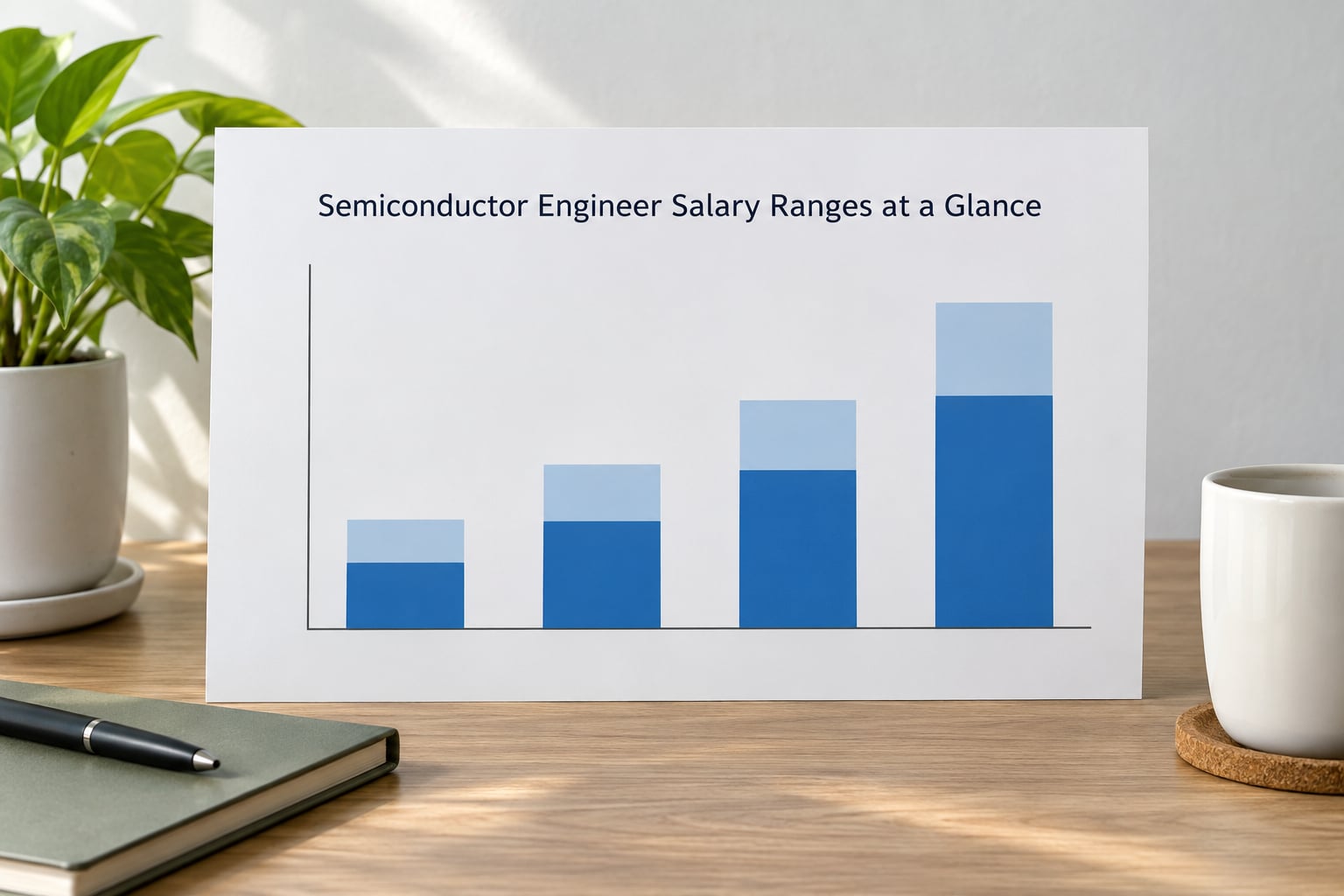
The table below splits the market by experience level. Base pay is the salary line on your offer letter. Total compensation adds target bonus plus the annual value of equity, and it is the number that matters once you are past your first job.
| Experience level | Typical years | Base salary range (USD) | Typical total compensation (USD) |
|---|---|---|---|
| New graduate (entry, L3, Associate) | 0 to 2 | 85,000 to 120,000 | 95,000 to 140,000 |
| Mid-career (L4, Senior) | 3 to 5 | 115,000 to 160,000 | 145,000 to 210,000 |
| Senior (L5, Staff) | 6 to 10 | 145,000 to 200,000 | 200,000 to 300,000 |
| Principal (L6, Distinguished) | 10 to 15 | 180,000 to 250,000 | 280,000 to 420,000 |
| Distinguished / Fellow | 15 plus | 200,000 to 300,000+ | 350,000 to 500,000+ |
| Engineering manager (people lead) | 8 plus | 160,000 to 220,000 | 220,000 to 320,000 |
Compiled from Levels.fyi US semiconductor submissions, BLS May 2025 Occupational Employment and Wage Statistics, and recruiter band data, as of October 2026. Levels.fyi total compensation figures skew toward design roles at large technology companies and exclude most fab and equipment-side candidates.
Why the federal data says less than you expect
The Bureau of Labor Statistics has no occupation code for semiconductor engineers. The closest standard proxy is electronics engineers, except computer (O*NET 17-2072), which recorded a national median of USD 130,220 in May 2025. Inside semiconductor and electronic component manufacturing specifically, the median rises to USD 146,700, with a 10th percentile of USD 81,840 and a 90th percentile of USD 206,960.
Materials engineers (17-2131) at USD 112,860 and electrical engineers (17-2071) at USD 120,630 are secondary proxies. Use the BLS numbers as a floor-setting benchmark, not as a description of what a specific company in a specific city pays.
The numbers to know before you read further
- A US semiconductor engineer on a median base of about USD 130,000 sits close to the BLS electronics engineer median, so a salary at or below that is normal and not a red flag.
- Median total compensation across the US semiconductor industry sits near USD 204,000 on Levels.fyi, roughly 50 percent above the median base. The gap is equity, not cash.
- New graduate base pay commonly starts between USD 85,000 and USD 120,000, and most campus postings put chip design at the top of that range.
- Total compensation overtakes base pay in importance somewhere around the senior level, where annual equity can be worth more than a year of salary growth.
- Metro choice moves a base salary by 20 to 40 percent on its own, before you count signing bonus or relocation support.
- Target bonus for engineers is usually 8 to 20 percent of base, and it is a target rather than a guarantee.
What Affects Semiconductor Engineer Pay

Six factors move a semiconductor offer more than anything else: level, specialty, experience, location, employer type and industry segment. Everything else is negotiation on top of a band those six set.
Job title and level, which set the band
Recruiters pay by band, not by title. “Engineer II,” “Senior Engineer,” “Staff Engineer” and “Principal Engineer” usually map cleanly onto a level structure, but a company with L3 through L6 bands is telling you something the job title alone will not. Ask which internal band the requisition sits in, because two people with identical job descriptions can sit two levels apart and 40,000 USD apart.
Technical specialty, which decides which band you qualify for
Demand for people who can hold a specific line item is what moves a number, not the job description. A process integration engineer working on advanced-node lithography competes for a smaller pool of candidates than a test engineer doing ATE work, and the scarcity shows up in the band. Specialty matters most at the senior and principal levels, where companies are paying for a specific body of knowledge rather than for years of service.
Experience and education, which widen the gap over time
Ten years of experience used to mean ten years of raises. It increasingly means ten years of a wider spread between the top and bottom of the band, because the people who moved into design automation, physical design or advanced-node device work kept accumulating skills while the others kept doing the same tasks. A master’s degree helps most at the entry level and in roles where the credential is genuinely required, such as some device physics or materials positions.
Metro location, which is worth 20 to 40 percent
The same job pays differently in each of the main US semiconductor metros. Levels.fyi shows a median around USD 268,867 for the San Jose area, while Glassdoor reports an average of USD 207,237 in Dallas-Fort Worth with a base range of USD 103,000 to 181,000, and its Austin semiconductor equipment engineer figure sits at USD 146,397. These are different populations measured different ways, which is the subject of a later section.
| Metro | Base range (USD) | What drives the level |
|---|---|---|
| San Jose and the wider Bay Area | 150,000 to 240,000 | Design, EDA and AI accelerator work; Levels.fyi industry median of 268,867 total comp |
| Austin, Texas | 110,000 to 175,000 | Design plus a heavy secondment market from fabs; Glassdoor equipment engineer average of 146,397 |
| Phoenix, Arizona | 105,000 to 170,000 | Fab operations, the largest concentration of cleanroom jobs in the US |
| Dallas-Fort Worth, Texas | 105,000 to 181,000 | Design and test; Glassdoor average of 207,237 total pay |
| San Diego, California | 115,000 to 190,000 | Wireless and analog design, and the deepest RF talent market on the West Coast |
| New York, Hudson Valley | 100,000 to 165,000 | Legacy fabs and pilot lines; Levels.fyi Poughkeepsie median of 182,750 |
| New Mexico and rural fab towns | 90,000 to 150,000 | Cheaper housing offsets a thinner local market |
As of October 2026. Aggregator medians mix base and total pay, so read each row as a direction rather than a precise offer.
Employer type and company size
A large chip designer posting a public band, a mid-size analog company, a fabless startup and a staffing agency all price the same job differently. Large public companies publish salary bands in their job postings, which makes them the easiest to benchmark. Startups may compensate below market cash and above market equity, which is only rational if the equity survives. Government laboratories and federal contractors price closer to public-sector scales.
Industry segment and where the work physically happens
Inside a semiconductor company, the segment decides the pay track more than the title. Design roles carry the highest equity. Equipment and materials suppliers sit in the middle and lean on the CHIPS-driven buildout for demand. Fab operations carry shift differentials and sometimes union-influenced structures on construction-adjacent work, where one benchmark cited a union rate of USD 78.30 an hour including fringe. A new fab town with a thin local market will often pay a premium to lure people in; the same role in a mature market pays less.
Work authorization and performance pay
Companies that sponsor work authorization build that cost into the offer, usually as a one-time payment or a higher base at entry. On the other side, performance pay and the annual review cycle decide how fast you climb inside a band. Most large employers use a merit increase of roughly 3 to 6 percent in a strong year, which on its own will not close a gap of 40,000 USD.
How Salary Ranges Vary by Semiconductor Career Path
The largest pay difference inside the industry is not seniority. It is whether you sit on the design side, the device and process side, or the support side that keeps tools running and customers installed.
| Career path | Entry base (USD) | Mid-career base (USD) | Senior and above base (USD) |
|---|---|---|---|
| Process integration | 95,000 to 120,000 | 130,000 to 165,000 | 175,000 to 230,000 |
| Device and transistor engineering | 100,000 to 130,000 | 140,000 to 180,000 | 190,000 to 250,000 |
| Yield engineering | 95,000 to 125,000 | 130,000 to 170,000 | 175,000 to 225,000 |
| IC design and design verification | 100,000 to 130,000 | 140,000 to 185,000 | 190,000 to 260,000 |
| Design automation and EDA | 105,000 to 135,000 | 145,000 to 195,000 | 200,000 to 275,000 |
| Packaging and test | 85,000 to 110,000 | 115,000 to 150,000 | 155,000 to 205,000 |
| Field service and applications | 75,000 to 100,000 | 100,000 to 135,000 | 140,000 to 180,000 |
| Semiconductor sales engineering | 80,000 to 105,000 | 115,000 to 155,000 | 160,000 to 220,000 plus commission |
| Engineering management | 115,000 to 150,000 | 150,000 to 190,000 | 180,000 to 240,000 |
Base salary ranges, as of October 2026. Equipment engineering tracks process and yield within about 10,000 USD, and facilities engineering tracks packaging.
Process, equipment, yield and test engineering
These are the fab-side roles that own the recipe, the tool uptime and the yield ramp. Entry bands cluster around USD 95,000 to 125,000, and the money starts moving once you own a module or an excursion rather than running someone else’s DOE. A new Mexico WFE process support engineer was reported at around USD 100,000 in 2020 with technical program managers near USD 150,000, which shows how steep the local gap was in a rural fab market at that time.
Product, IC design, verification and physical design
Chip design posts the highest base bands and the largest equity grants. Acceler8 Talent’s September 2026 benchmarks put chip design at USD 95,000 to 125,000 on entry, USD 130,000 to 175,000 at mid level, USD 175,000 to 230,000 at senior and USD 220,000 to 290,000 for lead and principal, with principal total compensation clearing USD 320,000 once equity is counted. Design automation and physical design sit at the top of that list because the candidate pool is small.
Packaging, test, field service and applications
These roles get the least attention in salary guides, and field service is the one most engineers start in. Base pay is usually 10 to 25 percent below a comparable fab role, and the schedule is the trade: compressed three or four day, 12-hour shifts. One new graduate field service offer posted on r/Semiconductors came in at USD 34.95 an hour, about USD 72,750 a year base, with total compensation of USD 100,683 once shift differential and other components were counted. Applications engineering pays a little better than field service and is a common path into a product or design role.
Semiconductor sales engineering
Sales engineering blends a lower base with commission and an uncapped variable component. The base often sits at or below the packaging range, and the total can beat design at the senior end, but only in a year where the quota lands. Treat the base as the floor and ask what the trailing two-year payout distribution looked like.
Engineering management
Moving into management usually costs you a step in the individual contributor ladder and pays for it in stability. Base lands in the USD 160,000 to 220,000 range at the senior management level, with the bonus tied to team output rather than personal delivery. The trade is simple: less equity, more control over the budget and headcount, and a harder time returning to hands-on work later.
Decoding internal job titles to semiconductor engineer salary levels
Recruiters pay by band, not by title. The table below maps the level names most US semiconductor companies use internally onto the market equivalents that appear in public salary data.
| Internal band | Common market title | Base range (USD) |
|---|---|---|
| L3 | Associate, Entry, Engineer I | 85,000 to 120,000 |
| L4 | Senior, Engineer II | 115,000 to 160,000 |
| L5 | Staff, Senior II, Lead | 145,000 to 200,000 |
| L6 | Principal, Distinguished | 180,000 to 250,000 |
| M1 to M3 | Manager, Senior Manager, Director | 160,000 to 240,000 |
Contract pay versus permanent pay
Contract roles price on an hourly basis and run lower on paper than the equivalent permanent base. Agency W-2 contract work has been reported around USD 52 to 85 an hour, and corp-to-corp rates around USD 90 to 125 an hour in chip design, with the employer loading a corp-to-corp rate by roughly 30 to 40 percent. A 168,000 USD permanent base is roughly USD 81 an hour before benefits, so a lower hourly contract rate can still lose once you add health coverage, retirement contributions and the absence of equity.
How to Evaluate a Job Offer
An offer is a package with seven moving parts, and comparing only the base line is the most expensive mistake a candidate makes. Work through these in order.
1. Find your position inside the band
Ask where the posted range starts, where it ends and where you are inside it. A candidate who came up against a posted range of USD 78,000 to 159,000 at Lam Research, and asked publicly how to position their experience against that spread, was asking exactly the right question. Mid-band is the market average. Top-of-band means you were hired for something the company needs now, and it is the only point at which a negotiation is easy.
2. Read the bonus language literally
“Up to 15 percent” is a range, not an offer. Ask what the target is, what the three-year payout history was for engineers in your group, and whether the target changed when the company missed a quarter. Engineered packages also treat the sign-on and the retention grant differently, and those are one-time amounts that should not be annualized into your salary.
3. Value the equity instead of counting it
An RSU grant is worth the share price multiplied by the number of shares that actually vest, and public companies usually vest over four years. Multiply the grant by the vesting fraction, discount for the chance the company does well, and ask what the refreshed grant is at your next level. A large grant at a startup is worth less than half its face value in any realistic calculation, because unvested equity is your biggest hidden switching cost if the company struggles.
4. Price the benefits and the retirement match
A 6 percent retirement match on 150,000 USD adds roughly 9,000 USD a year, which is a real number even though it is not cash. Look at medical premium cost per pay period, because a family plan can quietly take 10,000 USD or more a year out of the package. Also check the paid time off and the shift model, because compressed 12-hour days change what a “vacation day” is worth.
5. Price the one-time and shift components
Sign-on, relocation, temporary housing, per diem and shift differential each have a different character. Sign-on is often forfeited if you leave within 12 to 24 months, so treat it as compensation for patience, not as a permanent increase. Shift differential is genuinely valuable cash if you want it, and it is the line that closes most of the gap between field service and fab pay in the example above.
6. Find out what the schedule really costs
Ask about on-call rotation, expected travel percentage and how much of the role is cleanroom-floor time versus office time. A design role with 20 percent travel and a fab role with night rotations in a rural town are not interchangeable on a per-hour basis, whatever the base comparison says.
7. Run the offer through the same lens every time
New graduates have no frame of reference and usually accept the first number, which is exactly how the salary sites get their low averages. One recurring theme on r/Semiconductors is that US engineers undervalue semiconductors relative to software and negotiate from a position they would never take in software. Whatever your role, get one recruiter to give you the band’s midpoint in writing before you say a number.
Ways to Increase Semiconductor Engineer Earnings
Compensation moves when your position in the labor market moves. These are the levers that have actually worked, roughly in order of impact.
Specialize in something with fewer qualified people
Recruiter benchmarks for 2026 put the premium on AI and ML accelerator RTL at 25 to 35 percent above general design work, physical design at 18 to 25 percent, and SystemVerilog with UVM at 15 to 20 percent. Advanced-node FinFET process integration sits in the same scarcity band. The pattern is the same each time: the premium attaches to work where a bad quarter costs the company millions, not to years served.
Decide which side of the industry you are on
Moving from a fab process role to a design role, or the reverse, changes your pay track more than any other single move. The reverse move into a design role is the common one, and it is easiest for engineers who already own a yield excursion or a module, because that is proof you can debug under pressure. The move from design into process is rarer and usually needs a masters degree or a strong tape-out history to be worth the cut in pay.
Use location as a lever, not as a constraint
The same job can be worth 30 percent more in one metro. Before you accept below-band pay, check whether the company posts a range for the other location, and whether the higher-cost office has a larger band. Some engineers take a small base cut to live somewhere cheaper, which is fine, but do it knowing it is a cut rather than calling it a raise.
Decide early whether you want management
The management ladder pays a little less at the top and a lot more reliably through the middle. Engineers who want to stay hands-on should say so out loud early, because it is much easier to stay on the individual contributor track before you manage a team than after.
Time advanced education to the market
A PhD pays back slowly for process and device roles and does not pay back at all for a test engineer with three years of experience. If the role description asks for a PhD, the credential is worth more than the cash differential. If it says “preferred,” it usually is not.
Review the whole package every year
Most large companies run an annual merit cycle that lands 3 to 6 percent, plus a separate equity refresh. Ask for the refresh explicitly at your level change, because it is the most commonly missed part of a senior package, and ask for the band midpoint in writing before you accept a promotion that pays you less than a market move would.
Frequently Asked Questions
What is the average salary for a semiconductor engineer in the US?
A US semiconductor engineer earns roughly USD 90,000 to 180,000 in base salary, with a median base near USD 130,000. The BLS reports a May 2025 median of USD 130,220 for electronics engineers except computer, and USD 146,700 inside semiconductor and electronic component manufacturing. Total compensation runs higher: Levels.fyi puts the US industry median at roughly USD 204,000 because it includes bonus and equity from design-heavy roles.
What is the starting salary for a graduate engineer in semiconductors?
New graduate base pay typically lands between USD 85,000 and 120,000, with chip design posting at the top of that range and field service and test at the bottom. A new grad field service offer reported on r/Semiconductors came in at USD 34.95 an hour, about USD 72,750 a year base. Chip design postings most often start near USD 95,000 to 125,000.
How much does a semiconductor process engineer make?
Process integration engineers start around USD 95,000 to 120,000, sit at USD 130,000 to 165,000 with three to five years, and reach USD 175,000 to 230,000 at senior level. Advanced-node FinFET process work carries a scarcity premium. Equipment and yield engineering track within about 10,000 USD of process roles. Fab work can also add a shift differential on top of base.
What is a normal bonus for a semiconductor engineer?
Target bonus for US semiconductor engineers is usually 8 to 20 percent of base salary, with higher targets at senior levels and in management. Watch the wording: up to 15 percent describes a range, not a guaranteed payment. Ask the recruiter for the target figure and the three-year payout history for engineers in the same group before you annualize it into your salary.
Which semiconductor roles pay the most in total compensation?
Principal and distinguished design engineers sit at the top, where total compensation can reach USD 350,000 to 500,000 or more. Senior AI accelerator RTL and physical design engineers typically clear USD 300,000 once equity is counted, and NXP embedded hardware postings have been reported in the USD 282,000 to 412,000 range at senior levels. Fab and field service roles rarely exceed USD 220,000 in total compensation.
Do semiconductor engineers get RSUs, and how much are they worth?
Most US semiconductor engineers receive RSU grants, and at senior and principal levels the annual grant can be worth more than a year of salary growth. Value the grant by share price times the shares that actually vest, then discount for company risk. A 4-year vest means only a quarter vests in your first year. Equity usually replaces part of the base rather than adding on top of it, so compare total compensation, not base.
Conclusion
Semiconductor engineer pay is decided by four things: your level inside the company’s band, your specialty, your metro and how much of the package is equity rather than cash. Base alone will mislead you, because the median US base of about USD 130,000 and the median total compensation of about USD 204,000 describe the same people.
Start by pinning down three things before you compare anything: which internal band the role sits in, whether the number you are reading is base or total, and the date on the source. Then compare offers on total compensation with the equity discounted, not face valued. That is a few hours of work, and it is the difference between a fair offer and one that cost you 30,000 USD a year.