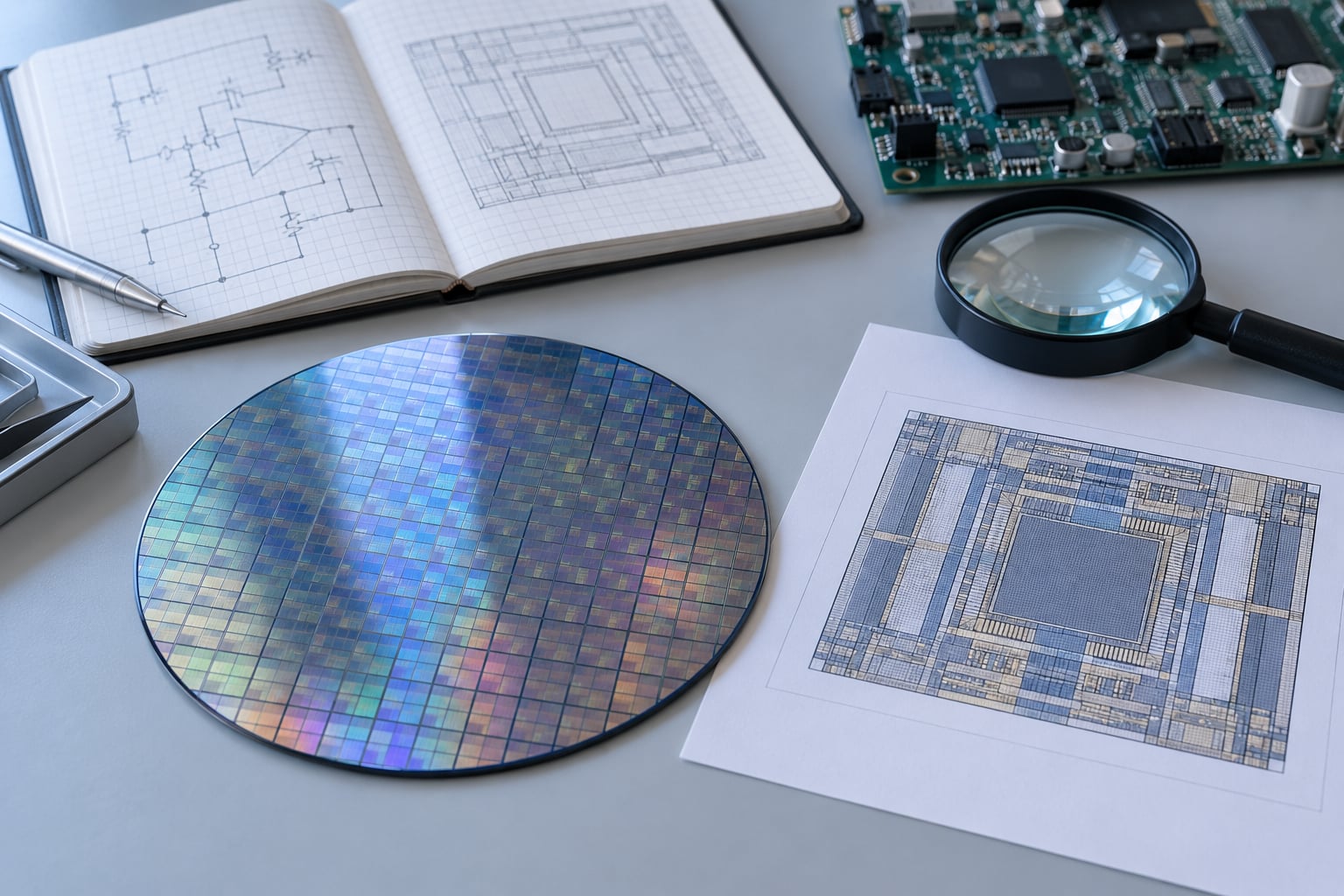
If you are searching for the degrees needed for semiconductor jobs, the short answer is this: an associate degree or certificate covers fab technician and equipment work, a bachelor’s in electrical engineering or a close relative covers most process and chip design roles, and a master’s or PhD is expected for research, device physics, and advanced process development. The degree that matters is the one that matches the job family you want.
That is the part most career advice leaves out. There is no single semiconductor degree. A fab hiring process engineer and a chip designer sit in the same industry and want genuinely different schoolwork. This guide maps degree levels to specific job families so you can tell, before you enroll, whether you are aiming at a two-year technician path, a four-year engineering path, or a research track.
Everything below reflects how requirements are actually written in postings. One common fab technician listing asks for an associate degree in a relevant technical field such as mechatronics, electronics, or robotics “and/or 2 years of experience,” while entry-level process engineer postings ask for an MS in electrical engineering or physics plus several years of demonstrated industry experience. Same industry, very different ladders.
Table of Contents
- Degrees Needed for Semiconductor Jobs by Career Path
- Which Semiconductor Career Goals Match Each Degree?
- What Education Do Chip Design Engineers Usually Need?
- Which degrees needed for semiconductor jobs lead to Verilog and EDA work?
- What Education Do Process and Manufacturing Engineers Need?
- What Education Do Packaging, Test, and Reliability Jobs Require?
- Can You Get a Semiconductor Job With an Associate Degree?
- Do Semiconductor Employers Require Graduate Degrees?
- How to Build a Strong Semiconductor Resume Without the Perfect Degree
- How to Choose the Right Degree for Your Semiconductor Goal
- Frequently Asked Questions
- What degree do you need to be a semiconductor engineer?
- Is a computer science degree enough for semiconductor jobs?
- Is a physics degree good for semiconductors?
- Can you be a semiconductor technician without a degree?
- Do semiconductor jobs require a master’s degree?
- Is semiconductors a good career path?
- Conclusion
Degrees Needed for Semiconductor Jobs by Career Path
Here is the mapping most people are looking for. Degree level follows the responsibility: the more a role touches device physics, process integration, or design decisions, the higher the required degree.
| Job family | Typical minimum degree | Most common majors |
|---|---|---|
| Wafer fab technician, equipment and facilities technician | Associate degree, postsecondary certificate, or equivalent experience | Electronic systems, mechatronics, robotics, industrial technology, microelectronics |
| Process integration engineer | Bachelor’s; master’s for many postings | Chemical engineering, materials science and engineering, electrical engineering, physics |
| Yield and manufacturing engineer | Bachelor’s | Industrial engineering, chemical engineering, electrical engineering, statistics-adjacent majors |
| Metrology and process control engineer | Bachelor’s | Materials science, electrical engineering, physics, chemical engineering |
| Digital IC design and RTL design | Bachelor’s minimum; master’s common at larger firms | Electrical engineering, computer engineering |
| Verification and design-for-manufacturing | Bachelor’s | Electrical engineering, computer engineering |
| Analog, RF, and mixed-signal design | Bachelor’s; advanced device physics often at master’s | Electrical engineering, physics |
| Physical design, layout, and mask design | Bachelor’s | Electrical engineering, computer engineering |
| Packaging, assembly, and test engineering | Bachelor’s; associate degrees common for technician tracks | Materials science, mechanical engineering, electrical engineering, industrial engineering |
| Failure analysis and reliability engineering | Bachelor’s; master’s for advanced failure analysis | Materials science, electrical engineering, physics, mechanical engineering |
| Semiconductor research scientist | PhD, or master’s with several years of research | Physics, materials science, electrical engineering, chemistry |
| Technical program and engineering management | Bachelor’s plus industry experience | Any engineering major, plus management or technical program coursework |
Two rules sit underneath that table. First, job postings frequently say “or equivalent combination of skills and experience,” which is not filler. Second, the major listed on a posting is a filter for relevance, not a legal requirement to practice.
Which Semiconductor Career Goals Match Each Degree?
Match the major to the job family, not to the industry name. Here’s how the degrees map to work.
| Degree | Job families it opens | Watch out for |
|---|---|---|
| Electrical engineering | Digital and analog design, RTL, verification, physical design, process integration, semiconductor device physics | Broadest posting coverage; expect heavy coursework and design-tool practice |
| Computer engineering | Digital design, RTL, verification, architecture, embedded and test engineering | Hardware depth varies by program; check that the curriculum includes VLSI and HDL courses |
| Physics | Device physics, process development, TCAD modeling, research, advanced analog design, failure analysis | Strong theory base, usually thinner on manufacturing process and tooling |
| Materials science and engineering | Process integration, thin films, CMP, failure analysis, packaging, reliability, yield | Some programs still require legacy metallurgy coursework unrelated to fab work |
| Chemical engineering | Process integration, wet chemistry, etching, deposition, contamination control, yield | Best fit for front-end process rather than transistor-level design |
| Mechanical engineering | Packaging, thermal management, fixtures and tooling, equipment design, reliability | Often needs a solid electronics or MEMS elective track |
| Industrial or manufacturing engineering | Yield, capacity planning, fab operations, test operations, quality | Pairs well with statistics coursework and production experience |
| Chemistry | Materials characterization, wet chemistry, failure analysis, analytical lab work | Research-heavy; add a materials or MEMS specialization |
| Business or technical management | Technical program management, supply chain, operations leadership after a technical start | Weakest route into hands-on engineering without earlier technical experience |
One thing worth knowing: hiring language for digital roles leans heavily on electrical engineering. Recruiters and forum users both note that major chip company listings mention EE far more often than computer engineering, even where the job is pure digital design. That is a screening habit, not a statement about what computer engineers can do.
What Education Do Chip Design Engineers Usually Need?
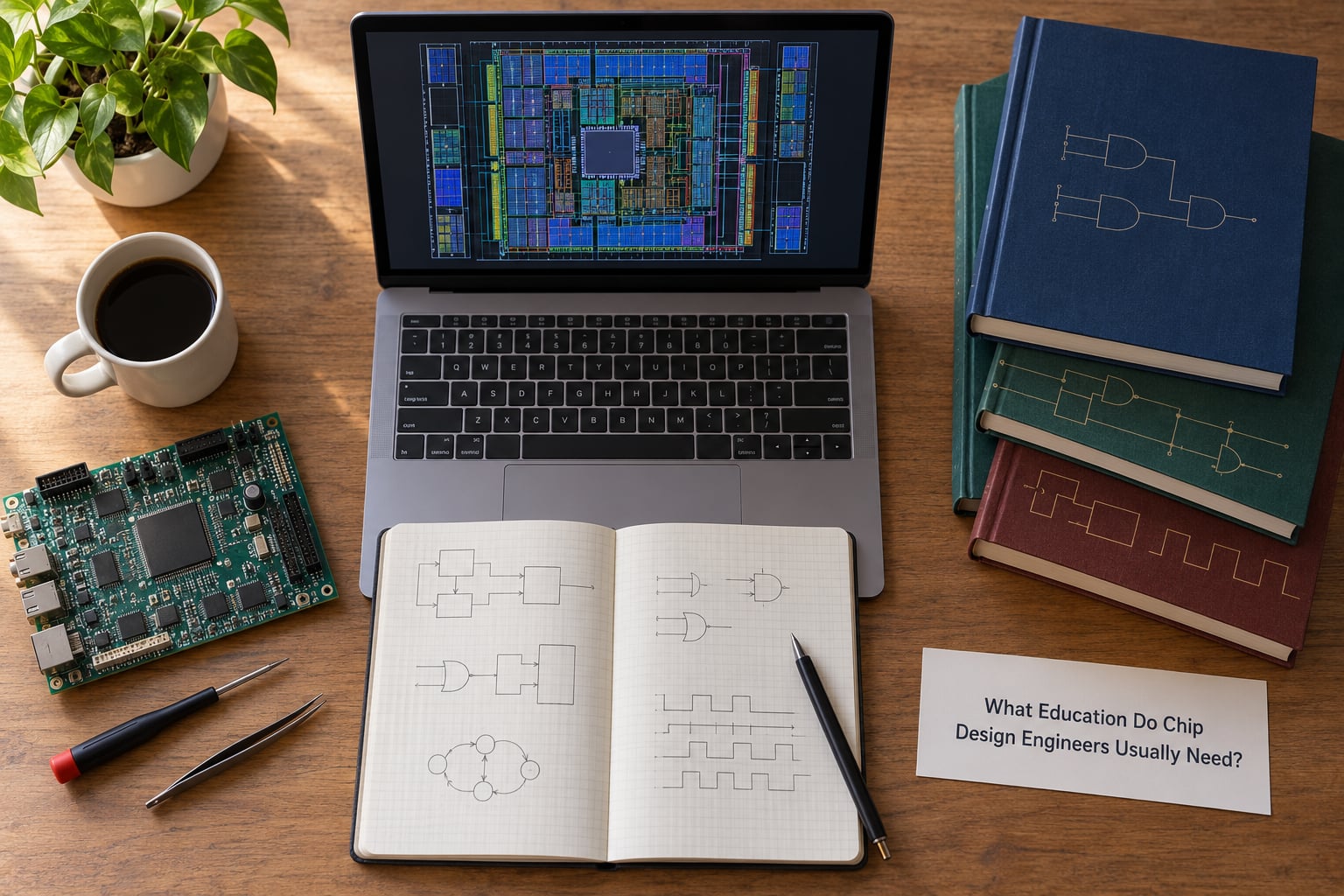
Chip design roles want a bachelor’s in electrical engineering or computer engineering, and a lot of what comes after the degree is learned on the job or in graduate school.
The undergraduate signal for design is digital logic and computer architecture. That means Boolean algebra, finite state machines, synchronous design, and at least one hardware description language. Verilog or SystemVerilog coursework is the single most portable thing a student can do, because it is what an interviewer can actually assess in an hour.
Analog design is the opposite fork, and it needs more physics. Transistor-level analog and RF work rests on device behavior, small-signal analysis, noise, and biasing. Physics forums put it plainly: gate-level digital design with Verilog needs little semiconductor physics, while analog, process development, and device modeling need a lot of it.
Here is what a four-year engineering degree typically does not cover. Nobody teaches you the commercial electronic design automation tool suite in a semester, and you will not have run a tape-out. Verification environments, synthesis and place-and-route flows, timing closure, power and physical verification, design-for-manufacturing rules, and standard-cell library characterization all come from vendor training, on-the-job mentoring, or a graduate lab. Get the fundamentals right at school and learn the tools fast once you are inside one.
Which degrees needed for semiconductor jobs lead to Verilog and EDA work?
Electrical engineering and computer engineering are the direct answers. Physics and computer science can land there too, but only when paired with hardware coursework or a design project. If your program does not include logic design, VLSI, and at least one HDL, you will be starting from zero on day one, and the gap closes much faster with a graduate degree or a first job that is heavy on mentoring.
Ask schools directly whether students get time on the tools. A program that owns a lab license teaches you far more in two semesters than a program where the hardware course is theory only.
What Education Do Process and Manufacturing Engineers Need?
Process and manufacturing work is the largest job family in the industry, and the degree requirements are more varied than the headlines suggest. A bachelor’s in chemical engineering, materials science and engineering, electrical engineering, or physics covers most entry-level postings. Some senior process integration roles ask for a master’s in chemical or materials engineering, electrical engineering, or physics.
The coursework that matters is different from design. Look for thin films, thermodynamics and transport, reaction engineering, statistical process control, and quality methods. On the fab side, the work is a sequence: lithography, etch, deposition, ion implantation, clean, metrology, then repeat thousands of times per lot. Yield is the scoreboard, and yield work is applied statistics.
Laboratory experience does more for you here than anywhere else in the industry. Process engineers talk about chamber conditions, gas flow, temperature profiles, and measurement repeatability all day. If your school has a cleanroom teaching facility or a materials characterization lab, get in it. If it does not, look for an internship, a co-op, or a summer research program where you handle instruments.
Equipment engineering sits next to this. Some equipment and facilities technicians and engineers come through mechatronics or industrial technology programs, and several postings accept an associate degree with a couple of years of experience instead. Facilities and utility work, in particular, values practical mechanical and electrical skills over a specific major.
What Education Do Packaging, Test, and Reliability Jobs Require?
Back-end roles are the most flexible part of the industry on credentials. Assembly, packaging, burn-in, and test technicians frequently accept an associate degree, a postsecondary certificate, or equivalent manufacturing experience. Engineering roles in the same areas, package design, thermal and mechanical reliability, test engineering, and failure analysis, usually want a bachelor’s in materials science, mechanical engineering, electrical engineering, or industrial engineering.
The skill profile leans electrical measurement and data. Test engineers live in measurement systems, statistical process control, scripting for test programs, and yield analysis. Reliability engineers think in acceleration models, temperature and humidity stress, failure rate math, and root-cause work under a microscope in a failure analysis lab.
Failure analysis sits between disciplines and hires from several. Materials scientists, physicists, mechanical engineers, and electrical engineers all end up there. The common thread is curiosity plus instruments: SEM, X-ray, thermal imaging, focused ion beam, and a lot of time asking why a die cracked.
For career changers, this is often the easiest door into the industry. It is closer to advanced manufacturing than to research, it has a lower degree bar, and the skills transfer to aerospace, automotive, and medical device work if you later move.
Can You Get a Semiconductor Job With an Associate Degree?
Yes. Technician, equipment, facilities, assembly, and test-support roles are open to associate degree holders, postsecondary certificate holders, and people with military technical training or industrial experience.
A live fab technician posting for process, facilities, and equipment work lists the minimum as an associate degree in a relevant technical field such as mechatronics, electronics, or robotics, and/or two years of experience. Read the “and/or” carefully. It is a genuine alternative path, and it is how most people enter fab operations.
The honest limit: a two-year degree does not open design or advanced engineering doors. Those postings ask for a bachelor’s or higher, and they will not be waived. What an associate degree buys you is a real job in the industry with a clear ladder. From inside a fab, moving up means finishing a bachelor’s part-time or through an evening program, and plenty of technicians have done exactly that.
Shorter bridges exist too. Universities now offer semiconductor microcredentials built from three to four classes totaling 10 to 13 credits, which compress specific parts of the curriculum into a few months for people already in the field. Industry immersion programs go further and state plainly that applicants do not need a technology degree, prior semiconductor experience, cleanroom experience, or advanced engineering knowledge. Those programs are aimed at people who already have a degree or relevant work experience, not at complete beginners, so read the prerequisites before you sign up.
Do Semiconductor Employers Require Graduate Degrees?
Not at entry level, but yes in specific families. A master’s is common for process integration, device physics, research, and technical leadership roles, and a PhD is the standard expectation for research scientist and faculty positions. A degree that is not required: several small and mid-size firms, plus every design role that values portfolio over credentials, hire bachelor’s graduates straight into engineering positions.
The master’s pays off in specific situations. It matters when you want to own a process module, move into TCAD or device modeling, work on advanced nodes where physics depth is the differentiator, or shift from an individual contributor path into research or management. It is less valuable when you want to be a strong RTL designer or a fab technician, where the skills you need are learned by doing.
The PhD question is sharper. It is worth it if you want a research career, publication, or a faculty position. It is probably not worth it for a manufacturing or design job, where the return is rarely there and you would be competing against people with four more years of industry experience.
One note on foreign degrees. A non-US bachelor’s is usually recognized as equivalent for screening purposes, but you may need to document coursework, and some applications ask for credential evaluation. The degree field matters more in the review than the country it came from.
How to Build a Strong Semiconductor Resume Without the Perfect Degree
Most candidates have an adjacent degree, not a perfect one. What separates them is evidence. Here is what actually moves the needle.
Internships and co-ops carry more weight than people expect, especially a fab internship that put you in a cleanroom or a design internship where you owned part of a block. Recruiters talk about them first in screens because they prove you can work inside a real engineering team.
Hands-on tools beat course lists. Have you written Verilog testbenches, run SPICE simulations, built a parameterized test program, scripted something in Python for data analysis, or characterized a device? Put the tool and the outcome on the resume, not the class.
Lab and fab projects are evidence. A materials project, a thin-film deposition experiment, a diffraction or microscopy study, or a semiconductor course project you designed and measured yourself tells a hiring manager you can handle instruments and messy data.
Statistics and scripting are quietly decisive for process and yield roles. Most fab problems are data problems, and candidates who can do root-cause analysis in Python or with statistical process control move up faster.
Published or open work helps too. Tape-out through a university shuttle program, a chip design contributed to an open-source project, a conference paper, or a strong undergraduate thesis in device physics all count as design or process experience.
Relocation is part of the resume too. Semiconductor jobs cluster: Texas has a deep fab and equipment base, California concentrates design and advanced packaging, and Arizona, Oregon, and New York each host major facilities. Where you are willing to go shapes which postings you can realistically answer.
How to Choose the Right Degree for Your Semiconductor Goal
Use this order of decisions. Start with the job family, because that sets the degree level. Technician, facilities, and test support means associate degree or certificate. Process, yield, packaging, or design means a bachelor’s. Research, device physics, or advanced process means a graduate degree.
Then pick the major that serves that family. Design points to electrical or computer engineering. Process integration points to chemical or materials engineering, with physics a strong alternative. Failure analysis and reliability open to materials, mechanical, and electrical engineering alike. Management usually comes after a technical degree, not instead of one.
Next, test your own fit. Design work rewards people who like abstract logic and long debugging sessions. Process and equipment work rewards people who like instruments, troubleshooting, and being on a floor where something is always slightly wrong. Neither is better; they are different jobs, and picking the wrong one is the expensive mistake.
Then audit the program, not just the name. Ask whether the curriculum includes digital logic and an HDL, whether students get cleanroom or fabrication lab time, whether the school runs internship co-ops with fabs, and whether the engineering program is accredited. A materials program heavy in extractive metallurgy can leave you without the thin-films and processing coursework fabs want, so read the actual course list.
Finally, weigh geography and money. If the fabs you want are in three states, picking a program near one of them plus a co-op is worth real money in time and rent. And if you are starting from an unrelated degree, do not pay for a second full bachelor’s yet. Take the graduate coursework or microcredential first, prove the fit with a project or internship, and only then commit.
Professional Engineer licensure is worth a separate note. It matters if you work on equipment, facilities, or structures and want to stamp designs; it adds little for chip design or process roles. Check your state’s experience requirements, usually several years of work under a licensed engineer, before you count on it.
Frequently Asked Questions
What degree do you need to be a semiconductor engineer?
Most semiconductor engineer postings ask for a bachelor’s in electrical engineering, computer engineering, physics, materials science and engineering, or chemical engineering. Technician, facilities, and equipment roles are the exception, often accepting an associate degree or certificate plus two years of experience. Process integration, device physics, and research roles frequently add a master’s or PhD requirement.
Is a computer science degree enough for semiconductor jobs?
For software, EDA tool development, and test or automation work, yes. For hardware design roles, usually not on its own, because postings ask for Verilog or SystemVerilog, digital logic, computer architecture, and microelectronics coursework. A computer science degree pairs well with silicon work if you add an HDL course, a VLSI project, or a hardware internship.
Is a physics degree good for semiconductors?
Physics is a strong path, especially for device physics, process development, TCAD modeling, failure analysis, and research. It also works for analog and RF design, where transistor-level behavior matters more than gate-level logic. Most physics students should add semiconductor device courses, lab work, and programming to make the degree legible to hiring managers.
Can you be a semiconductor technician without a degree?
Yes. Fab technician, equipment, facilities, assembly, and test support roles are commonly open to associate degree holders, postsecondary certificate holders, military technical training, and equivalent industrial experience. Postings often read associate degree in a relevant technical field and/or two years of experience. Design and advanced engineering roles still require a bachelor’s or higher.
Do semiconductor jobs require a master’s degree?
Only some families. A master’s is common for process integration, device physics, TCAD modeling, research, and technical leadership roles. It is rarely required for RTL or analog design positions, where a portfolio and tool experience carry more weight, and it does not apply to technician paths. A PhD is expected for research scientist and university roles.
Is semiconductors a good career path?
It is a stable, growing field with hard-to-replace skills and strong geographic concentration of employers. The trade-offs are location, since fabs and design houses cluster in a handful of states, and long ramps where new engineers spend real time on training before contributing. Ask about both before you commit, especially if you are weighing a four-year degree against an associate path.
Conclusion
The degrees needed for semiconductor jobs split cleanly by how close a role sits to device physics and design decisions. Technician and facilities work starts at an associate degree or certificate, often with two years of experience as an alternative. Process, yield, packaging, test, and design roles want a bachelor’s in engineering, physics, or materials science. Research and advanced process work add a master’s or PhD.
Start by naming the job family you want, then read ten real postings for it and list the majors and tools they ask for. That list is more useful than any general guide, including this one. Then choose the accredited program whose actual course list matches those postings, and get inside a fab or a design project while you are still a student.
For current education and pay data, verify your numbers against O*NET occupation profiles, the College Scorecard, and the Occupational Outlook Handbook in the Bureau of Labor Statistics, since all three update on their own schedules and the industry moves faster than any published page.