An equipment technician career in a fab means keeping the machines that make computer chips running, hour after hour, on a fixed schedule. These are the technicians who perform scheduled maintenance, chase breakdowns to root cause, calibrate subsystems, manage spare parts, and hand tools back to production in a qualified state. It is a skilled trade, not a janitorial job, and it is not the same thing as automotive or heavy equipment repair.
Table of Contents
- Equipment Technician Career in a Fab: What the Role Involves
- Who the equipment technician is not: four technician tracks side by side
- Where Equipment Technicians Work in a Semiconductor Fab
- What an Equipment Technician Does During a Shift
- Gowning up and the cleanroom
- Pass-downs, alarms, PM windows and documentation
- ERT, hazards and ungowning
- Common Equipment You May Maintain
- The Skills Employers Look For
- Technical fundamentals
- Analytical habits
- Documentation discipline
- Communication and shift management
- Education, Training, and Certifications
- How Preventive Maintenance Keeps Production Moving
- Safety, Cleanrooms, and Shift Work
- Equipment Technician Pay and Working Conditions
- How Equipment Technicians Advance
- How to Decide Whether This Career Fits You
- Frequently Asked Questions
- Do I need an engineering degree to become a semiconductor equipment technician?
- What does an equipment technician do in a semiconductor fab?
- Is semiconductor fab work physically demanding?
- Do equipment technicians work nights or rotating shifts?
- Can an equipment technician move into an engineering role?
- Conclusion: Start with the Equipment and the Production Process
Equipment Technician Career in a Fab: What the Role Involves
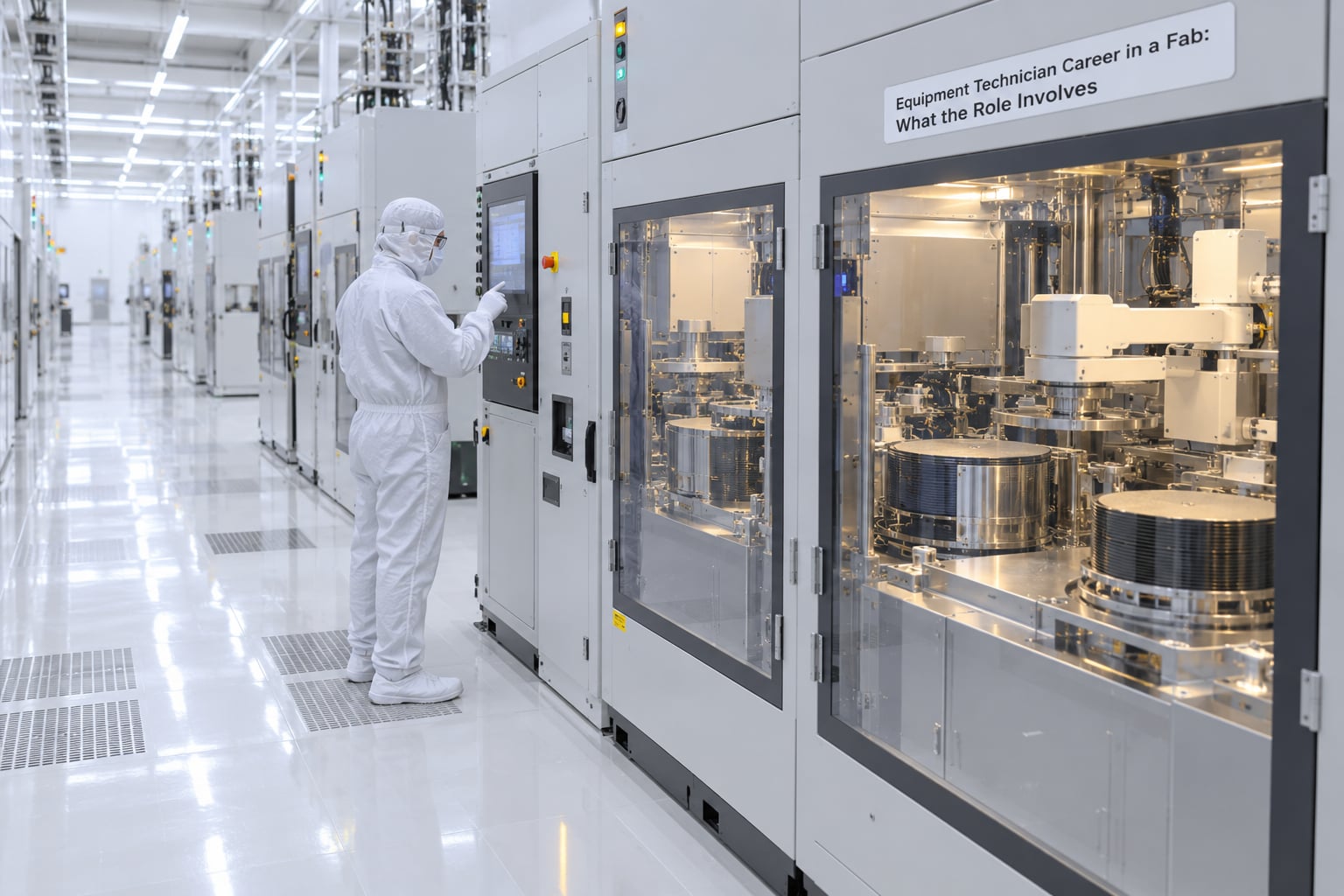
A semiconductor equipment technician owns a set of tools. Ownership means you are the named person the shift calls when a tool alarms, the person who signs the maintenance record, and the person held to the standard for why that tool ran or did not run. In most fabs that responsibility extends to PM, BM, wafer recovery, spare parts, interlocks, fault detection signals, safety walks, and tool performance against the site’s uptime targets.
If you have searched the phrase equipment technician online, most results are about bulldozers and state civil service classifications. Ignore them. A fab equipment technician works inside a cleanroom on multi-million-dollar electromechanical systems whose tolerances are measured in nanometres.
Key takeaways
- Fab technicians fall into four tracks: equipment, process/wafer, metrology, and AMHS or facilities. Equipment technicians own the machines.
- A high school diploma is the true minimum at many fabs; an associate degree speeds up the climb but is not a gate.
- Planned maintenance and breakdown maintenance are different jobs with different standards, and both are documented in the fab’s equipment management system.
- Fabs run around the clock, so nights, weekends and rotating differentials are normal, not exceptional.
- The track ceiling is real. Senior technicians and equipment engineers come from this pipeline, but the climb takes years, not months.
Who the equipment technician is not: four technician tracks side by side
The phrase fab technician covers at least four distinct specialisations, and job postings use them loosely. This table is the fastest way to tell them apart.
| Role | Entry credential | Core task | First standard | Next rung |
|---|---|---|---|---|
| Equipment technician | High school diploma, associate preferred | Keeps tools available: PM, breakdown response, calibration, parts | Tool qualification on a first system | Senior technician, then equipment engineer |
| Process or wafer technician | Associate degree common | Loads and moves lots through the line, runs recipes, monitors SPC signals | Line and recipe qualification | Process engineer, process integration |
| Metrology or inspection technician | Associate degree common | Measures wafers and films, flags excursions for review | Measurement tool and gauge qualification | Metrology engineer, yield engineer |
| AMHS or facilities technician | High school diploma to associate | Maintains the automated material handling system, cleanroom utilities and the building | AMHS route and utility system certification | Facilities or material flow supervisor |
Equipment and process technicians sit next to each other on the floor and get confused constantly. The process technician is worried about the wafer. The equipment technician is worried about the machine the wafer is sitting in.
Where Equipment Technicians Work in a Semiconductor Fab
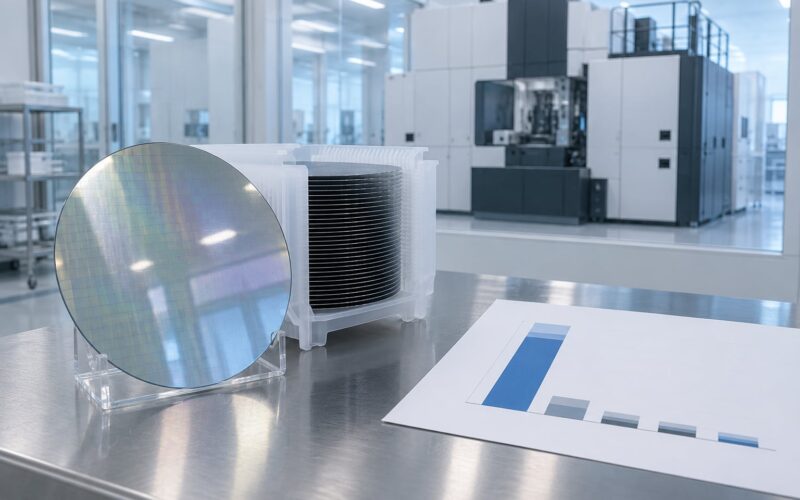
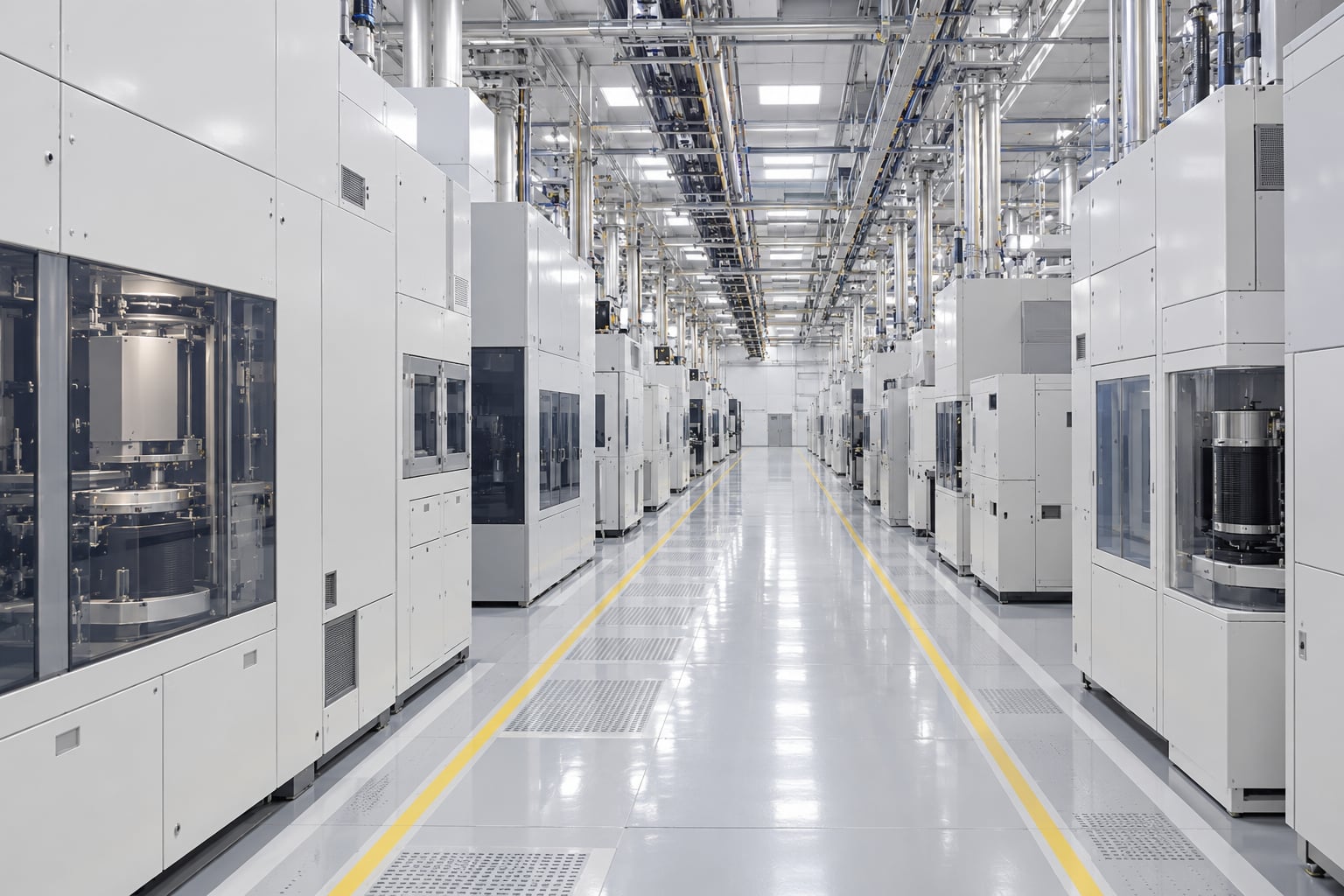
Front-end wafer fabs are where most equipment technicians work. The bay holds the deposition, etch, clean, thermal and lithography tools that build structures into silicon wafers, usually in a Class 1 style environment with ISO 5 mini-environment over the most sensitive process steps and ISO 7 in the surrounding bays under ISO 14644-1. Chemical delivery lines, vacuum subsystems and utility systems run alongside them, and technicians often split their time between the tool and the support equipment feeding it.
Advanced packaging and test operations look different but need the same skills at a different scale. Packaging fabs use pick-and-place, bonding, molding and inspection equipment, often with a shorter process flow and a large pilot-line or start-up flavour where a small team wears many hats. Back-end test areas have probers, handlers and thermal systems running long, repetitive uptime demands, which suits technicians who like steady routine work over constant alarms.
Utility and facilities operations are the third home. Compressed air, vacuum, chilled water, ultra-pure water, scrubbers and the cleanroom air handlers are the systems that make the bay possible, and the technicians who maintain them are often the highest-paid non-production roles on site because their failures stop everything.
Assignment varies by fab and by manufacturer. Some sites divide technicians into small tool sets within one department. Others rotate across process areas on a schedule, which broadens your experience faster but makes each individual tool less familiar.
What an Equipment Technician Does During a Shift
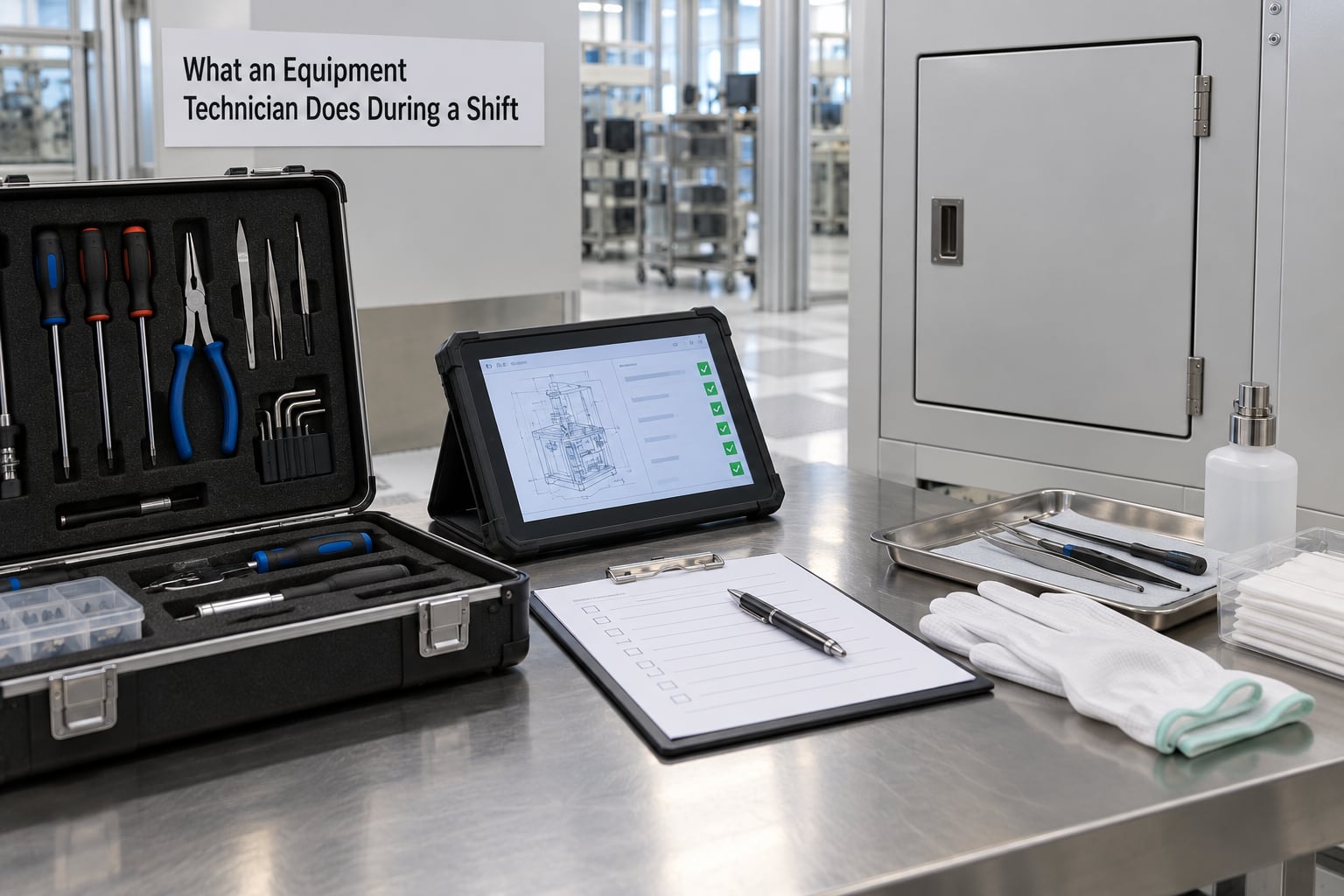
Here is a representative shift. The exact order changes by site, but the shape is consistent across fabs.
- Badge in and take the pass-down. You arrive in the gowns room, suit up, and meet the outgoing technician for a verbal and written handoff of every tool on your set.
- Review open work orders. Unfinished PMs, deferred repairs, parts on order and tool restrictions are on the equipment management system before you touch a tool.
- Run the health check on each tool. Confirm critical parameters, leak rates, sensor values and consumable status match the expected baseline.
- Execute planned maintenance in the PM window. The window is scheduled so the tool is down on purpose, during a period production can absorb.
- Respond to breakdowns. A tool-down page routes to you. Time to root cause matters more than speed alone.
- Return the tool to production. After corrective action, run a qualification check so the process owner knows the tool is back inside control limits.
- Recover wafers when a tool stops mid-run. Wet processes can hold wafers in chemical baths; the recovery procedure is written, and improvising it is how wafers get scrapped.
- Order and stage spare parts. You manage the parts inventory for your set and know which modules to keep on the shelf.
- Document everything. Every action goes into the system: part used, readings taken, steps performed. Undocumented work did not happen as far as the fab is concerned.
- Pass down and ungown. You brief the next technician on tool condition, open tickets and anything you changed.
Gowning up and the cleanroom
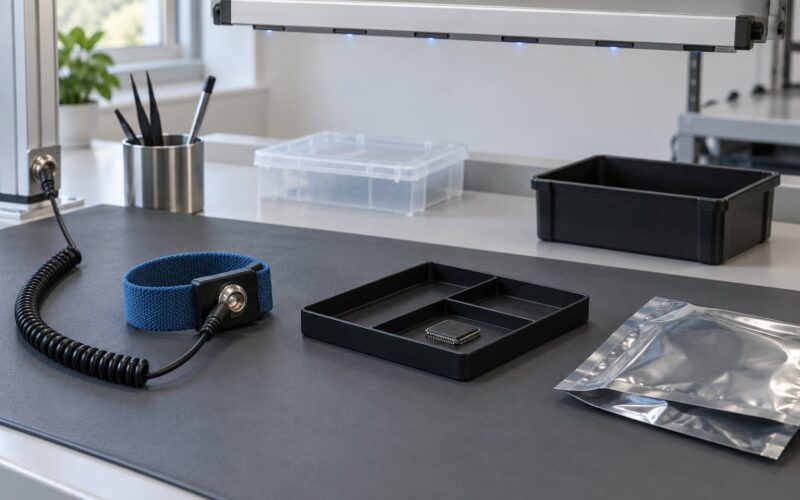
A cleanroom is a space engineered to hold airborne particle counts far below office levels, because a speck of dust on a wafer becomes a dead device. Gowning happens in a defined order, roughly top-down: gloves, bouffant cap, hood, safety glasses, gown, then boot covers, with the cleanest surfaces touching your skin. Contamination control also covers electrostatic discharge, which is why grounding straps and wrist straps are worn whenever you handle electronics, and why your certification includes the ANSI/ESD S20.20 standard.
Pass-downs, alarms, PM windows and documentation
Because production never pauses, tools are handed between shifts rather than switched off. The pass-down is the formal transfer of ownership, and a sloppy pass-down is a real event. Alarm response is the part of the job that separates technicians from button-pressers: reading the alarm, pulling the fault history, checking a sensor or a valve, and deciding whether the fix is a reset, a part swap, or a call to the equipment engineer.
ERT, hazards and ungowning
Most fabs run an Emergency Response Team made up of technicians alongside site emergency services, with drills on chemical releases, fires and medical events. Hazard training is not optional decoration. The job involves chemical exposure, high voltage, stored energy, and heavy components, and many sites expect technicians to work at heights with ladders and to lift loads around 20 pounds as part of routine parts handling. Ungowning is faster than gowning, and nobody appreciates being the person who cuts that corner.
Common Equipment You May Maintain
Technicians rarely maintain one machine forever. Over a career you will usually touch several tool families, and the skills transfer even when the brand does not.
| Tool family | What it does | Subsystem skills it demands |
|---|---|---|
| Lithography | Prints circuit patterns onto resist-coated wafers | Precision motion stages, optical alignment, vibration and vibration isolation, ultra-clean gas handling |
| Deposition | Layers films onto wafers, including thin and thick films | Vacuum systems, RF and plasma generators, chamber matching, gas delivery |
| Etch | Removes material to carve features into the wafer | Plasma and RF matching, vacuum, corrosive chemistry, endpoint detection |
| Cleaning | Removes residue and particles between steps | Chemical handling, temperature control, megasonic and spin hardware, chemical supply |
| Thermal processing | Furnaces, LPCVD, diffusion and rapid thermal anneal | High-temperature control, quartz and tube systems, gas safety, thermal profiles |
| Chemical mechanical planarization | Flattens the wafer surface before the next layer | Press and slurry systems, head and pad wear control, endpoint measurement |
| Metrology | Measures film thickness, features and defects | Calibration, optics, stage accuracy, measurement uncertainty and gauge repeatability |
| Support systems | Chemical delivery, vacuum, air and water utilities, AMHS | Plumbing, controls networks, interlocks, material handling routes, environmental monitoring |
The Skills Employers Look For
Fab hiring managers screen for four clusters, and none of them is raw talent in electronics alone.
Technical fundamentals
Vacuum, pneumatics, hydraulics, motors and drives, reading schematics, using a multimeter, basic PLC and controls literacy, and reading a controlled work instruction correctly the first time. A technician who improvises outside the written procedure causes more downtime than the fault they were chasing.
Analytical habits
Statistical process control, fault detection and classification, and the ability to read a trend rather than a snapshot. Knowing the difference between a process excursion caused by the tool and one caused by the recipe is the core skill, and it is learned through repetition on one tool set, not through a course.
Documentation discipline
Every reading, part and step gets recorded in the equipment management system, because the manufacturing execution system and the quality record depend on it. Strong technicians write more than weak ones, even when the fix took two minutes.
Communication and shift management
Handing over clearly, escalating to the equipment engineer at the right moment, briefing production on when the tool will return, and mentoring a newer technician without taking the work away from them. Most fabs also want someone who can prioritise four alarms at once without dropping any of them.
Education, Training, and Certifications
The minimum is usually a high school diploma or equivalent. Many postings ask for an associate degree in electronics, electromechanical technology, industrial maintenance, robotics or a related field, and that preference is about the ramp time rather than a legal bar. Several community colleges now run quick-start semiconductor programs and employer academies, often funded through CHIPS Act investments, where manufacturers co-design the curriculum and interview at the end.
Military electronics experience transfers unusually well. Tank and vehicle mechanics, shipboard radio technicians, and avionics maintainers arrive with discipline around controlled procedures, fault isolation and shift habits that most civilian applicants have to learn on the job. Veterans frequently tell recruiters this is the main reason they were hired.
Certification is employer- and tool-specific. Expect an open-book or proctored test on a first tool system, a supervised shadowing period, and a sign-off from a senior technician or engineer before you work the set alone. Industry credentials such as maintenance or electronics certifications help, but the tool qualification is the one that actually opens tools.
One thread in the r/Semiconductors bootcamp discussion described the first months plainly as walking around, writing down what you see, and watching senior technicians work. Treat that as the honest baseline. Employer programs move faster, but nobody hands you a tool set in week one.
How Preventive Maintenance Keeps Production Moving
Planned maintenance is scheduled, performed in a window, and followed by a qualification check. Breakdown maintenance is unscheduled, reactive, and measured by how fast the tool returns to production and whether the same failure happens again. Technicians are judged on both, and the ratio between them is one of the clearest signals of tool ownership maturity.
Condition monitoring pushes the split further toward the planned side. Vibration, temperature and current signatures on critical assemblies are watched against baselines, so degrading parts get replaced during a window instead of at three in the morning. Calibrations follow their own schedule because a drifting sensor will quietly push process output out of specification, which costs yield rather than uptime.
Mean time between failures is the number most fabs track closely, and spare parts inventory is the lever technicians control. Knowing which modules sit on the shelf, which ones take eight weeks to arrive, and which supplier to call for an emergency swap is a real skill with a direct effect on the number.
Production coordination ties it together. An idle tool is lost capacity, so a good technician tells the production team early that a tool will be down for six hours rather than letting them plan around an assumption. A qualified return beats a fast one.
Safety, Cleanrooms, and Shift Work
Safety in a fab is layered: lockout/tagout for every energy source, ESD control for electronics, chemical handling procedures for wet tools, confined-space and hot-work permits, and ergonomic practices for a job that means a lot of standing, kneeling, twisting and ladder work. Emergency response training, respirator fit and SCBA use sit alongside it. Report near-misses rather than only injuries, because most sites track near-misses as the leading indicator.
Then there is the schedule. Fabs run 24/7, so coverage comes in patterns: permanent day or permanent night assignments on some lines, rotating crews on others, and compressed schedules such as four 12-hour shifts followed by three days off. Rotating crews pay a differential for the inconvenience; permanent night assignments pay more than day shifts. A typical compression is around ten percent for the swing shift and twenty-five percent or more for nights, which is a common pattern rather than a universal rule.
What that means in practice is a job that touches your weekends, your sleep and your family planning. It also means more days off in a row, which some people value more than a Monday-to-Friday rhythm. Know which arrangement a specific site runs before you accept, because rotation is a deal breaker for a lot of people and postings are often vague about it.
Equipment Technician Pay and Working Conditions
Below is a US-oriented view of what moves a number, not a market average. Compensation changes constantly and varies by site, so treat any figure you see in a posting as dated. Entry hourly rates for technician roles are frequently quoted in the low twenties per hour, and sign-on bonuses, differentials and overtime can add meaningfully over a year.
| Factor | What it does to the number |
|---|---|
| Base hourly rate | Set by site and region; new fabs in growth markets often pay above established fabs chasing the same workers |
| Level | Each rung of the ladder adds scope, on-call load and technical responsibility, not just a title |
| Shift differential | A percentage of base tied to the shift or rotation; nights and swing shifts pay more than days |
| Sign-on bonus | Often paid in stages after 30, 60 and 90 days, so leaving early forfeits most of it |
| Overtime and on-call | Call-outs during breakdowns and coverage gaps on compressed schedules can move the annual figure a lot |
| Tool set and department | Start-up and pilot-line support is often higher risk and higher reward than steady production support |
| Advanced degree | Pushes you toward the engineer track rather than raising the technician base |
Working conditions come with the pay. Expect ungowning and regowning several times per shift, heat inside a bunny suit, hours on your feet, and time in a controlled environment where glasses or contact lens rules are stricter than anywhere else you have worked. One poster in an r/FieldService thread described roughly five years in and compensation well above the entry figures employers advertise, which is the useful part of the story: the top of the equipment track is far above the starting number, and the gap is mostly time, scope and on-call.
How Equipment Technicians Advance
Fabs that publish their ladders usually look like this, with cumulative responsibility at each level.
| Level | Typical experience band | What changes |
|---|---|---|
| Level I | Entry to about 3 years | Runs tools per instruction, performs scheduled PM, records and interprets tool data |
| Level II | 3 to 10 years | Troubleshoots independently, owns a tool set, executes process changes with guidance, coaches new technicians |
| Senior technician | 10 to 15 years and beyond | Leads a bay, owns a process area’s tool performance, drives downtime and cost reduction projects |
| Master technician | 20 years and beyond | Sets technical direction across tools, mentors and writes procedures, leads start-up or technology transfer work |
From there, the most common move is equipment engineer, where a technician’s real advantage is that they already know the tool. Process integration, yield and manufacturing supervision are other directions, as is leaving the fab for an equipment supplier or an OEM field service role, where the hours are more predictable and the travel is worse.
The honest version of the status question: technicians and equipment engineers are different jobs with different accountability, and a technician can be on call at three in the morning for a tool they own outright. The r/Semiconductors thread on whether equipment engineers are glorified technicians never resolves neatly, which tells you something real about how differently individual sites run the boundary. The useful question for a candidate is not the title but whether the site will show you the certification path and the promotion criteria before you sign.
How to Decide Whether This Career Fits You
Talk to people who already do it. Job postings describe the duties; they rarely describe the floor. A technician at a local fab will tell you more in ten minutes than a careers page will in an hour, and most sites will arrange a plant tour if you ask through the recruiting team.
Ask the questions you would want answered before accepting: how many tools in the set, how long the shadowing period lasts, who signs the qualification, what the rotation actually is and which days are off, whether the differential is a percentage or a flat amount, and how the bonus is paid out. Recruiters who answer those plainly are worth more than a site with a better brand name and vague answers.
Read the thread-level deal breakers. People leave these roles over permanent unpredictable nights, over being assigned one machine with no cross-training, over no sign-on bonus and no stated differential, and above all over joining a site that will not define how you get certified or promoted. Those are solvable at the interview stage, so ask early.
And be honest about the physical and emotional load. Standing, ladders, heat inside the suit, and a bad call at three in the morning are part of the trade. So is the quiet satisfaction of being the person who knows one machine better than anyone else in the building.
Frequently Asked Questions
Do I need an engineering degree to become a semiconductor equipment technician?
No. A high school diploma or equivalent is the minimum at many fabs, and an associate degree in electronics, electromechanical technology or industrial maintenance is usually preferred rather than required. Some manufacturers run their own academy or quick-start programs. A four-year degree does not block you, but it usually shifts you toward the engineer track instead of raising the technician base rate.
What does an equipment technician do in a semiconductor fab?
They own a set of tools and keep them available for production. That means scheduled preventive maintenance, breakdown troubleshooting to root cause, calibration, spare parts management, wafer recovery after a tool stop, and returning the tool to a qualified state after every intervention. All of it is documented in the fab’s equipment management system, and shifts hand tools over with a formal pass-down because production runs continuously.
Is semiconductor fab work physically demanding?
Yes, in ways most office jobs are not. Expect hours standing, kneeling and twisting, ladder work, heat inside a clean suit, repeated regowning, and routine lifting of loads around 20 pounds. Chemical exposure, high voltage and stored energy add hazard. Postings usually describe these conditions plainly, so read the working conditions section rather than discovering them on your first shift.
Do equipment technicians work nights or rotating shifts?
Most do, because fabs run 24/7. Patterns vary: some sites assign permanent day or night shifts, others rotate crews on compressed schedules such as four 12-hour shifts followed by three days off. Swing and night shifts usually carry a differential, often around ten percent for swing and twenty-five percent or more for nights. Ask which pattern a specific site runs before accepting.
Can an equipment technician move into an engineering role?
Yes, and it is one of the most common paths. Equipment engineers frequently come up through the technician ranks because they already understand the tool, its failure modes and its history. The move usually takes years rather than months, and some sites help with tuition. The other directions are process integration, yield, bay supervision, or leaving for an equipment supplier or OEM field service role.
Conclusion: Start with the Equipment and the Production Process
Pick a process area first, learn the tool families and the safety vocabulary that go with it, then pursue training that connects hands-on work to documented process outcomes. Equipment technician skills are portable across manufacturers and across industries, and the difference between a technician who plateaus and one who becomes an equipment engineer is mostly how deliberately they close the gap between fixing a machine and understanding what the machine does to the wafer.