If you have no specific FPGA, ASIC, or aerospace destination in mind, learn Verilog first. It gets you from blank file to blinking output faster than VHDL, and the examples, courses, and interview questions you will find online are overwhelmingly written in it. Pick VHDL instead if you are targeting DO-254 work, defense, or a team that already speaks it.
That is the short version of the verilog vs vhdl which to learn first question, and it deserves more than the paragraph of forum argument you will get if you search it. The forum is genuinely split: exmadscientist on Hacker News posted “absolutely, definitely, 100% learn VHDL” back in 2022, while plenty of working FPGA engineers on comp.arch.fpga tell beginners to start with Verilog because it is less off-putting. Both camps are right about their own readers.
So this is a comparison written for the person who has not picked yet.
Table of Contents
- Verilog vs VHDL Which to Learn First at a Glance
- How Verilog and VHDL Handle Syntax and Design Structure
- Which HDL Is Easier for Beginners to Learn?
- Verilog vs VHDL which to learn first: the beginner verdict
- Is VHDL harder because it is verbose?
- The C-like syntax trap in Verilog
- Verilog or VHDL for Simulation and Open-Source Tools?
- Which Language Is Better for FPGA and ASIC Design?
- Verilog vs VHDL for Jobs, Teams, and Long-Term Career Value
- Which Should You Choose?
- Frequently Asked Questions
- Is VHDL harder than Verilog for beginners?
- Which language should I learn first for FPGA development?
- Do I need C or C++ programming skills before learning an HDL?
- Should beginners learn SystemVerilog instead of Verilog or VHDL?
- How long does it take to learn Verilog or VHDL?
- Conclusion: Start with the HDL That Matches Your Goal
Verilog vs VHDL Which to Learn First at a Glance
Verilog wins on time-to-first-working-design and on the volume of free material. VHDL wins on type safety, on large multi-engineer codebases, and on regulated industries where the language choice is written into the certification standard. Neither one is a dead end, and SystemVerilog is the third option that quietly dominates the job market.
| Criterion | Verilog | VHDL |
|---|---|---|
| Syntax style | C-like braces, semicolons, weak typing | Ada-like, strongly typed, keyword-terminated |
| Declarations | Often omitted and inferred | Required and explicit, ports declare direction and type |
| Design unit | module | entity plus architecture |
| Signal type | reg, wire, logic | std_logic, std_logic_vector |
| Instantiation | Positional ports by default, named optional | Named port association required |
| Learning curve | Gentle start, subtle semantics later | Steep first month, better habits after |
| Compile-time checks | Weak, most width errors surface at simulation | Strong, most width errors stop at analysis |
| Free open-source tools | Icarus Verilog, Verilator, Yosys | GHDL, plus the same synthesis tools |
| Vendor free editions | Vivado ML Standard, Quartus Prime Lite | Both vendors read VHDL in those same editions |
| Strongest domains | ASIC, SoC, SerDes, verification, AI accelerator RTL | Large FPGA systems, aerospace, defense, rail, DO-254 |
| Best first choice for | Most students, career switchers from software, self-learners | FPGA specialists, formal and safety-critical work |
One clarification before the rest. SystemVerilog is not Verilog, even though it shares the name and about ninety percent of its syntax. It is a separate language standardized as IEEE 1800, and it added classes, constrained-random stimulus, assertions, and interfaces that core Verilog never had. When people say Verilog is dying and mean SystemVerilog replaced it, they are usually talking about verification jobs, not about RTL design. For RTL, Verilog and SystemVerilog are close to interchangeable, and tools will happily compile a design written in one as the other.
The practical consequence for a beginner: you are not choosing between two dead languages. You are choosing the easiest on-ramp to RTL design, and the easiest on-ramp to RTL design in 2026 is Verilog.
How Verilog and VHDL Handle Syntax and Design Structure
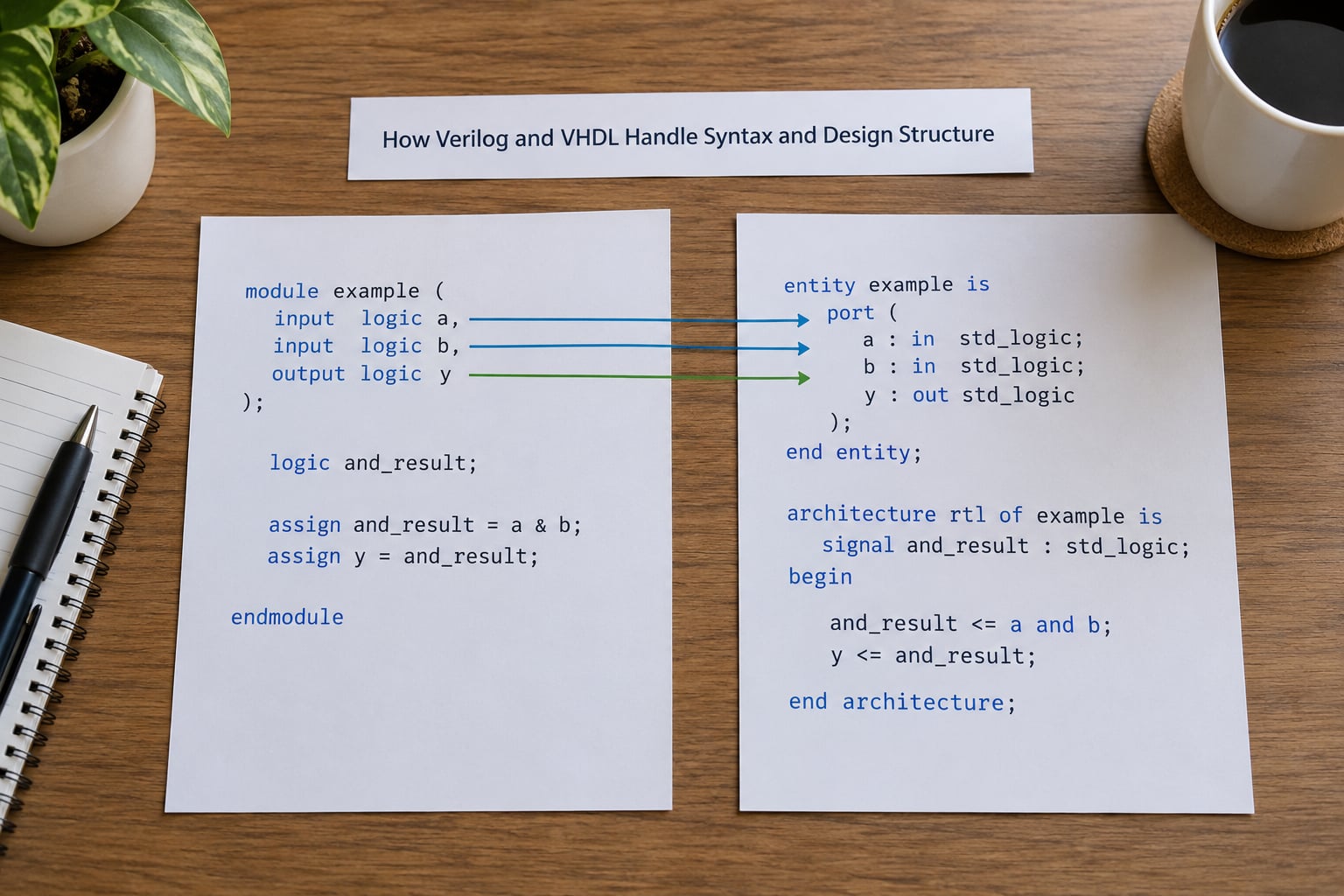
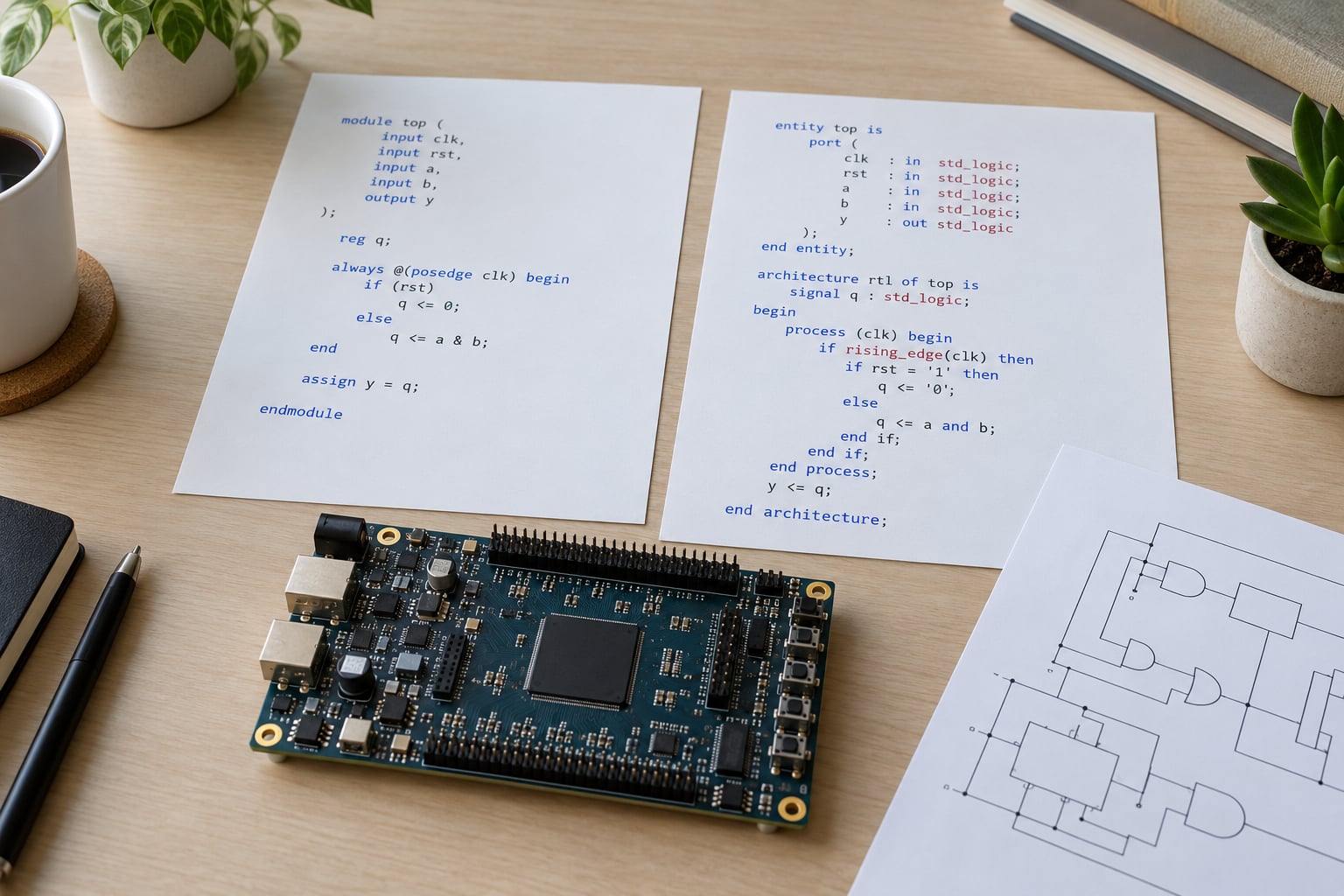
Both languages describe the same hardware. Here is a four-bit counter with a clock, reset, and enable, written twice, so you can see exactly where the philosophies split.
// Verilog
module counter (
    input  wire       clk,
    input  wire       rst_n,
    input  wire       en,
    output reg  [3:0] count
);
    always @(posedge clk or negedge rst_n) begin
        if (!rst_n)
            count <= 4'b0;
        else if (en)
            count <= count + 1'b1;
    end
endmodule
-- VHDL
library ieee;
use ieee.std_logic_1164.all;
entity counter is
port (
clk : in std_logic;
rst_n : in std_logic;
en : in std_logic;
count : out std_logic_vector(3 downto 0)
);
end entity counter;
architecture rtl of counter is
signal count_reg : std_logic_vector(3 downto 0) := (others => '0');
begin
process (clk, rst_n)
begin
if rising_edge(clk) then
if rst_n = '0' then
count_reg <= (others => '0');
elsif en = '1' then
count_reg <= count_reg + 1;
end if;
end if;
end process;
count <= count_reg;
end architecture rtl;The structural differences are consistent once you see them side by side.
Design units. Verilog has one, the module. VHDL splits every circuit in two: the entity, which is the interface, and the architecture, which is the implementation. That split is why VHDL projects have separate files for interface and body, and why a VHDL module can have four different architectures for the same ports.
Signals and nets. Verilog gives you a small set of wire-like types, and the useful distinction between a wire and a register is a declaration you often skip. VHDL requires you to declare every signal with an explicit direction on the port, so a mistake in which way a signal flows is a compile error rather than a mystery waveform.
Process and assignment. Verilog’s always block lists its sensitivity, and the code inside looks a lot like software you would write in C, which is exactly the trap. VHDL’s process has two forms: a clocked process that runs on rising_edge, and a combinational process that is sensitive to its inputs. The compiler holds you to which is which.
Types. This is the deepest difference. VHDL is strongly typed, so assigning a four-bit vector to a three-bit signal fails at analysis time. Verilog mostly lets you do it and then quietly truncates the top bit, or promotes widths in ways that surprise you the first time they appear on a waveform.
Instantiation. VHDL uses named association, so you write clk => clk_i and nothing can shift position out of alignment. Verilog defaults to positional, though named style is encouraged in modern code. Tim Wescott, writing on comp.arch.fpga, points out that this named port mapping is the thing C++ programmers end up envying in both languages, because renaming a port no longer means hunting through call sites.
Reuse. VHDL packages let you declare functions, types, and constants once and import them anywhere, which is how large VHDL projects avoid drowning in duplicated declarations. Verilog equivalents exist in SystemVerilog but core Verilog relies on include files and macros.
Which HDL Is Easier for Beginners to Learn?
Verilog vs VHDL which to learn first: the beginner verdict
Verilog, for most beginners. You can write a working module in an afternoon, and the compiler stops arguing with you at every line. If your goal is to learn digital design, the language should be a transparent layer over the hardware, and Verilog is closer to that for a first-time reader.
That is a statement about the first two months, not about the career. Plenty of senior engineers argue the opposite case, and they are not being contrarian. VHDL’s verbosity is a real cost at the start and a real asset later, because every explicit declaration is a mistake the toolchain catches before you simulate.
Is VHDL harder because it is verbose?
Partly. The complaint you will hear most is word count, and it is fair. A VHDL port declaration states name, direction, type, and default, where Verilog lets you write nothing. glen herrmannsfeldt put the counterargument on comp.arch.fpga in a useful way: C programmers thrive on terse code, and VHDL treats verbose explicit description as an asset rather than a defect.
Here is why that framing holds up. Hardware bugs are not typos, they are widths and directions that were never checked. VHDL pushes those decisions to the front where a compiler can see them. You pay in lines now, and you save in debugging sessions later, which is a trade that works out well on a project with a schedule and badly on a weekend project with neither.
The C-like syntax trap in Verilog
This is the part the Verilog camp underplays. Because Verilog looks like C, newcomers assume it behaves like C, and it does not. Blocking assignments inside a clocked always block describe flip-flops, not function calls. Loops in synthesizable code unroll into hardware rather than iterating. Reading a variable does nothing. Simulation races, non-blocking assignment discipline, and inferred latches all come from that gap between familiar syntax and unfamiliar semantics.
Senior engineers on comp.arch.fpga warn about this specifically: the superficial similarity to C confuses newcomers more than it helps them. So Verilog is easier to start and harder to learn properly, which is a fair summary of the whole trade.
Both languages have classic beginner mistakes worth knowing. In Verilog they are missing non-blocking assignments in clocked logic, forgetting to declare a signal that should be reg, and writing a combinational always block that infers a latch because the output is not assigned on every path. In VHDL they are forgetting the final count <= count_reg; output assignment, using std_logic where a numeric operation is needed, and sensitivity list mistakes in combinational processes.
Verilog or VHDL for Simulation and Open-Source Tools?
Simulation is where beginners spend most of their time, and both languages have real, free, open-source options that need no purchase and no license server.
For Verilog, Icarus Verilog is the long-standing easy install, and Verilator is the fast cycle simulator that later became the backbone of much open-source hardware tooling. Yosys synthesizes a large slice of Verilog and SystemVerilog into gate-level netlists, and it is the engine behind most of the hobby and open-source FPGA flows.
For VHDL, GHDL is the open-source analyzer, simulator and synthesizer, and it also serves as the VHDL frontend for Yosys. The practical result is that the same Yosys-based toolchain handles either language, which is why the open-source hardware world treats the two as near-equals.
Waveform debugging is a tie. GTKWave reads VCD output from both, and every simulator on the list can dump to it, so nothing about a beginner’s debug loop changes with the language choice.
Where the ecosystems genuinely differ is in mixed-language projects. If a design has Verilog RTL, a VHDL testbench, and a vendor IP core in one of them, you need a simulator that resolves all three. That is exactly the friction Rob Gaddi described on comp.arch.fpga when he argued that Verilog support is a given in Altera’s tools while VHDL support is marginal at best, leaving you needing a mixed-language simulator or stuck. Modern commercial simulators handle mixed designs routinely, and vendor tools have improved, so the gap is narrower than that thread suggests, but a beginner working solo has no reason to run into it. Pick one language and stay in it for the first few months.
Both FPGA vendors also give away usable free editions. Vivado ML Standard covers a generous device set, and Quartus Prime Lite does the same for Intel Altera parts. Both read Verilog and VHDL sources. You can do an entire beginner course without paying anyone anything.
Which Language Is Better for FPGA and ASIC Design?
For RTL-heavy ASIC and SoC work, Verilog is the default. Most interface IP, SerDes, memory controllers, and accelerator blocks in the commercial world are specified and written in Verilog or SystemVerilog, and the verification side assumes the same. When an AI accelerator or chiplet team hands you a block to modify, the surrounding code is overwhelmingly Verilog-family.
For large FPGA systems, the split is less about language quality and more about what the team’s IP and tooling already are. A company that bought a video processing platform years ago may have a VHDL-heavy IP library, and matching it is often cheaper than rewriting. VHDL also scales well in big block-based designs because strong typing and packages keep a multi-engineer codebase honest.
For safety-critical domains, VHDL has a specific and durable claim. DO-254, the FAA’s guidance for airborne hardware, does not mandate VHDL, but VHDL is the language that certification evidence is most commonly built around, because its explicitness produces a design that can be reviewed and traced more readily. The same pattern holds in defense, rail, and nuclear work. That market is small, well paid, and stable, which is why VHDL survives in 2026 despite the loud predictions of its death.
Mixed-language teams are ordinary, not a problem to fear. Most working FPGA and ASIC groups use both, often because the vendor supplies IP in one of them. Pick a primary language for your own code and get comfortable reading the other early, because that reading skill is the one that will save you when you join a team.
Verilog vs VHDL for Jobs, Teams, and Long-Term Career Value
Neither language has a permanent advantage in hiring, and anyone who tells you otherwise is selling a course. What actually shows up in job descriptions has more to do with the domain than the syntax.
Verification roles lean heavily on SystemVerilog and UVM, with Verilog as the underlying design language. If your real target is verification, learn Verilog as a foundation and then move up to SystemVerilog, which is a smaller jump than learning it cold. An ECE student on r/ECE put it plainly: for an internship, Verilog alone is fine, and upgrading from Verilog to SystemVerilog is much easier than starting with SystemVerilog from scratch.
Digital design and RTL roles at ASIC companies list Verilog or SystemVerilog, occasionally VHDL. FPGA roles list whichever language the team’s flow uses, and small teams often pick based on the board vendor’s example code. The same split shows up in interview screens, where Verilog questions are simply more common.
One adoption figure keeps circulating on Reddit and is worth repeating with the caveat that it came from a forum answer rather than a standards body: design-under-test usage is roughly VHDL 65 percent to Verilog 58 percent, which is to say nearly even, while testbenches skew overwhelmingly toward SystemVerilog. Nearly even design usage is the honest summary. Neither language is winning.
For aerospace, defense, and rail, VHDL knowledge is a genuine differentiator, because fewer engineers have it and the domains that use it are regulated. For general FPGA and ASIC roles, Verilog knowledge is more broadly useful.
Across every case, the same three things decide how employable you are: understanding of synchronous design and timing, the ability to write a testbench and read a waveform, and enough RTL literacy to review someone else’s code. The syntax is the part you learn in the first month.
Which Should You Choose?
Choose Verilog first if you are a student without a target domain, a career switcher from software, working through web-based courses, or someone who wants a working design this month. Choose VHDL first if you are committing to FPGA specialization, moving into formal verification or safety-critical work, or joining a team where VHDL is already the house style.
Either way, the first four weeks look roughly like this.
Week 1. Install a free toolchain, Icarus Verilog with GHDL alongside it, or Vivado ML Standard. Write a blinking LED or a toggling bit and simulate it. Do not skip simulation; the waveform is the whole point.
Week 2. Build a counter, then a small state machine. Add a testbench that drives reset, clock, and a few stimulus vectors, and learn to read the resulting waveform. This is the single highest-value week in the plan.
Week 3. Learn the synthesizable subset properly. Non-blocking assignments in clocked logic, blocking assignments in combinational logic, reset handling, and the difference between simulation semantics and hardware. For VHDL, also learn records and generate statements, which is where its real power lives.
Week 4. Push your design onto real hardware. An FPGA board turns simulation understanding into hardware understanding faster than anything else. Then write a short README explaining the interfaces, because that habit is what reviewers notice.
Add the second language once you can build and debug something non-trivial in the first. If you started with Verilog, VHDL will feel slow and obvious for a couple of weeks, then repay you with the type checking. If you started with VHDL, Verilog will feel loose and permissive, and the discipline VHDL taught you is the thing you will miss. rickman described this on comp.arch.fpga as VHDL playing Ada to Verilog’s C, and the transfer really is easier in one direction than the other.
Then decide about SystemVerilog. If verification is the destination, that is your next language, not the other one. If RTL design is the destination, SystemVerilog’s assertions and interfaces are worth picking up later, and they are a small step from Verilog.
Frequently Asked Questions
Is VHDL harder than Verilog for beginners?
It is harder to start and easier to keep correct. VHDL requires explicit declarations, entity and architecture units, and named port mapping, so the first month feels slower than Verilog. In exchange, the compiler catches width and direction errors before you simulate. Beginners coming from C usually get Verilog running faster; beginners who stick with VHDL tend to write more disciplined code once they are past the syntax.
Which language should I learn first for FPGA development?
Verilog for most people, because the volume of tutorials, board example code, and free toolchain material is far larger, and the path to a working bitstream is shorter. Pick VHDL first if the FPGA role you want sits in aerospace, defense, or rail, where DO-254-oriented work and existing IP libraries favour it, or if the team you are joining already writes VHDL.
Do I need C or C++ programming skills before learning an HDL?
No, but it helps with the parts that are ordinary programming. Variables, loops, functions, and file handling are familiar in Verilog and in the process bodies of VHDL. The skills that do not transfer are the important ones: hardware is concurrent, there is no memory model to rely on, and a for loop unrolls into hardware instead of iterating. Expect a short adjustment period on those semantics.
Should beginners learn SystemVerilog instead of Verilog or VHDL?
For RTL design, start with Verilog and add SystemVerilog once you are comfortable, since it is largely a superset and the step is small. For verification work, SystemVerilog is the main language and UVM is the framework, so a Verilog foundation first still makes sense rather than starting cold. A few student and career forums make the same point, that upgrading from Verilog is far easier than beginning with SystemVerilog.
How long does it take to learn Verilog or VHDL?
To write and debug a small synchronous design you understand, most people need four to six weeks of regular practice in Verilog and closer to eight in VHDL. Being job-ready in RTL design takes much longer, since the real work is timing, testbenches, and reading other people’s code. Set your own pace by projects rather than hours, and use free simulators so nothing blocks you at the start.
Conclusion: Start with the HDL That Matches Your Goal
Start with Verilog unless you have a specific reason not to. Most beginners reach a working design faster that way, and no gate closes on you afterward. Choose VHDL instead when you are committing to FPGA work in aerospace, defense, or rail, or when the team you are joining already uses it, because the strong typing and the certification background will pay off there in a way it will not in a hobby project.
Either way, the next action is the same: code one small synchronous circuit, write a testbench for it, look at the waveform, then put it on a board. Learning an HDL is not reading about it, and the four weeks that take you from a blank file to working hardware are shorter than most people expect.