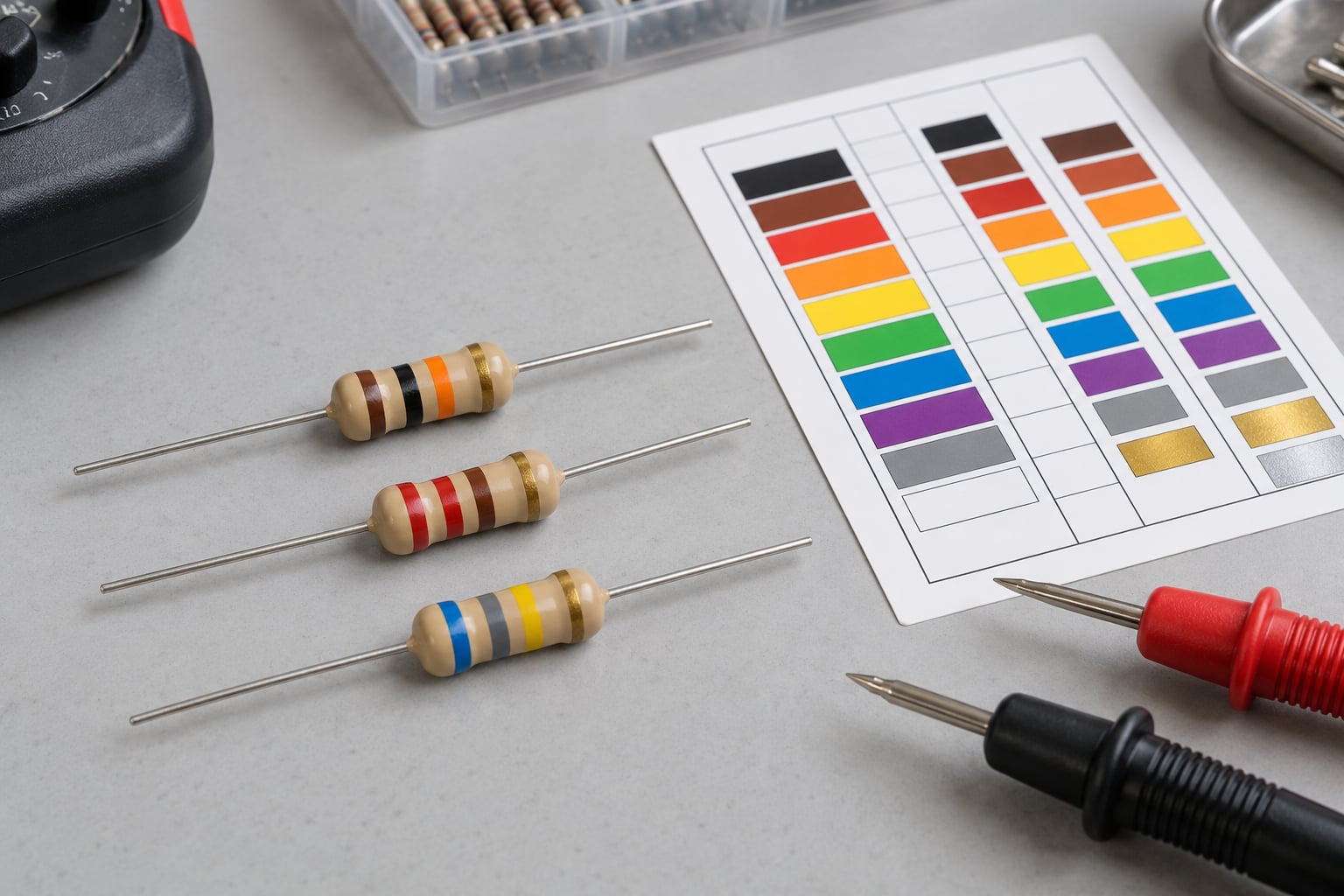
To read resistor color codes, turn the resistor so the bands group tightly at one end, then read left to right: the first two bands are digits, the third is a multiplier, and the last band is the tolerance. The wider gap and the gold or silver band at the far right tell you where to start.
A 4-band resistor with yellow, violet, red and gold bands is 47 multiplied by 100, which is 4,700 ohms, or 4.7 kOhm, with a plus or minus 5% tolerance. The whole system takes about ten minutes to learn once you have the chart in front of you.
Table of Contents
- What You Need
- Step-by-Step: How to Read Resistor Color Codes
- 1. Identify the Bands and Orientation
- 2. Read the First Two Digit Colors
- 3. Decode the Multiplier Color
- 4. Read the Tolerance Band
- 5. Verify the Reading
- Resistor Color Code and Multiplier Chart
- Worked examples
- Five- and Six-Band Resistors
- Common Mistakes
- Reading from the wrong end
- Treating gold as a multiplier when it is the tolerance
- Skipping a decade on the multiplier
- Ignoring the spacing
- Trusting a color that is not clean
- Expecting the bands to tell you the power rating
- Frequently Asked Questions
- How do I know which side of a resistor to start from?
- Why is there a larger gap between the tolerance band and the other bands?
- What happens if I cannot identify one of the resistor colors?
- How do I calculate the allowed resistance range from the tolerance band?
- Can resistor color bands be read from both ends?
- What is the difference between four-band and five-band resistors?
- Conclusion
What You Need
You need three things, and two of them are optional. The first is the resistor itself, a standard axial through-hole part with four colored bands printed on a beige or blue body.
The second is the color reference: a printed resistor color code chart, or the table further down this page. The third, optional but worth having, is a multimeter. Experienced hobbyists still cross-check their reading against a second source, because a misread band is easy to make and hard to notice.
Always check for a printed value on the body first. Modern metal film parts often carry the resistance, tolerance and temperature coefficient as numbers, which beats any color reading.
Step-by-Step: How to Read Resistor Color Codes
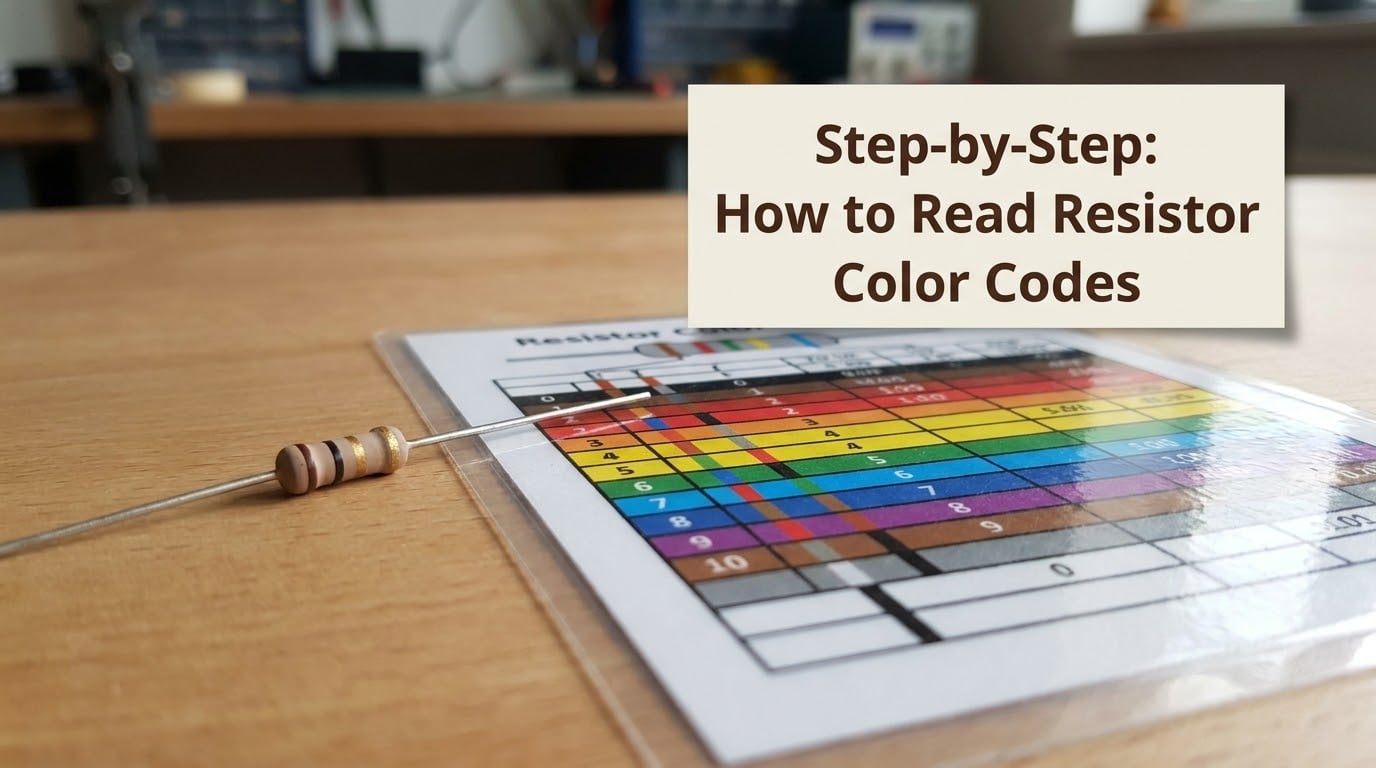
1. Identify the Bands and Orientation
Hold the resistor between your fingers and look for the gap. Bands are printed in a tight group on one end with a noticeably wider space before the last band, and that last band is the tolerance.
If you see gold or silver at one end, that end is the right-hand end. The system is defined by IEC 60062 and, for military parts, MIL-STD-138, so the orientation rule holds for every manufacturer.
Orientation trips up more beginners than anything else. If the bands look evenly spaced, look again under better light before you commit to a reading.
2. Read the First Two Digit Colors
Each color maps to one digit: black 0, brown 1, red 2, orange 3, yellow 4, green 5, blue 6, violet 7, grey 8, white 9.
Brown then black gives 1 and 0, so 10. Red then violet gives 2 and 7, so 27. Orange then white gives 3 and 9, so 39.
On a 4-band part, two digits is all you get, which is why those parts top out around plus or minus 5%. When you need three significant figures, you need a 5-band resistor.
3. Decode the Multiplier Color
The third band is a power of ten applied to those digits. Black is times 1, brown is times 10, red is times 100, orange is times 1,000, yellow is times 10,000.
Blue continues upward: times 100,000, then grey times 1,000,000 and white times 10,000,000. The two colors that break the pattern are gold, times 0.1, and silver, times 0.01, which is how resistors below 1 ohm are marked.
One warning about commonly repeated charts: red is times 100, and times 1,000 is orange. Some summaries list brown times 10 next to red times 1,000 as if they were neighbours, which drops a whole decade.
Do the arithmetic out loud. For yellow, violet, brown, gold: 47 times 100 equals 4,700 ohms, which is 4.7 kOhm. For brown, black, red, gold: 10 times 100 equals 1,000 ohms, exactly 1 kOhm.
4. Read the Tolerance Band
The last band tells you how far the real part may sit from the marked value. Gold is plus or minus 5%, silver is plus or minus 10%, and a resistor with no tolerance band at all is the old plus or minus 20% type.
Tighter parts use different colors: brown is plus or minus 1%, red is 2%, green is 0.5%, blue is 0.25%, violet is 0.1%.
To get the allowed range, multiply the marked value by the tolerance percentage. A 1 kOhm resistor with a gold band runs from 950 to 1,050 ohms. A 10 kOhm resistor with a gold band runs from 9.5 kOhm to 10.5 kOhm.
Do not confuse tolerance with the temperature coefficient, which is printed as a separate number on metal film bodies and is not part of the band code.
5. Verify the Reading
Set your multimeter to ohms, touch the probes to the two leads, and compare the number with what you decoded. A 4.7 kOhm resistor should settle near 4,700.
If the meter is all you have, trust it over the bands. Faded bands on old beige carbon film bodies, scorched paint from a failed board, or a phone camera’s autofocus can all turn a red band into a brown one in a photograph.
On a damaged board, a resistor pulled from a live PCB reads out of circuit, which is the only reliable answer. Several repair threads end that way, with the reader guessing a value from partial bands and a calculator before anyone touched a meter.
Resistor Color Code and Multiplier Chart
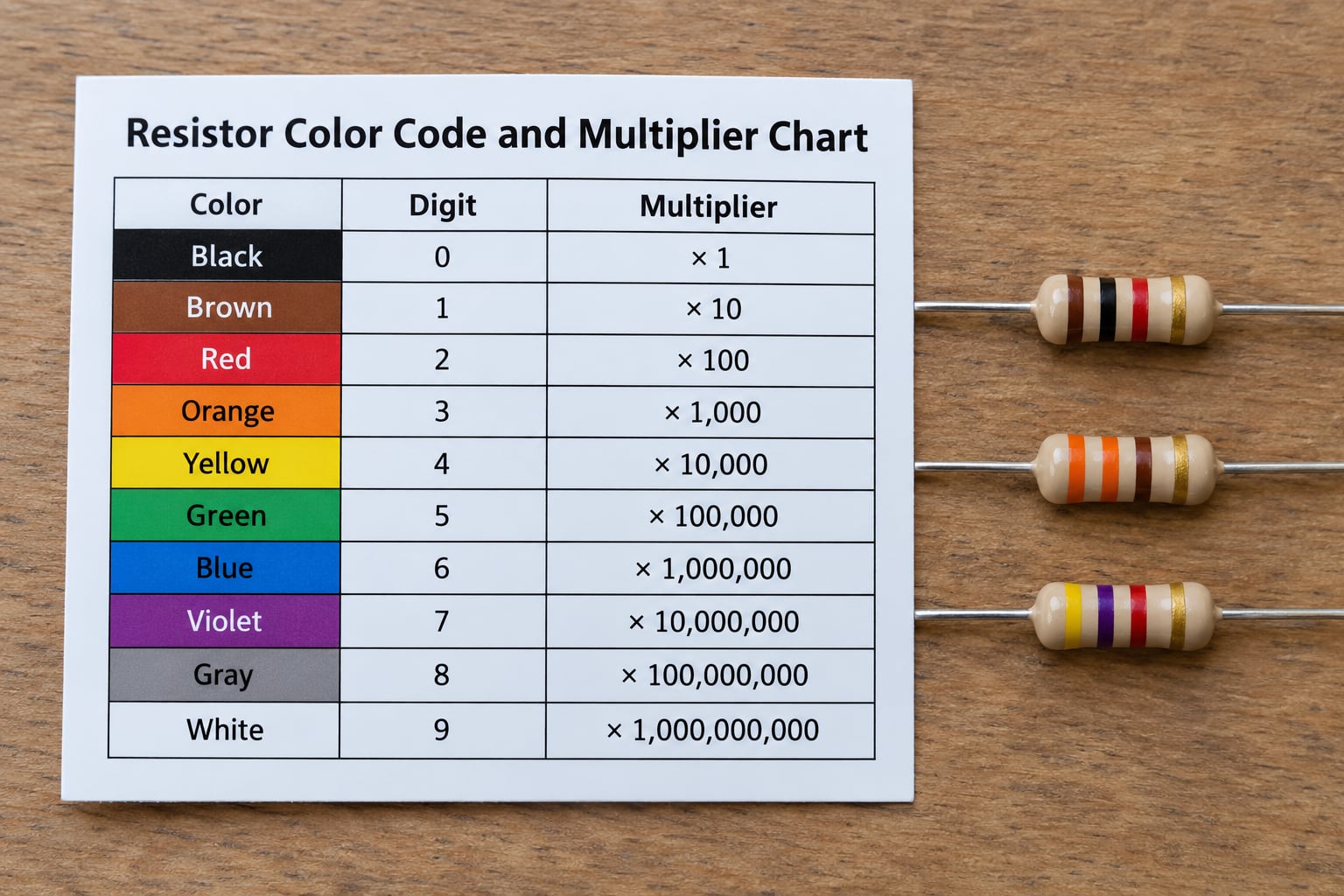
This is the full chart. Every color does three jobs depending on its position, which is why you have to work from the orientation, not from the color alone.
| Color | Digit | Multiplier | Tolerance |
|---|---|---|---|
| Black | 0 | 1 | – |
| Brown | 1 | 10 | 1% |
| Red | 2 | 100 | 2% |
| Orange | 3 | 1,000 | – |
| Yellow | 4 | 10,000 | – |
| Green | 5 | 100,000 | 0.5% |
| Blue | 6 | 1,000,000 | 0.25% |
| Violet | 7 | 10,000,000 | 0.1% |
| Grey | 8 | 100,000,000 | – |
| White | 9 | 1,000,000,000 | – |
| Gold | – | 0.1 | 5% |
| Silver | – | 0.01 | 10% |
Gold and silver never work as digit bands, which is why a resistor ending in silver is always read as a 10% part.
Worked examples
- Brown, black, red, gold: 10 times 100 = 1,000 ohms = 1 kOhm, plus or minus 5%.
- Red, red, brown, gold: 22 times 10 = 220 ohms, plus or minus 5%.
- Orange, white, brown, gold: 39 times 10 = 390 ohms, plus or minus 5%.
- Brown, green, red, gold: 15 times 100 = 1,500 ohms, plus or minus 5%.
- Yellow, violet, red, gold: 47 times 100 = 4,700 ohms = 4.7 kOhm, plus or minus 5%.
- Red, violet, brown, gold: 27 times 10 = 270 ohms, plus or minus 5%.
- Brown, grey, red, gold: 18 times 100 = 1,800 ohms, plus or minus 5%.
- Brown, black, black, brown: 10 times 1 = 10 ohms, plus or minus 1%.
- Green, blue, red, gold: 56 times 100 = 5,600 ohms, plus or minus 5%.
- Brown, blue, grey, gold: 16 times 1,000,000 = 16 megaohms, plus or minus 5%.
Five- and Six-Band Resistors
A 5-band resistor gives you three significant digits, then a multiplier and a tolerance. Three digits is what makes plus or minus 1% and plus or minus 0.1% parts possible, because a 4-band code cannot express values like 4.32 kOhm.
Read it the same way. Orange, grey, yellow, brown, brown is 3, 8, 4, times 10, plus or minus 1%, which is 3.24 kOhm within 1%. Read it from the wrong end and the order becomes 4, 2, 3, times 10, plus or minus 1%, or 4.23 kOhm. That reversal is the single most expensive mistake on the page, because both readings look plausible.
A 6-band resistor adds one more band at the end for the temperature coefficient, expressed in parts per million per degree Celsius. Grey is 0.25 parts per million per degree on a precision part, for instance.
Three-band resistors are old and rare: two digits plus a multiplier and no tolerance band at all, so plus or minus 20% by assumption. You will meet them in vintage equipment, and some parts marked with a printed code such as 220 use the same idea, where 220 means 22 ohms with no multiplier.
Common Mistakes
Reading from the wrong end
A reversed 4-band resistor reads tolerance as multiplier, so gold becomes times 0.1 and the value comes out ten times too small. Find the wider gap and start there instead.
Treating gold as a multiplier when it is the tolerance
Gold means plus or minus 5% unless it sits in the third band position. Silver works as a multiplier only in third position; everywhere else it is 10% tolerance.
Skipping a decade on the multiplier
Red is times 100. Orange is times 1,000. If your answer is off by exactly ten, this is why, and it is the most common arithmetic slip in the whole code.
Ignoring the spacing
Evenly spaced bands mean you have missed one, or the last band has peeled off. Resistors with only three bands exist, so count before you calculate.
Trusting a color that is not clean
Red under warm light reads brown, and gold can look like dull yellow on a beige body. A magnifier, bright neutral light and a printed value on the body solve most of it. A phone camera is worse than your eye here, because autofocus shifts the white balance.
Expecting the bands to tell you the power rating
They do not. Wattage comes from the package size and the datasheet, so a 1/4 watt carbon film part and a 2 watt wirewound part can carry the same band colors. Check the body diameter or the schematic.
Frequently Asked Questions
How do I know which side of a resistor to start from?
Look for the gap between bands. The bands are printed close together in a group on one side, then a wider space before the tolerance band. That tolerance band is always the rightmost one, so you read from the grouped end toward it. If you see gold or silver at one end, start at the other end. Silver also marks the rightmost band on a zero-ohm jumper.
Why is there a larger gap between the tolerance band and the other bands?
The gap exists so you can tell which end to read from without checking colors. It has to be wide enough to survive manufacturing tolerances and the rough handling these parts get in parts bins, which is why it is noticeably larger than the even spacing between the other bands. On a 4-band resistor you get two close bands for the digits, a third for the multiplier, then the gap, then tolerance.
What happens if I cannot identify one of the resistor colors?
Do not guess. A wrong multiplier gives you a value off by a power of ten, and the circuit may simply fail in a way that looks unrelated. Check for a printed value on the body, look at the same resistor under bright neutral light with a magnifier, and then confirm with a multimeter on ohms. If the part is still soldered down, desolder one leg before measuring.
How do I calculate the allowed resistance range from the tolerance band?
Multiply the marked value by the tolerance percentage, then add and subtract that number from the marked value. For 1 kOhm at plus or minus 5%, 5% of 1,000 is 50, so the range is 950 to 1,050 ohms. For 4.7 kOhm at plus or minus 1%, 1% is 47, giving 4,653 to 4,747 ohms.
Can resistor color bands be read from both ends?
Only if the resistor is symmetric, which no real one is. Every 4-band part has the tolerance band at the right end, so the left-to-right order matters. Reading the same resistor backwards gives you a different and wrong value, usually ten times off, because gold or silver gets used as the multiplier. When in doubt, use the band grouping gap to set your direction before reading.
What is the difference between four-band and five-band resistors?
A 4-band resistor gives two significant digits, a multiplier and a tolerance, so it is accurate to about plus or minus 5% and cannot express values like 4.32 kOhm. A 5-band resistor gives three significant digits plus a multiplier and tolerance, which is what lets you order plus or minus 1%, 0.5% and 0.1% parts. The decoding steps are identical, with one extra digit band at the front.
Conclusion
Start with the gap, not the colors. Find the group of close bands, confirm the tolerance band sits alone on the right, then read digit, digit, multiplier, tolerance from left to right and do the multiplication on paper.
Two habits keep you out of trouble: treat gold and silver as tolerance unless they sit in third position, and check a reading with a multimeter whenever the bands are faded, scorched or oddly spaced. Once you can decode two digits and a multiplier quickly, the rest of the chart fills in on its own.