Choosing a PCB manufacturer for prototypes comes down to matching a factory’s engineering review, certifications, inspection coverage, and honest lead time to your design, not to the lowest price per board. A prototype run is small, so the value sits almost entirely in what the vendor catches before copper is poured.
This guide is vendor-neutral. No manufacturer is named as a recommendation, because the right shop for a four-layer 0201 board with a fine-pitch BGA is not the right shop for a 12-layer impedance-controlled backplane, and neither is a good fit for a mixed analog and power board built for 300 units a month. Last reviewed and updated in 2026 by the engineering desk here at Charteredsemi.
The mistake most first-time buyers make is treating the RFQ as a shopping cart. They upload Gerbers, collect per-board numbers, and hand the job to whoever answers first with the lowest total. That approach skips the only phase where a cheap prototype still costs almost nothing to fix.
Here is the workflow we use, in the order we use it. It takes a few hours of your time and about a week of vendor response time, and it is the difference between a board that boots on the bench and a board that comes back with a shifted drill file.
Table of Contents
- What You Need
- Step-by-Step: How to Choose a PCB Manufacturer for Prototypes
- 1. Define the prototype requirements
- 2. Verify the manufacturer’s technical capabilities
- 3. Check prototype quantity and lead time
- 4. Compare quotes using the same specification
- 5. Assess quality controls and communication
- 6. Review the prototype ordering workflow
- 7. Test a sample or small first order
- 8. Make the final supplier decision
- Common Mistakes
- Frequently Asked Questions
- How many PCB prototypes should I order for a first build?
- What is a DFM review, and do I need one for a prototype?
- What is the 3W rule in PCB design, and should my manufacturer enforce it?
- How do I compare two PCB manufacturer quotes fairly?
- Is it safe to send Gerber files to an overseas manufacturer?
- How do I choose a PCB manufacturer for prototypes when comparing several options?
What You Need
Before you contact anyone, assemble a package that a factory can quote from without emailing you eight follow-up questions. Most quote delays are not pricing games; they are missing inputs.
- Design files — Gerber X2 or RS-274X layer data, an Excellon drill file, and optionally ODB++ or IPC-2581 if you have it.
- Fabrication specification — board outline dimensions, layer count, laminate type (FR-4, high-Tg FR-4, polyimide, Rogers), copper weight in ounces, surface finish, minimum trace and spacing, minimum annular ring, controlled impedance targets with your stackup, and any mechanical tolerances.
- Assembly package — a bill of materials with exact manufacturer part numbers, a centroid or pick-and-place file, a CPL or polarity file, and drawings or notes for anything the tool cannot infer.
- Quantity and schedule — how many prototypes, what date you need working boards in hand, and whether that date is real or aspirational.
- Test requirements — bare-board electrical test, AOI, X-ray for hidden joints, in-circuit test, flying probe, or a functional test against a fixture you will supply.
- Compliance and paperwork — RoHS or REACH declarations, UL file requirements, ITAR registration if defense work is involved, and the NDA you want signed before files move.
- Supplier information — who signs off, who engineers the build, and where the boards physically ship.
If you are outsourcing assembly, decide now whether you want turnkey (the vendor sources everything) or consignment (you ship your own parts). That single choice changes the quote structure completely, and switching later means restarting the order.
Step-by-Step: How to Choose a PCB Manufacturer for Prototypes
1. Define the prototype requirements
Write the specification down before you shop, because vague RFQs produce vague quotes. For a typical EVT build, that means two to four layers of FR-4, 1 oz copper, HASL or ENIG finish, a stated minimum trace and spacing, and a quantity somewhere between five and twenty-five.
Decide where this build sits in your product lifecycle. EVT proves the design works at all, DVT proves it works repeatedly under stress and environmental testing, and PVT proves the manufacturing process itself is repeatable. Vendors quote differently for each, and a shop that knows which one you are running will tell you which risks they are willing to absorb.
How it worked: your quote requests all carry the same spec sheet, so you are comparing factories rather than comparing three different boards.
2. Verify the manufacturer’s technical capabilities
Capability claims are cheap, so check the process, not the brochure. Ask what laminate stock they hold, what their minimum trace and space rules are on their standard process, whether they run laser direct imaging and sequential lamination, and whether fab and assembly sit in the same building.
For a design with controlled impedance, ask for the stackup they intend to use and the impedance coupons they will build. A house that answers with actual numbers and a Tg and Dk value for the material has done this before. A house that says “we can do impedance” has not told you anything.
Push on the design rules too. The 3W rule — minimum trace width, minimum spacing, and the weave margin under a trace for glass weave distortion — is a manufacturing constraint, not a style preference. Ask whether their CAM checker validates it and whether violations get flagged before imaging rather than after.
Ask what their engineering review actually catches. Acid traps, copper slivers, resist starvation, drill runout, and drill-to-copper registration are the failure modes that show up weeks later as intermittent faults. A vendor who names them unprompted is running a review. A vendor who only checks that files parse is running a file open.
Certifications are worth verifying rather than trusting. Look up UL recognition in the UL Product iQ directory, check the ISO 9001 certificate number against the issuing body’s registry, and confirm AS9100 or IATF 16949 scope covers the work you are buying. Certificates expire and scopes narrow, so a logo on a web page proves very little on its own. For most prototypes, ISO 9001 plus workmanship to IPC-A-610 Class 2 and fabrication to IPC-6012 is the working baseline; medical, aerospace, and automotive work raises the bar to AS9100 or IATF 16949, and defense work adds an ITAR registration question.
3. Check prototype quantity and lead time
Prototype pricing and production pricing are different businesses. Below roughly twenty-five boards, your per-board cost is dominated by setup, engineering review, and material minimums, not by panel efficiency. A factory that quotes you a production rate for a five-board run is either wrong or planning to batch your boards with someone else’s, which changes your delivery date.
Ask for the schedule broken into segments: fabrication, assembly, inspection, and transit. A realistic quick-turn bare board often lands in about a week, while a full turnkey assembly run with component sourcing on hard-to-find parts takes several weeks. Treat any single number covering all of it as marketing.
Forums are full of stories about promised turnaround that quietly became a month. The honest counter is a vendor who quotes a realistic date and tells you in advance when it will slip. Practitioners treat aspirational 24-hour promises as a warning sign, not a selling point.
4. Compare quotes using the same specification
Two quotes are only comparable when the spec behind them is identical. The most common failure is comparing a quote that includes assembly and sourcing against one that covers bare boards only.
Send every vendor the same package and ask for the same line items in the same order. Then read the quote the way you would read a contract.
| Quote line | What it actually is | What to ask |
|---|---|---|
| Engineering or setup fee | One-time CAM review, stencil, and workholding setup | Is the fee credited back on a production order? |
| Material and process | Laminate, copper weight, finish, layer count | Which laminate grade and finish, by name? |
| Per-board price | Divided by quantity break | What is the price at 25, 100, and 500 units? |
| Component cost | Per line item at whatever markup | What markup, and are substitutions quoted as alternates? |
| Testing | Bare board electrical test, AOI, ICT, X-ray | Which tests are included and which are per-unit extras? |
| Freight and duties | Shipping, and sometimes import duty | DDP or DDU, and who clears customs? |
Layer count, board area, surface finish, copper weight, and quantity break are the five drivers that move a prototype quote the most. ENIG costs more than HASL, two-ounce copper costs more than one, and going from 4 to 8 layers adds lamination cycles. If two quotes differ in a way you cannot attribute to one of those, ask before you decide.
5. Assess quality controls and communication
This is where prototypes differ most from production orders. At low volume, one board out of ten is one bad afternoon for your whole program, so process control matters more than per-board price.
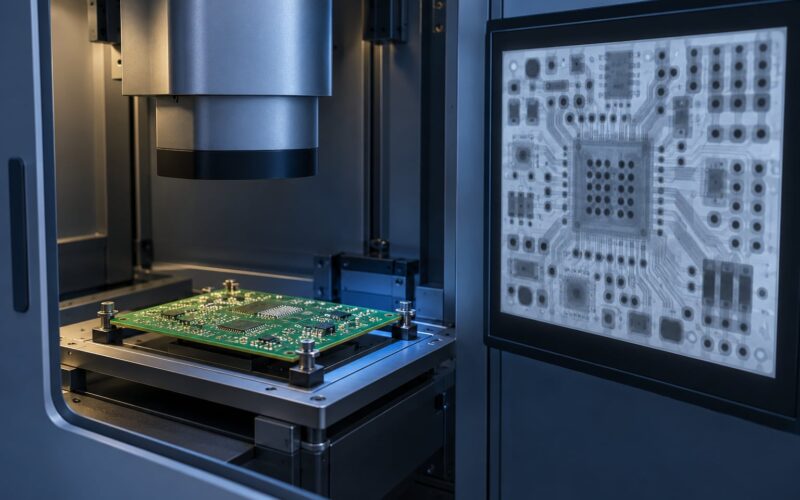
Ask which inspection steps are standard rather than optional: bare-board electrical test, AOI on both sides, X-ray on BGA and QFN joints, in-circuit or flying-probe coverage, and a functional test. AOI catches missing components, polarity, and offset; it does not see under a QFN. X-ray sees hidden joints; it does not test them. Knowing which method catches which defect class tells you whether the coverage is real.
Then ask what documentation arrives with the boards. A first article inspection report should reference your actual build, list the inspection steps performed, and note any deviations. Ask how they handle non-conforming product and what their corrective action process looks like.
Communication is the easiest signal to read. In hardware forums, engineers consistently describe unsolicited engineering questions about your Gerbers as a positive sign that a human reviewed the files. If nobody asks you anything, you are dealing with an automated front end.
| Question to ask | What a good answer sounds like | What a bad answer sounds like |
|---|---|---|
| Who reviews my files before production? | A named engineer or CAM group, with findings returned in writing | “Our system checks automatically.” |
| What happens if you find a DFM issue? | They stop, flag it, and ask you to decide | They build it anyway and note it later |
| How long is the quoted lead time, broken down? | Segmented schedule with a realistic date | “Fast.” |
| What if a part is unavailable or counterfeit? | Quarantine, notify you, offer alternates for approval | Substitute silently and ship |
| Can I see certificates and test records? | Sent with the build, scope and expiry stated | “We are certified.” |
6. Review the prototype ordering workflow
Ask each finalist to walk you through their process end to end. A well-run prototype order looks like this: file upload with a quote you can read, engineering review returned within a day or two, your approval on any stackup or finish change, fabrication, assembly and test, inspection documentation, packaging that protects a small fragile order, and a tracking number.
Watch for the gaps. If nobody confirms your stackup, nobody looked at your impedance targets. If the status update only arrives when you ask for it, plan on spending your own time chasing the build.
For planning, treat the receipt date as the finish line. Commissioning, rework on your own schematic, and retesting all happen after the boards land, and experienced hardware teams budget extra time for that tail.
7. Test a sample or small first order
Do not award a production relationship on quote analysis alone. Put your top two or three candidates through a small order that still exercises the risky parts: the fine-pitch device, the controlled-impedance nets, the thermal pad, the connector you are least sure about.
Then do your own acceptance testing rather than trusting a green report. Check dimensions against your fab drawing, look for the failure modes under magnification, run a continuity and isolation check on nets you care about, power the board with current limiting, and confirm silkscreen and polarity orientation before the components go on.
A vendor who ships a first article with your drawings and inspection results attached has told you how their later production build will behave. One who ships bare boards with no paperwork has told you nothing, and you will be doing their inspection work for free.
8. Make the final supplier decision
Score the finalists on the same weighted sheet. The weights are yours, but make them before you see the answers, because the criteria you weight after the fact are the ones you will rationalize.
| Criterion | Typical weight | Vendor A | Vendor B |
|---|---|---|---|
| DFM and engineering review | 25% | ||
| Technical capability for your design | 20% | ||
| Inspection, testing, and documentation | 15% | ||
| Lead time honesty and schedule | 15% | ||
| Total cost including setup and freight | 15% | ||
| Communication and responsiveness | 10% |
Prototype-to-production scalability is the last input, and it is the one people skip. If your volume factory later cannot do what your prototype factory did — buried vias, a specific finish, a material you qualified on — you will pay for a redesign. Tell candidates early that volume is the goal and ask which processes would need to change at 1,000 units. Common practice among experienced hardware teams is to split the work when one supplier cannot cover it, buying bare boards from a fabricator and assembly from a separate partner, so keep both relationships open.
Common Mistakes
- Comparing unlike quotes. One vendor quoted bare boards, another quoted turnkey assembly and sourcing. Fix: force a single spec sheet and a fixed line-item format, and re-quote anything that comes back in a different shape.
- Choosing on per-board price. The cheapest quote often carries engineering time you end up paying for yourself in rework. Fix: score total cost including setup, freight, and the realistic cost of one failed build.
- Skipping the DFM review. Fabricators that return boards built to a broken Gerber are rare; fabricators that build them without telling you are not. Fix: require a written review before fabrication, and treat a “nothing to report” response with suspicion if your design has fine features.
- Trusting a lead time without a breakdown. Fix: ask for fabrication, assembly, inspection, and transit as separate numbers, then add your own commissioning time.
- Not verifying certifications. Fix: spend ten minutes in the UL Product iQ and ISO directories checking the certificate number and its scope.
- Uploading Gerbers with no NDA or IP terms. Your layout reveals the product. Fix: sign a mutual NDA before upload, and ask what the vendor does with files after the order closes.
- Ordering one board fewer than you need. The eighth board costs a fraction of the first once setup is paid for, and it is the one you will need when a prototype is destroyed on the bench. Fix: order your working quantity plus a few spares.
Frequently Asked Questions
How many PCB prototypes should I order for a first build?
Most teams order five to ten working boards plus a few spares. You want enough to power continuously while debugging, enough to run a thermal or environmental check, and enough that losing one to a soldering mistake is not an event. Bare boards are cheap relative to your time, and setup fees are already paid at this quantity, so the extra boards barely move the cost.
What is a DFM review, and do I need one for a prototype?
A design-for-manufacturability review is an engineer’s check of your Gerbers, stackup, drill data, and BOM before fabrication starts. It catches acid traps, drill-to-copper registration problems, thin annular rings, unsupported wide traces, and parts that will not clean or place. For a prototype it is the highest-value service a vendor can offer, because a flagged issue costs a conversation while an unflagged one costs a re-spin.
What is the 3W rule in PCB design, and should my manufacturer enforce it?
The 3W rule states that minimum trace width, minimum spacing, and the margin for glass weave distortion under a trace should all be equal or close to it. Wide traces and large spacing can shift the effective dielectric as the glass weave moves relative to copper. Ask whether the fabricator’s CAM checker validates 3W violations and whether they flag them before imaging rather than shipping boards that fail later.
How do I compare two PCB manufacturer quotes fairly?
Normalize both quotes to the same specification: layer count, material grade, copper weight, surface finish, quantity, assembly scope, test coverage, freight terms, and payment terms. Then separate the one-time charges from the per-board cost and check which line items differ in a way you can explain. If a gap cannot be attributed to layer count, board area, finish, copper weight, or quantity break, ask about it before you score the vendor.
Is it safe to send Gerber files to an overseas manufacturer?
Treat Gerbers as confidential design data and sign a mutual NDA before you upload, then confirm in writing how long files are retained and whether they can be used for other customers. Use an NDA-backed vendor that already handles export-controlled work if your design is sensitive, and confirm ITAR registration when defense work is involved. Overseas prototyping is widely used and workable; the paperwork is what protects you.
How do I choose a PCB manufacturer for prototypes when comparing several options?
Define your requirements, shortlist three to five factories that can actually run your process, and send every one the identical RFQ package. Score the replies on a weighted sheet covering engineering review, technical fit, inspection and documentation, lead-time honesty, total cost, and responsiveness. Award a small trial order to your top two, run your own acceptance test, and let the build quality settle the decision rather than the quote.
The first thing to do is write down your specification and send the same package to three factories. Ask each of them, in writing, what their engineering review will check and when you will get the result. The vendor that answers that question best is usually the vendor your prototype deserves, whatever the per-board numbers say.