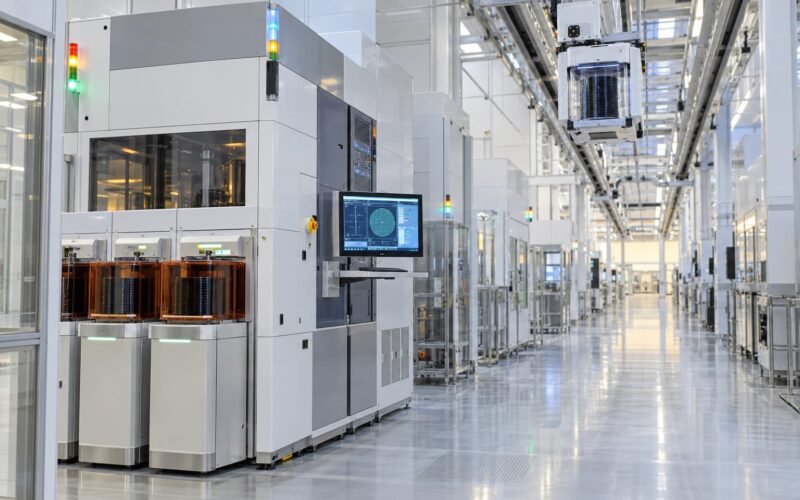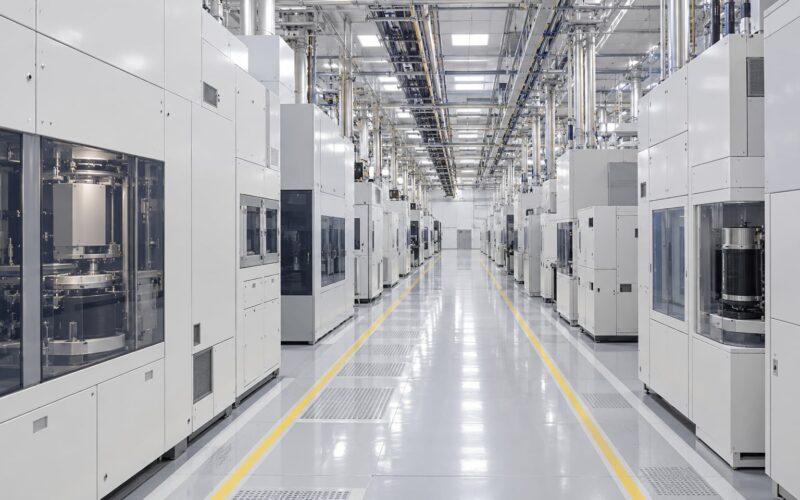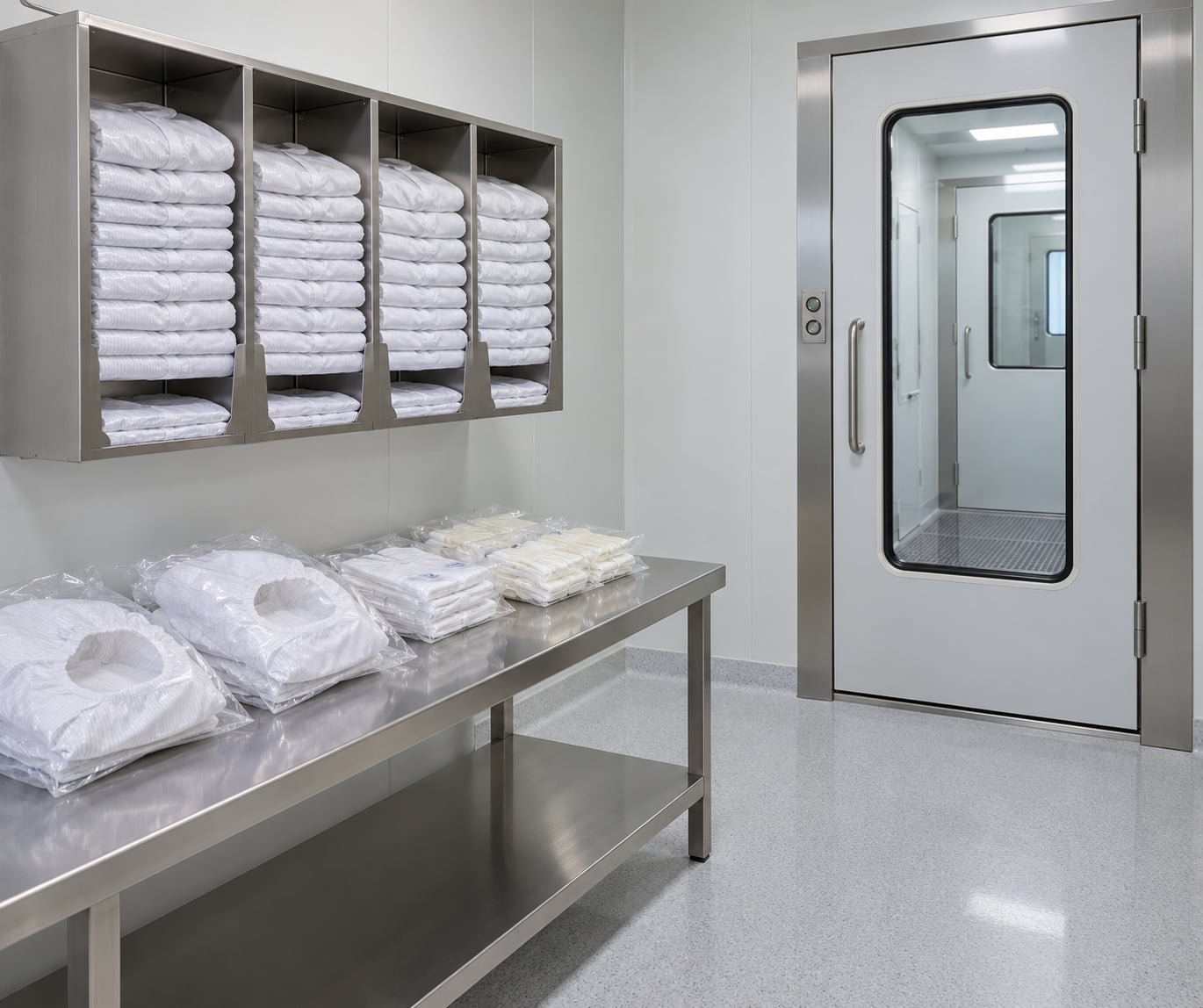
Fab gowning is the controlled, step-by-step process of putting on contamination-controlled garments in a dedicated gowning room before you cross into a semiconductor fabrication cleanroom: hair covered, coverall sealed, boots on, gloves on, wrist strap connected. A gowning procedure in a fab explained simply means the garments are a barrier against the person wearing them, not protection for the person, and every step exists to keep skin flakes, hair and fabric fibres off wafers and tools. Here is how the whole thing works, from the changing room to the exit.
Table of Contents
- Gowning Procedure in a Fab Explained: What It Is and What It Isn’t
- Why Fab Gowning Matters for Chip Manufacturing
- The Fab Gowning Sequence: From Entry to Cleanroom
- How to wear a gown step by step, in one sentence
- What Fab Engineers Wear and Why
- How to Put On Cleanroom Garments Without Contamination
- How Airlocks and Pass-Throughs Work During Gowning
- Gowning Procedure for Visitors, Students, and New Engineers
- Common Gowning Mistakes That Can Contaminate a Fab
- How to Remove Fab Garments and Leave the Cleanroom Safely
- Frequently Asked Questions
- Who has to gown before entering a semiconductor fab cleanroom?
- Can engineers wear personal clothing under a cleanroom coverall?
- What should I do if my garment is torn or I break my gown?
- How long does it take to gown up in a fab?
- Why are contact lenses, cosmetics and nail polish restricted in the cleanroom?
- Do the AORN standards govern gowning in a semiconductor fab?
- Conclusion: Learn the Facility’s Procedure Before Entering
Gowning Procedure in a Fab Explained: What It Is and What It Isn’t
Gowning, also called donning, is only one part of cleanroom entry. Entry is the wider chain: credential check, personal-item storage, hygiene steps, gowning, equipment checks, an airlock or air shower, and the walk to the bay. Gowning is the clothing portion of that chain, and it is the part where the operator personally can ruin a day of yield.
The other half is the exit, called de-gowning or doffing. Many engineers know how to get dressed for the bay and much less about how to come out of it correctly, which is where contamination escapes the cleanroom.
Fab gowning practice is written down. ISO 14644-5 covers cleanroom operations, including gowning procedures, and IEST RP-CC027 is the recommended practice most sites reference when they write their own SOPs. Older documents still use Fed Standard 209E class names, so you will hear “Class 100” next to “ISO Class 5” in the same conversation. Read ISO 14644-1 and your site’s SOP, and treat anything else as background reading.
Why Fab Gowning Matters for Chip Manufacturing
People are the contamination source a fab controls most aggressively, because a human sheds continuously and cannot be cleaned to a standard. The figures most commonly cited come from Philip Austin’s Encyclopedia of Clean Rooms, Bio-Cleanrooms and Aseptic Areas (2000): a person sheds on the order of a billion particles per day, and the gowning activity itself generates roughly 3 million particles per minute.
That second number is the one that surprises new engineers. The riskiest minute of contamination control is not the hour spent at a tool, it is the five minutes in the gowning room.
Particles land on wafers before a pattern is written, and a single defect can kill a die. On a 300 mm wafer carrying thousands of dies, one random particle can cost an entire lot, not one chip. Lithography is the most sensitive step because the printed features are now on the order of microns and there is no second chance to remove a defect after the resist is developed.
Particles also land on tool internals, in process chambers and on wafer-handling surfaces, where they scratch, seed defects or change process conditions. That is why fabs spend money on air showers, tacky mats and full mirror checks rather than treating them as theatre.
Cleanroom rules are not a general safety code like hard-hat rules. Safety PPE protects the wearer; cleanroom garments protect the process, and the logic runs the other way. That is also why pharmaceutical aseptic guidance you may have read elsewhere does not transfer directly. USP 797 and USP 800 govern sterile compounding with a microbial focus, while fab work follows ISO 14644 particle classes. Different goal, different garment logic.
The Fab Gowning Sequence: From Entry to Cleanroom
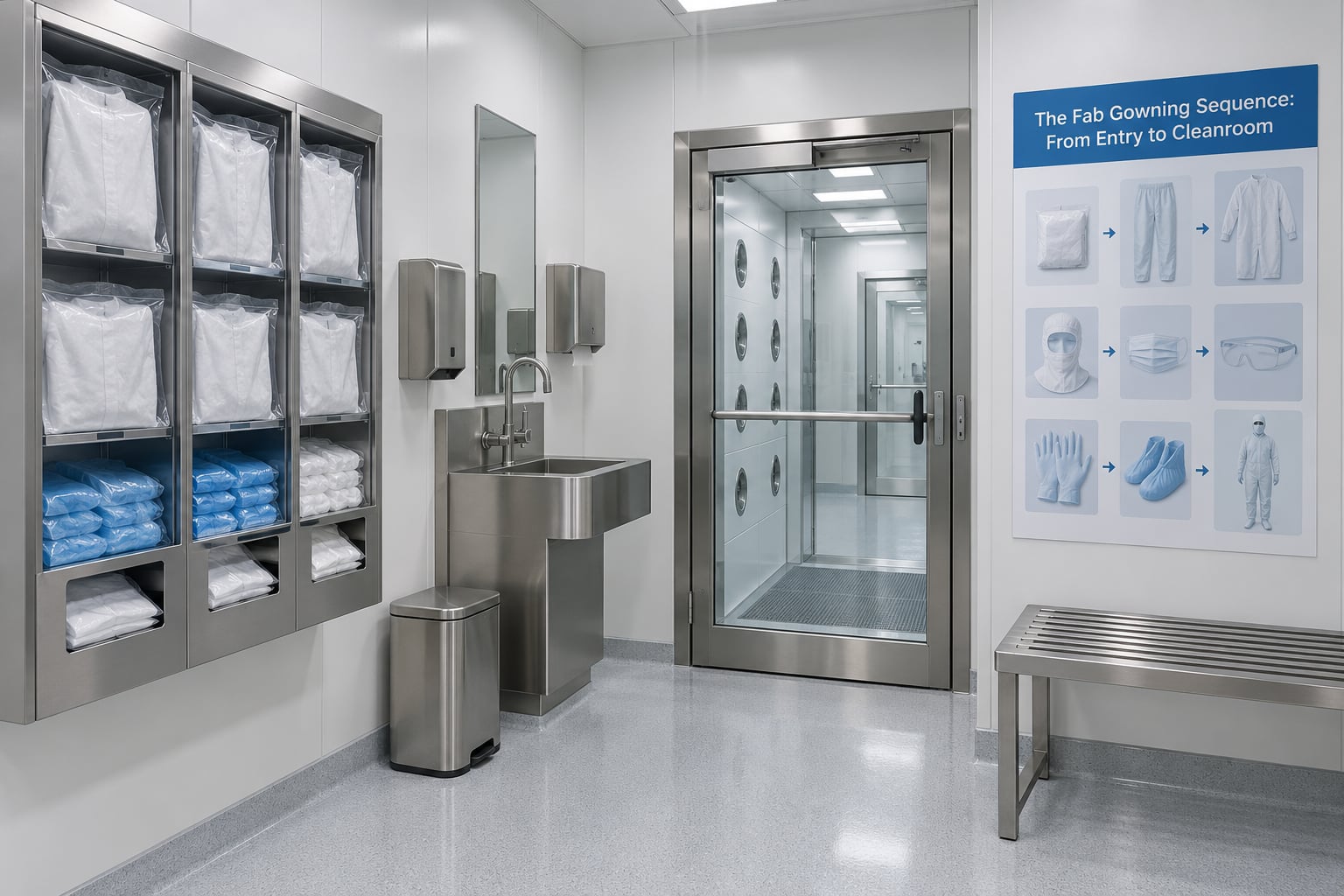
The order below is the common fab sequence: hand hygiene and hair cover first, then footwear, then body garment from the top down, then eye and face protection, then gloves, then verification, then the airlock. Every fab adjusts some detail, so treat this as the shape of the process and follow your site’s written sequence, which is always the controlling document.
- Store personal items. Phones, wallets, keys, bags, drinks and food go in a locker. Nothing from outside the boundary comes into the gowning room.
- Wash and dry your hands. Lather to the elbows, rinse, dry with a one-use towel. Nails trimmed, no polish, no lotion on the hands; lotion flakes are a classic particle source.
- Put on a hair cover. A bouffant or mob cap first for most areas, because scalp hair sheds heavily. If you have facial hair past the mask line, add a beard snood at this step.
- Step into shoe covers or cleanroom boots. Sit on the gowning bench, cross one leg at a time, and pull the cover over the shoe and trouser cuff. Cover the trouser leg, not just the shoe.
- Cross the stepover bench. Never let a covered foot touch the gowning-room floor, and never bring the gowning-room floor onto the cleanroom side.
- Take the coverall out of its package without unfolding it fully. Garment cabinets with HEPA blowers are common in newer fabs; the cabinet or the package already holds the garment in the position you need to step into it.
- Put your arms in first, keeping your hands inside. Your bare skin never becomes the outer surface. Then pull the garment up over your head and shoulders.
- Fasten the full-length zipper. Work bottom to top, then close every snap or hook. Unzipped chest or cuff gaps are the most common audit finding in fabs.
- Tuck the hood inside the collar. Where a hood is required, the fabric edge sits inside the coverall collar so no skin shows at the neck.
- Fit the hood. Adjust it so no hair or ear skin is visible, then tighten the neck closure and confirm the mask seal underneath.
- Add eye and face protection. Safety glasses, goggles or a face shield depending on the area, plus the mask required by that bay.
- Add gloves. Nitrile gloves for handling, and a glove liner or double-glove combination where the tool or process demands it. Glove cuffs must fully cover the sleeve elastic.
- Connect your wrist strap and test it. Wrist straps and cleanroom footwear with ESD soles are part of the gown, not an accessory. Clip to the grounding point at the gowning-room wall and confirm the indicator before you leave the room.
- Check yourself in the full-length mirror. Zipper closed, hood tucked, cuffs covered, no skin at the wrists or neck, no suit or boot dragging on the floor. A peer check is standard at many sites.
- Cross the tacky mat and enter the airlock. Step on the mat, wait for the air shower cycle or the door interlock to release, then walk slowly and steadily.
How to wear a gown step by step, in one sentence
Hair covered, hands washed, footwear on, then a full coverall from the top down with hands kept inside, hood tucked into the collar, zipper fully closed, eye and face protection added, gloves pulled over the cuffs, wrist strap connected, mirror check passed, tacky mat and airlock.
What Fab Engineers Wear and Why
Garments follow the ISO class of the area. The class sets the particle limit, and the particle limit sets how much of you is allowed to be exposed.
| Area class | Legacy 209E name | Typical garment set |
|---|---|---|
| ISO Class 5 or cleaner, mini-environment or lithography bay | Class 100 | Fully integrated hooded coverall, hood tucked in collar, goggles or face shield, mask, cleanroom boots, double gloves or glove liners over the sleeve, wrist strap |
| ISO Class 7, most process bays | Class 1000 | Hooded coverall, safety glasses, mask, cleanroom boots, single gloves |
| ISO Class 8, mask, packaging and lower-criticality areas | Class 10000 | Coverall or smock with hood, shoe covers, hair cover, gloves where handling is required |
Class names are frequently misremembered as “bigger number, cleaner room”. It is the reverse, and the FS 209E names are easy to get wrong when translating: Class 100 maps to ISO Class 5, Class 1000 to ISO Class 7, Class 10000 to ISO Class 8.
Fab clothing is static-dissipative, not just low-lint. Garment fabric, gloves and footwear are chosen and tested so static charges bleed away rather than accumulating on an operator who is about to work next to a charged wafer. A coverall that blocks particles but builds a static field fails the tool.
Inside a mini-environment, an automated material handling system moves FOUPs between tools, and the person working at the load port may need an additional gown tier on top of the bay requirement. Ask what the load-port procedure is before your first FOUP opening rather than after.
How to Put On Cleanroom Garments Without Contamination
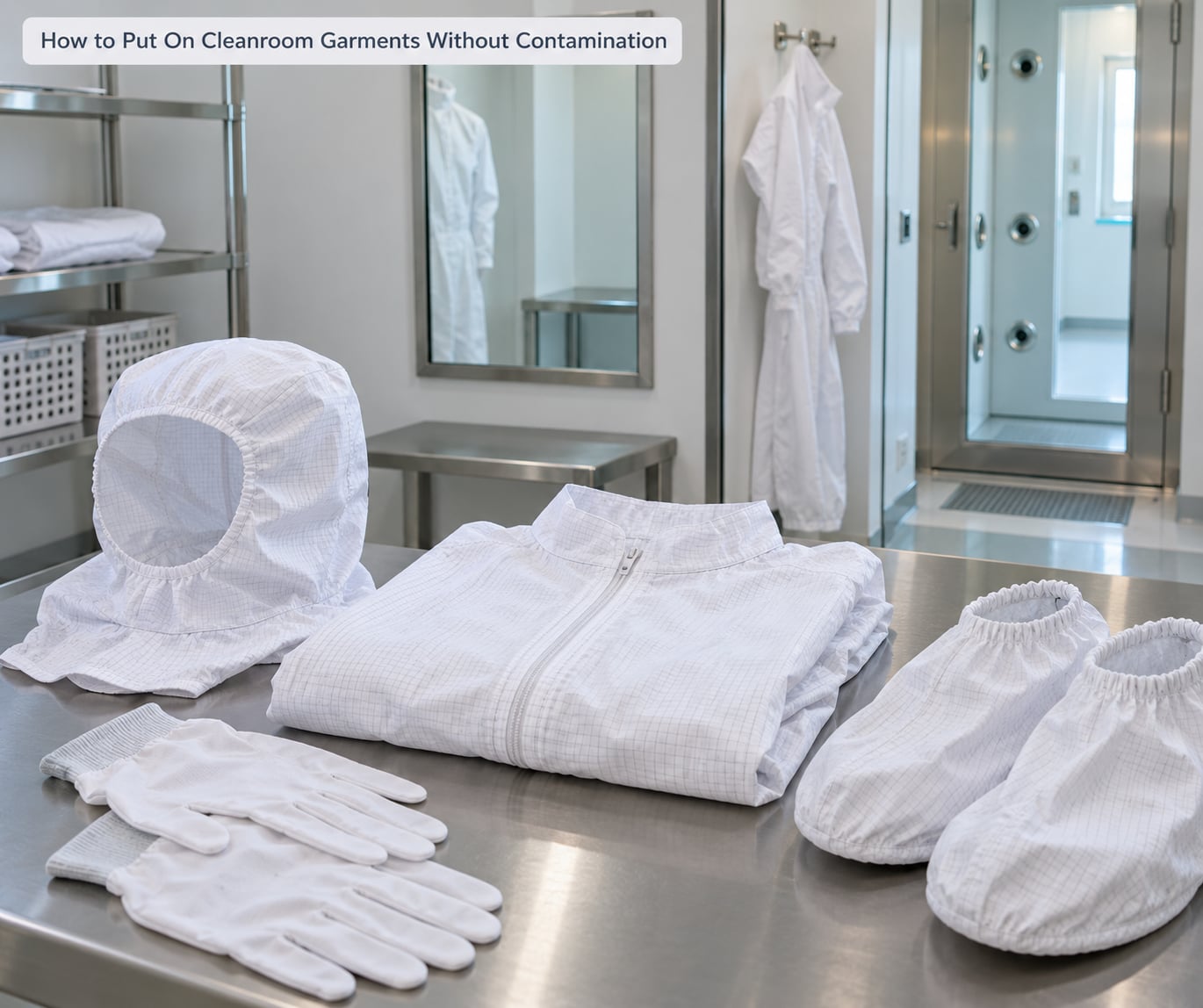
Particles released while dressing cascade downward. That single physical fact explains almost every rule in the gowning room: dress top down, move slowly, keep the garment’s clean inner surface against you and its outer surface away from everything.
Touch only the inside of a garment. If you grab the outside of a coverall, the area your hand covered is now handled and belongs on the outside of your body, where it will rub against tool surfaces and wafer carriers. If you must touch the outside, that suit needs replacing.
Use the lean rail and gowning bench the way the room is designed. The bench marks the clean and dirty boundary: sit on it to cross footwear, keep one side dirty and one side clean, and never place a garment on a floor or a bench top reserved for clean items.
Move at a normal walking pace. Fast walking and swinging arms generate a surprising multiple of a slow walk’s particle load, which is why seasoned operators seem to stroll around a fab. It is a contamination control behaviour, not a personality trait, even though people do notice it and new joiners get teased for walking like an operator for a month.
Fasten items in the prescribed order and check the details sites audit most: zipper to the chin, hood inside the collar, both wrist cuffs covered by gloves, no skin at the lower back, boot covers not dragging, wrist strap clipped and live. Most audit findings are one of those six, not a catastrophic mistake.
How Airlocks and Pass-Throughs Work During Gowning
The gowning room sits inside a pressure cascade. Air moves from the least clean space toward the cleanest, so contaminated air cannot be pushed back into an area you just left. Depending on the fab, the anteroom may be held slightly positive to the corridor and the bay positive to the anteroom, and a dip in pressure is a measurable alarm condition, not a mood.
Doors are interlocked so two cannot be open at once. An air shower between the gowning room and the bay blows filtered air over the operator, dislodging loose particles from the suit. Walk through it steadily and quietly rather than swinging your arms, and never force a door or hold it open for the person behind you.
Pass-through chambers move material, not people. Wafers in FOUPs, parts, tools and samples go through an interlocked chamber with its own separate cycle, and the person never follows the material inside. If you are handing a part to an area you cannot enter, you use the pass-through; you do not lean through the door.
Read the indicators. A red light or an interlock that will not release means stop, wait, and call the area owner if it persists. Nobody has ever been disciplined for waiting on an airlock, and people have been disciplined for going around one.
Gowning Procedure for Visitors, Students, and New Engineers
Visitors and students usually get a higher-tier garment than an operator working next door, because the rules are stricter when the person is unfamiliar with the area. A visitor coverall with an integrated hood, boot covers and gloves is common even when the destination bay would only need a smock for staff.
You need site training and a gowning qualification before entering, and the qualification is usually observed. Someone watches you gown, usually through the mirror or a camera, and signs off that your technique and your resulting particle count are acceptable. Universities and fab-adjacent programmes often run this as a joint exercise, but the fab still controls who signs the record.
Expect an escort, a restricted area list, and a badge that opens only the doors you have been cleared for. Tools, phones and cameras stay in lockers unless the area owner has explicitly approved them; personal phones are usually the single most common visitor violation, and camera phones may be prohibited outright in lithography bays.
Ask your fab host for the current site-specific instructions rather than working from a slide deck or a video. Sequences differ between buildings and between areas, and the written SOP for the building you are standing in is the only version that counts.
Common Gowning Mistakes That Can Contaminate a Fab
- Visible hair at the nape or temple. A mob cap that does not cover the hairline lets scalp flakes shed directly. Correct: tuck all hair inside and check the profile in the mirror, not just the front.
- Hood worn outside the collar. The hood fabric then sits on your shoulders shedding into the clean area. Correct: hood edge inside the collar, neck closure tightened.
- Wrist or glove cuff gap. An exposed wrist is a direct path to skin flakes. Correct: pull the glove cuff over the sleeve elastic and re-check in the mirror.
- Coverall zipped to the chest only. The most common audit finding in fabs. Correct: full-length zipper closed, snaps fastened.
- Touching the outside of a clean suit. Correct: touch inside surfaces only, and replace any suit whose clean side was handled.
- Damaged or dirty garment. A torn seam, a snagged finger on a nitrile glove or a suit that failed its laundry cycle does not get topped up with tape. Correct: report it, take a fresh one, and use the discard bin at the gowning bench.
- Walking too fast. Correct: walk at a steady pace, which measurably lowers particle generation from your suit.
- Wrist strap left unclipped. Correct: clip and test at the gowning-room grounding point every time, before you step into the airlock.
- Carrying personal items in. Correct: everything stays in the locker; if something must come with you, the area owner approves it in advance.
- Entering without waiting for the interlock. Correct: wait for the light, let the cycle finish, never prop or bypass a door.
If you break your gown mid-shift, stop where you are, do not brush the dust off, and move out of the bay. Exit through the nearest airlock and re-gown from a fresh garment set. Sites audit deviations like this as a process event, and treating it as a small nuisance is how a particle event turns into a scrap lot.
How to Remove Fab Garments and Leave the Cleanroom Safely
De-gowning runs roughly in reverse: gloves first, then eye and face protection, then the coverall, then the hood and hair cover, then footwear, stepped back over the bench to the dirty side. The underlying rule is the same as on the way in: you are shedding the entire time, so keep the dirty surface dirty-side down and stop shedding as soon as you are outside the airlock.
Fab garments are usually laundered and reused, not binned, and they are counted. Disposable items like mob caps, masks and some gloves go in the designated bin. Reuse means the garment goes into the laundry system by route, not into a bag you carry home, and you do not launder it yourself. At de-gowning after chemical bath work, the sequence changes: chemical addenda require PPE removal at a designated station and often a separate de-gown or shower-out step before the cleanroom exit.
Stepping out for a break is the part new engineers find least obvious. A restroom visit or a coffee run in many fabs means a full de-gown and complete re-gown, and operator discussions on the r/Semiconductors threads describe that as a 15-minute round trip rather than a five-minute one. Plan your breaks around it; you are not stepping out as yourself.
After chemical or wet-process work, de-gowning also doubles as chemical protection. Gloves and outer garments come off in the order your area specifies, and your site controls the rinse or shower steps. Nobody improvises this part.
Frequently Asked Questions
Who has to gown before entering a semiconductor fab cleanroom?
Everyone who crosses a cleanroom boundary: process and equipment technicians, integration and metrology engineers, contractors, maintenance vendors, and visitors. Even engineers who only walk through on inspection wear a garment set matched to the ISO class of the area. No exceptions for role, and no exceptions for a short visit.
Can engineers wear personal clothing under a cleanroom coverall?
Usually no. A shirt or trousers worn under a coverall sits between your skin and the coverall, and both add lint and restrict heat loss. Fabs generally issue all undergarments, including underwear, or require minimal coverage beneath. If you wear a base layer, it has to be site-issued or approved. Ask before you bring your own.
What should I do if my garment is torn or I break my gown?
Stop, do not brush or shake the garment, and exit the bay through the nearest airlock without touching the outside of the suit. Discard the damaged item at the gowning bench, put on a fresh set, and report the deviation. Sites treat this as a process event, and a quick report is far cheaper than an unexplained particle excursion.
How long does it take to gown up in a fab?
A trained operator gowned for an ISO Class 7 bay usually needs 10 to 15 minutes including the mirror check and wrist strap test. A first-timer with a visitor coverall commonly takes 20 to 30 minutes. Add air shower time and waiting for an interlock, which can double it. A mid-shift break that triggers full de-gown and re-gown can cost half an hour.
Why are contact lenses, cosmetics and nail polish restricted in the cleanroom?
Cosmetic powders flake, nail polish chips, and eye makeup transfers to gloves and then to wafer surfaces. Contact lenses bring handling of personal eye-care products inside the boundary and complicate an eye emergency. Most fabs ban cosmetics, false lashes, nail polish and perfume in gowning areas. Declared contact lenses are usually permitted with restrictions, so check your site’s list rather than guessing.
Do the AORN standards govern gowning in a semiconductor fab?
No. AORN guidance covers surgical gowns and gloving in an operating room and has no authority over a fab. Fab gowning follows ISO 14644-1 for classification, ISO 14644-5 for cleanroom operations, and the site SOP, with IEST RP-CC027 as a common reference. Pharmaceutical aseptic work follows USP 797 and USP 800 instead. Different industries, similar-looking suits, different rules.
Conclusion: Learn the Facility’s Procedure Before Entering
A gowning procedure in a fab explained comes down to one principle: the garment is a barrier between a shedding person and a wafer, and every step is a controlled way of putting that barrier on and taking it off without breaking it. The people in the gowning room are shedding the most, which is why the discipline there is tightest.
Your first step as an engineer is simple and non-negotiable: complete the site training, get your gowning qualification observed and signed off, then read the written SOP for the building you will actually enter. Sequences differ between fabs and between areas, and requalification is part of the job rather than a one-time box to tick. Bring the standards to your first session too: ISO 14644-1 and ISO 14644-5 give you the language the site uses, and knowing them saves you an hour of guessing what “Class 2” means in a document you have never read before.