Semiconductor IP licensing is a contract in which an IP vendor grants a chip designer the right to use a pre-designed block of a chip, such as a CPU core, GPU, memory controller or interface, in exchange for an upfront license fee and ongoing royalties on chips that ship. Understanding how semiconductor IP licensing works starts with three parties and one number that follows you through every phase: who owns the block, who builds with it, and how much you owe per unit once it reaches customers.
Most chips are not designed from the transistor up. A modern SoC might combine licensed processor cores, interface IP and physical blocks with a great deal of in-house glue logic, and the pieces carry different contracts with different economics. This guide walks the whole lifecycle, from the first nondisclosure agreement to the royalty report your finance team files after a chip is in volume production.
Table of Contents
- What Is Semiconductor IP Licensing?
- What Types of Semiconductor IP Are Licensed?
- How Semiconductor IP Licensing Works Step by Step
- 1. NDA and technical scoping
- 2. Shortlist and request for information
- 3. Technical evaluation
- 4. Commercial negotiation
- 5. Signature and delivery
- 6. Integration and verification
- 7. Tape-out, production and royalty reporting
- What Does a Semiconductor IP License Grant?
- How Are Semiconductor IP Licensing Fees Calculated?
- Exclusive, Non-Exclusive, and Single-Design Licenses
- Who Owns Changes Made to Licensed Semiconductor IP?
- What Happens During IP Integration and Chip Production?
- Common Risks and Mistakes in Semiconductor IP Licensing
- Royalty definitions that invite disputes
- Ignoring process-node compatibility
- Weak support terms
- Inadequate sublicensing rights
- Underestimating the audit obligation
- Depending on one provider
- Compliance treated as paperwork
- Buying power you do not need
- Losing control of the roadmap
- Frequently Asked Questions
- What is IP in the semiconductor industry?
- How does IP licensing work?
- How much does it cost to license semiconductor IP?
- What is the difference between a hard core and a soft core?
- Is IP licensing profitable?
- What is a field of use restriction in an IP license?
- Conclusion
What Is Semiconductor IP Licensing?
Semiconductor IP licensing is the legal permission to design, manufacture and sell a chip that contains someone else’s pre-developed circuit design. The party granting the permission is the licensor, often an IP vendor such as Arm, Synopsys, Cadence, Rambus or Imagination Technologies. The party building the chip is the licensee, usually a fabless designer that owns the product but not the underlying block.
What gets licensed exists at three layers. Physical IP is already laid out as GDS-II or another layout format, tuned to a specific foundry process. RTL IP, also called a soft core, arrives as synthesizable code the licensee compiles for any process it likes. An architecture license goes further and grants rights to build an implementation from the instruction set specification itself, which is how most large fabless vendors have historically handled a CPU.
The deal has two financial halves. The upfront fee covers evaluation, integration support and a head start on development. The royalty is the running cost, usually calculated per chip shipped or as a share of the chip’s average selling price, and it is where the majority of a mature licensing relationship’s value sits.
What Types of Semiconductor IP Are Licensed?
The licensed blocks fall into a handful of families, and each one carries different integration effort and different constraints.
| Category | Typical contents | What you get | Main constraint |
|---|---|---|---|
| Processor cores | CPU, GPU, AI accelerator instruction sets | Hard core, RTL, or architecture rights | Ecosystem lock-in to a vendor’s software |
| Interface IP | PCIe, USB, MIPI, Ethernet, DDR controllers, SerDes | RTL plus verification suites | Protocol versions age quickly |
| Memory and storage controllers | DDR, LPDDR, NAND, HBM controllers | RTL and optional hard macro | Tied to JEDEC spec revisions |
| Physical and analog IP | SerDes PHY, PLL, SRAM, I/O pads, analog macros | Layout bound to a process node | Process-specific, poor portability |
| Security IP | Root of trust, cryptographic engines, secure boot | Hard or soft, often certified | Verification burden at sign-off |
| Subsystems and DOKs | Pre-integrated blocks, design optimization kits | RTL plus area and power targets | Assumes a specific process and tool flow |
| Patent rights | Standard-essential patents, SEP pools | Defensive rights, not a design | Royalty stacking across suppliers |
Processor IP is the most visible and usually the most expensive. Interface and physical IP are often cheaper per design but add up faster because a single SoC can contain a dozen licensed interface blocks, and every one of them can carry its own royalty.
How Semiconductor IP Licensing Works Step by Step
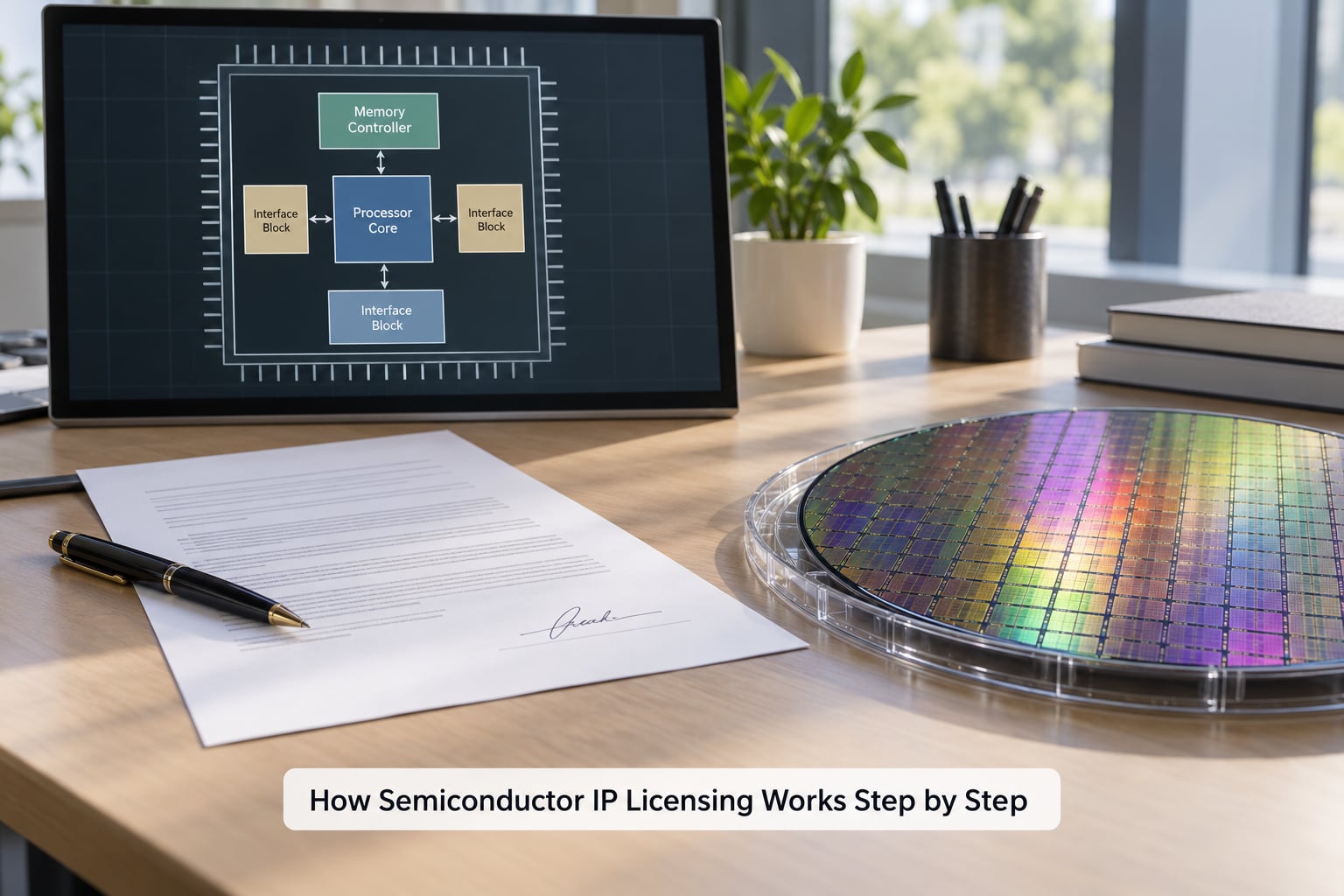
Deals follow a fairly consistent seven-stage sequence. The timeline below describes a mainstream IP core transaction; smaller blocks move much faster.
1. NDA and technical scoping
Both sides sign a nondisclosure agreement before anything substantive is shared. Inside that confidentiality wrapper, the licensee describes the product, the target process node and the required performance, and the licensor decides whether the IP family covers it. This step is where export-control screening starts too, because technology transfer to certain destinations or foreign persons can require a license before evaluation even begins.
2. Shortlist and request for information
Design teams usually evaluate two or three providers rather than one. Each supplies datasheets, delivery schedules, integration manuals, the reference process list and a commercial sketch. Teams that skip this step often discover too late that a block has no reference flow on their intended foundry, which turns a licensing decision into a tape-out delay.
3. Technical evaluation
This is the real engineering test. The team runs the vendor’s model or reference configuration against its own workload, checking area, power, latency and verification coverage. Integration engineers may also visit the vendor site, since much of the value of a mature IP vendor is the support organization rather than the RTL itself.
4. Commercial negotiation
Fee structure, royalty base, rate step-downs, minimum commitments, term, audit rights and field-of-use limits are negotiated here. Both sides are balancing different things: the licensor is protecting the value of its IP across future customers, while the licensee is protecting margin on a product that may or may not sell in volume. Founders sometimes treat this as a formality after technical selection, which is a costly assumption.
5. Signature and delivery
Once the agreement is signed, the licensor delivers the IP in the agreed form, along with documentation, a verification environment, driver or firmware where relevant, and access to the support team. Some agreements include a design-optimization kit, which targets specific silicon area or power figures and is a contractual commitment rather than a rough estimate.
6. Integration and verification
The block is instantiated inside the SoC, connected to the rest of the design, and driven through simulation and emulation. Verification environments, assertions and scoreboards matter more here than most buyers expect, because a licensed block that passes simulation and fails at tape-out costs a full respin.
7. Tape-out, production and royalty reporting
Once silicon returns and passes bring-up, the product ships. From that point the licensee reports shipments or sales under the agreement’s reporting obligations and pays royalties on the defined base. The license does not end here; it runs for the term and defines what happens if the product is retired, the company is acquired, or a second source is added.
What Does a Semiconductor IP License Grant?
A semiconductor IP license grants a defined set of permissions, and the difference between a workable license and an unusable one usually sits in the clauses that are easy to overlook.
Use. The right to implement the IP in a design. Modification. The right to change it, often with an approval step. Integration. The right to combine it with other blocks, including in-house IP, which is the point of the whole exercise. Sublicensing or redistribution permission matters when the licensee passes derivative work to a customer, an original equipment manufacturer or a contract manufacturer. Manufacturing rights cover having a foundry build the design. Territory limits restrict where the chip can be sold. Field of use restricts what the chip may do, for example consumer only or automotive only.
Restrictions run the other way too. Most agreements forbid using the IP to build a competing product, reverse-engineering it, or sublicensing beyond what is expressly granted. A design optimization kit comes with its own obligation: meet the stated area or power target, or the guarantee does not hold.
How Are Semiconductor IP Licensing Fees Calculated?
Total cost is an upfront fee plus a running royalty, and the royalty is normally the larger number over the product’s life. Fees vary widely by block type, so treat the ranges below as orientation rather than quotes.
| Component | How it is usually set | What moves it |
|---|---|---|
| Upfront license fee | Negotiated, often tiered by how many designs are committed | Complexity of the block, exclusivity, support level |
| Per-unit royalty | A fixed amount per chip shipped | Block maturity and volume assumptions |
| Percentage of ASP royalty | A low single-digit share of average selling price | Whether the chip sells as a component or inside a finished product |
| Volume step-downs | The rate falls at agreed unit or revenue thresholds | How aggressively the licensee committed to volume |
| Minimum commitment | A floor on units or revenue per period | Balance of risk between the parties |
| Support and updates | Annual fee or a percentage of royalties | Whether the vendor will maintain the IP for new process nodes |
| Design fee or DOK fee | Separate fee for a guaranteed optimization target | Strictness of the guarantee |
The key negotiation lever is the royalty base. A per-unit royalty is simple and predictable, but it can be punishing on a low-priced chip with a heavy IP content ratio. A percentage of average selling price tracks margin better, but the licensee has to define exactly which sale the price refers to, and that definition is where disputes start.
Designers ask for step-downs before signature, not after volume surprises them. An agreement with a flat rate on a chip that eventually sells in the tens of millions of units can cost more than the license fee by an order of magnitude.
Exclusive, Non-Exclusive, and Single-Design Licenses
Licensing models differ along two axes: whether others can hold the same rights, and how many designs the licensee may build.
| Model | What it means | Typical fit |
|---|---|---|
| Non-exclusive | Many licensees hold the same rights | Most interface and physical IP; standard commercial choice |
| Exclusive | The licensee is the only party licensed, usually in a defined field or territory | Strategic products where the licensee is funding the next IP generation |
| Sole | The licensee may sublicense, while the owner licenses nobody else | Component makers distributing IP through their channel |
| Single-design | One tape-out of one product | Short-lived or experimental products |
| Multi-design | A defined number or product family of designs | Vendors building successive generations on one core |
| Subscription | Time-based access covering a product family | Fast-moving designs that need frequent IP updates |
Exclusivity costs real money and is rarely worth it for a commodity block. It makes sense when the licensee commits to funding new process-node versions, or when the product itself is the strategic asset and the licensee needs the vendor locked in. Field-of-use restrictions narrow exclusivity without the full premium, which is a common compromise: automotive-only rights, or a defined end market.
Who Owns Changes Made to Licensed Semiconductor IP?
Ownership splits along the background and foreground line. The licensor keeps its original IP, all underlying RTL, tools, documentation and any improvements it develops independently or for other customers. That background IP is what makes the vendor’s next customer possible.
The licensee typically owns everything specific to its own product: its SoC integration, its configuration, firmware it writes for the block, its testbench collateral, and customer-specific modifications. If the licensee asks the licensor to make a change that only that customer needs, most agreements treat it as commissioned work the licensee owns, often with a carve-out giving the licensor the right to reuse the underlying technique for others. Those two sentences are the entire negotiation.
Derivative works need their own clause. If the licensee modifies the block significantly enough that it is arguably a new design, the agreement needs to say whether that modified block stays with the licensee, reverts to the licensor, or requires a separate agreement. Where the licensed IP is a hard macro, masks and layout data derived from it are usually treated as licensee-owned outputs but remain subject to the license for as long as they are used. The same logic applies to firmware shipped alongside the core.
What Happens During IP Integration and Chip Production?
Signature is the midpoint, not the finish line. What follows is a schedule that runs in parallel with the rest of the SoC, and it usually takes longer than first-time licensees expect.
| Phase | What happens | Who owns it |
|---|---|---|
| Onboarding | Access to the IP delivery portal, support channels, escalation contacts and release cadence | Both |
| Model and reference flow | Building the vendor’s reference configuration in the team’s own tool flow | Licensee, vendor support |
| Integration | Instantiation, clocking, reset, power islands, register and interrupt mapping | Licensee |
| Verification | Running vendor testbenches, adding assertions, closing coverage before sign-off | Licensee, vendor fixes |
| Synthesis and place-and-route | Timing closure with the block under realistic congestion and power constraints | Licensee |
| Sign-off | Static timing, power integrity, physical checks, foundry sign-off packages | Licensee with foundry |
| Tape-out and manufacturing | Mask generation at the foundry; the IP vendor may review the tape-out if the license requires it | Licensee, foundry |
| Production reporting | Shipment or revenue reports to the licensor, royalty payments, audit rights | Licensee |
Process compatibility is the hard constraint. A hard core only works on the process it was characterized against, which can restrict foundry choice and multi-sourcing plans for years. Soft RTL is portable but demands more verification effort, which is why the fee difference between the two is usually smaller than the schedule difference.
Common Risks and Mistakes in Semiconductor IP Licensing
Most bad licensing outcomes trace back to decisions made under schedule pressure rather than to the contract itself.
Royalty definitions that invite disputes
Fix it before signature: define the reporting entity, the sale price used as the base, treatment of distributors, returns, warranty replacements and bundled multi-chip modules. Nearly every royalty dispute traces back to a term that looked obvious to both sides at signing and meant different things at audit.
Ignoring process-node compatibility
A block with reference flows on two nodes does not have two nodes of support. Ask which node the vendor is investing in and whether your node is scheduled for validation and characterized library updates.
Weak support terms
Specify what happens when the vendor deprecates a core or acquires the company. A support clause with no response targets and no last-time-buy provision leaves the licensee exposed during a vendor’s own restructuring.
Inadequate sublicensing rights
If your customer, contract manufacturer or original equipment manufacturer needs rights, get them in writing at signature. Retrofitting sublicensing after a customer has already integrated the design is expensive and slow.
Underestimating the audit obligation
Royalty reporting is a standing operational commitment, not a filing you do once. Design a reporting process early, because reconstructing shipment history two years later during an audit is painful and commonly ends badly for the licensee.
Depending on one provider
A single architecture supplier can decide pricing, roadmap and legal exposure for your entire product line. Ask about porting paths to an alternative core or to an open instruction set before you need one.
Compliance treated as paperwork
Export-control obligations, EDA seat terms and foundry process design kit restrictions are real legal constraints, not administrative details. This article is general information, not legal advice, and a team should have counsel review any license touching export-controlled technology or a foreign-person workforce.
Buying power you do not need
Exclusivity and large minimum commitments look attractive during negotiation and become the reason a product line cannot pivot. Size commitments against realistic volume forecasts, not against the pitch deck.
Losing control of the roadmap
If the block is on the critical path, know what your fallback is when the vendor slips a release. A dated escalation path and a named contact beat a relationship.
Frequently Asked Questions
What is IP in the semiconductor industry?
Semiconductor IP is a reusable pre-designed circuit block sold by a vendor and licensed into someone else’s chip. It exists at three layers: physical IP already laid out for one foundry process, RTL soft IP delivered as synthesizable code, and architecture rights that let a licensee build from an instruction set specification. Processor cores, interface controllers and analog macros are all licensed this way.
How does IP licensing work?
IP licensing works in seven stages: an NDA and technical scoping, a shortlist and request for information, technical evaluation against the design requirements, commercial negotiation of fees and royalties, signature and delivery of the IP, integration and verification inside the SoC, then tape-out and volume production during which the licensee reports shipments and pays per-unit royalties for as long as the term runs.
How much does it cost to license semiconductor IP?
The total has two parts: an upfront license fee negotiated on design commitment and support level, plus a running royalty. Royalties are usually a fixed amount per chip shipped or a low single-digit percentage of average selling price, often with step-downs at agreed volumes. Processor cores sit at the high end, interface and physical IP lower, and the figure moves sharply with exclusivity and process-node support.
What is the difference between a hard core and a soft core?
A hard core arrives as finished layout, already placed and routed for a specific foundry process. Performance and power are predictable and integration is quick, but it only works on that process, which limits multi-sourcing. A soft core arrives as synthesizable RTL you compile for any process. It is portable across foundries and nodes, but demands more verification, timing closure and optimization work from your own team.
Is IP licensing profitable?
It can be, but not at small scale by default. The licensor spends years and heavy upfront cost developing the block, then collects royalties that only start once customer products reach volume. That curve favors mature IP used in high-volume chips. A discussion in the r/chipdesign community about licensing silicon IP as a small team reflects exactly this skepticism: without a large shipment base, royalties rarely cover development.
What is a field of use restriction in an IP license?
A field of use limits which end markets the licensed IP may be sold into, for example automotive, industrial or consumer only. Vendors use it to price by market and to prevent a licensee from competing in a segment the vendor serves directly. It also narrows exclusivity without the full exclusivity premium, which makes it a common compromise in agreements covering high-volume consumer chips.
Conclusion
Start by writing down what the design actually requires: performance targets, the process node you have committed to, and the volume you can defend. Shortlist two or three providers on those terms, run the technical evaluation seriously, and negotiate the royalty base and step-downs with the same attention you give to the RTL. Then have counsel review the agreement before signature, and build a royalty reporting process the day the license goes into effect. Understanding how semiconductor IP licensing works comes down to those few decisions, taken in order.