Component sourcing basics for hardware startups come down to one thing: a complete bill of materials where every line has a real manufacturer part number, a named supplier, and a channel you trust. Before you release a single purchase order, you need to know what the parts must do, which of them are single-sourced, and what happens to the schedule if one goes on allocation or turns up counterfeit.
This guide walks through that sequence the way an engineer would actually do it: requirements first, then the BOM, then channel decisions, then verification, then purchasing control. It is written for a seed or Series A team with no procurement function, no approved vendor list, and no credit terms yet.
Table of Contents
- What You Need — Requirements, Documents, and the Cost Model That Comes Before Any Quote
- Step-by-Step — A Repeatable Component Sourcing Workflow
- 1. Translate the Product Requirements
- 2. Build and Classify the Bill of Materials
- 3. Identify the Right Component Types
- 4. Shortlist and Verify Suppliers
- 5. Compare Total Cost and Commercial Terms
- 6. Validate Before Committing to Production
- 7. Place a Controlled Pilot Order
- 8. Prepare for Volume and Supply Disruptions
- Common Mistakes
- Frequently Asked Questions
- How many components should a hardware startup source first?
- Should a hardware startup buy electronic components directly from the manufacturer?
- What is the difference between an authorized distributor and an independent distributor?
- How much inventory should a hardware startup keep for a first production run?
- When should a hardware startup choose an alternate component?
- Conclusion
What You Need — Requirements, Documents, and the Cost Model That Comes Before Any Quote
Most first-time sourcing failures trace back to a quote request that arrived before the team knew what it was asking for. Assemble these seven things before contacting anyone.
- Written product requirements. Electrical ranges, mechanical dimensions, operating temperature, expected duty cycle, target production volume and product lifespan. Suppliers quote against these, and vague requests produce vague quotes.
- Engineering documentation. Schematics, reference designators, package types, mechanical drawings, and the datasheets for anything already chosen. The schematic is the BOM’s parent document.
- Supplier contacts. Manufacturer sales or applications engineering, authorized distributors such as Digi-Key, Mouser, Arrow, Avnet or Future Electronics, plus one or two EMS partners if a factory will assemble the boards.
- Sourcing tools. A spreadsheet or PLM export is enough at the start. You also want a lifecycle status field per line, which most distributor search tools will show for you.
- A cost model. Separate per-unit component cost from non-recurring engineering, tooling, test fixtures and certification. Conflating them makes a cheap part look expensive and an expensive part look cheap.
- Quality criteria. What incoming inspection you will run, at what sample size, and what triggers a quarantine.
- A named compliance owner. Someone who knows whether the product needs FCC Part 15, CE/RED, RoHS and UL, and which component documentation each of those requires.
Owning the last item matters more than teams expect. RoHS declarations and material composition data come from the component manufacturer, and chasing them six months after design freeze is far harder than collecting them during sourcing.
Step-by-Step — A Repeatable Component Sourcing Workflow
1. Translate the Product Requirements
Requirements become sourcing criteria one layer at a time. An electrical requirement like “runs from a single lithium cell” becomes a battery protection IC with a specified voltage window. An environmental requirement like “operates in a parked vehicle at minus 20 °C” becomes a component rating, not a wish.
Write each requirement as a measurable line, then convert it into a constraint a supplier can answer yes or no: minimum current rating, maximum package size, temperature grade, isolation voltage, or an agency listing the assembly must carry. Certification requirements belong here too, because they restrict which parts you can even buy.
You know this step worked when a distributor can quote against your document without emailing you six clarifying questions.
2. Build and Classify the Bill of Materials
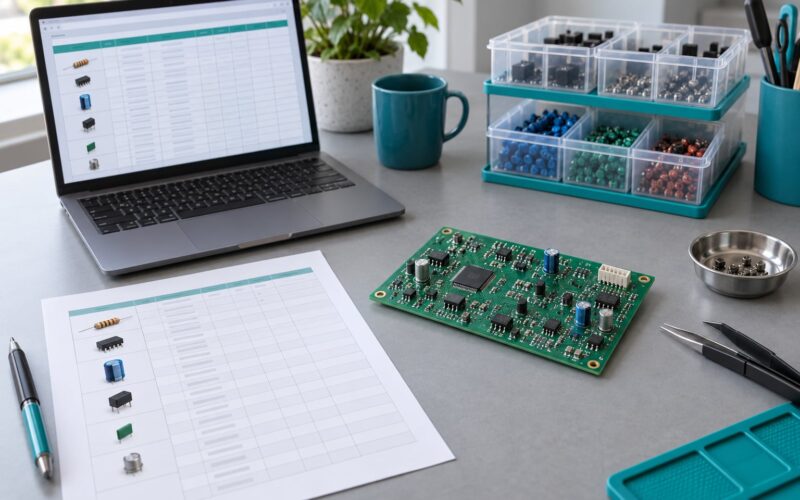
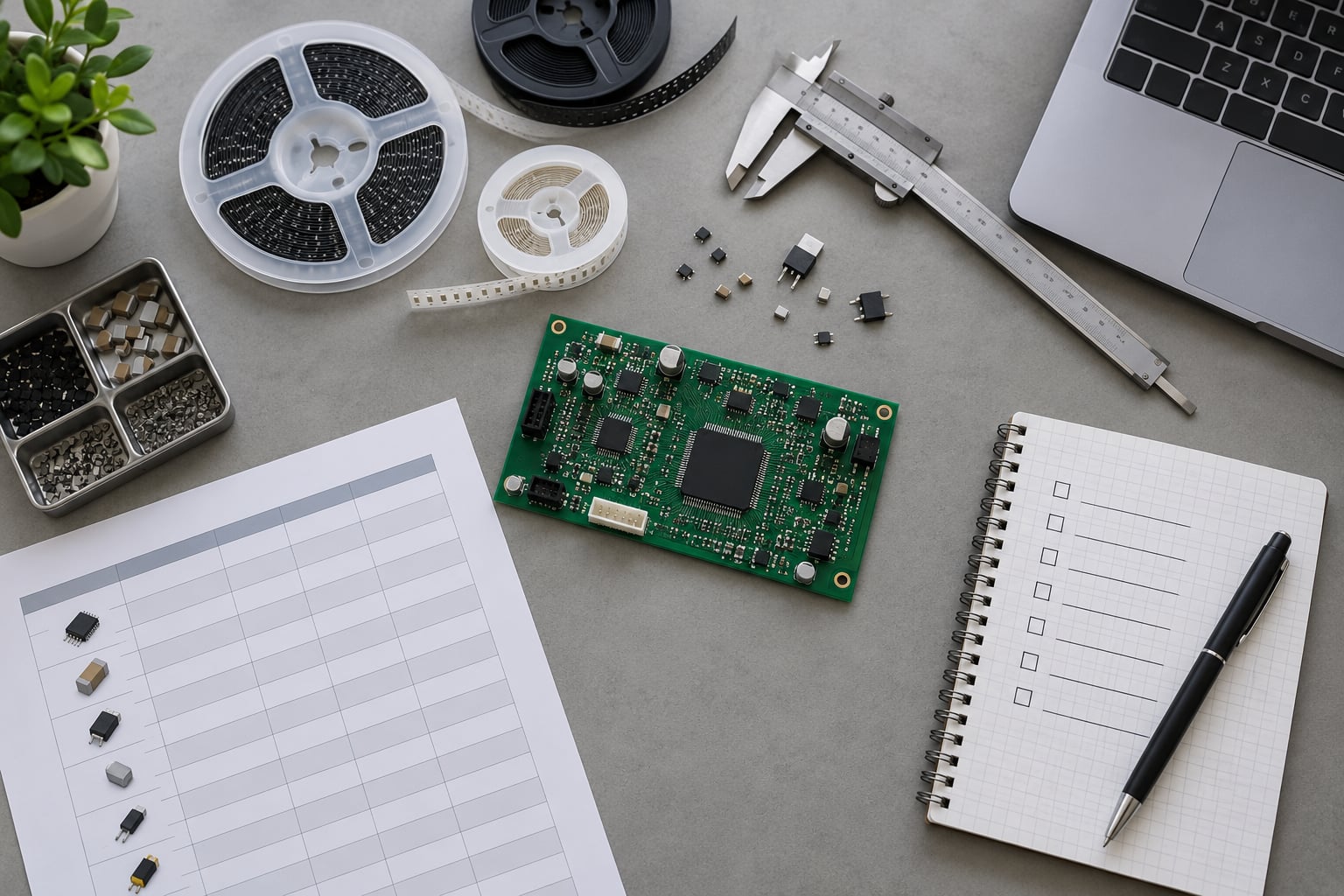
The bill of materials is the document your whole supply chain runs on, and it doubles as a risk register. At minimum, every line needs a manufacturer part number, a description, quantity per unit, reference designators, package type, lifecycle status, an approved alternate, and a sourcing-risk rating.
Mark parts that do not get populated as DNP so a supplier does not charge you for them, and keep alternates inside the BOM rather than in a spreadsheet nobody else opens. A useful risk column ranks each line by how hard it would be to replace: a 0402 resistor is trivially swappable, a specific RF module or memory part often is not.
Whoever wrote the schematic owns technical selection. Sourcing owns channel, price and approvals. At a startup those two jobs sit with two people, and the handover should be written down rather than assumed.
3. Identify the Right Component Types
Architecture decisions drive sourcing, so lock those before shopping for part numbers. Integrated circuits cover the compute and analog blocks. Discretes handle switching and rectification. Passives — resistors, capacitors, inductors — usually make up the majority of line items and the majority of your inspection burden, particularly multilayer ceramic capacitors with tight tolerances.
Connectors, mechanical parts, displays, batteries and modules are each a separate supply chain with separate qualification rules. A battery carries its own certification and shipping constraints. A display has a long quotation cycle and an end-of-life notice measured in years. Modules bundle risk into one line, which is sometimes worth it and sometimes hides a single-source dependency you will discover late.
Choosing a module to save engineering hours trades a component risk for a vendor dependency. Both are legitimate; just make the trade deliberately.
4. Shortlist and Verify Suppliers
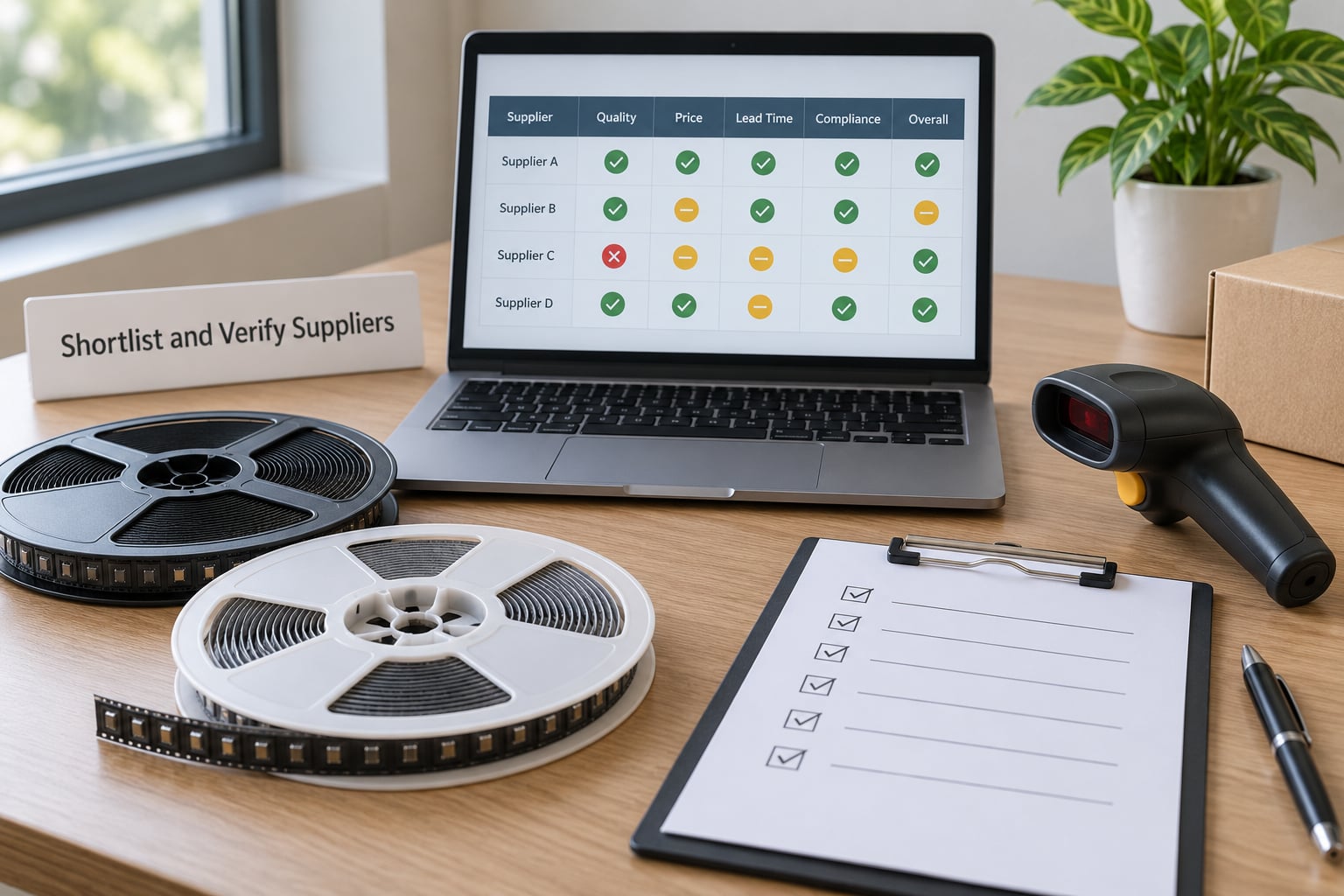
Four kinds of seller show up when you buy parts, and they are not interchangeable. Manufacturers sell direct, usually at volume, and rarely to a company with no forecast. Authorized distributors hold franchise agreements with specific manufacturers and carry full traceability paperwork. Independent distributors and brokers buy surplus and off-market inventory, often at attractive per-unit prices with less documentation. Contract manufacturers and EMS partners may source on your behalf under a consigned or turnkey arrangement.
Verification is mostly paperwork. Ask which manufacturer franchises they hold for the specific part number, request a certificate of conformance for each shipment, and confirm traceability back to the original manufacturer lot. For higher-risk parts, programs such as AS6081 or AS6171 describe how a supplier should control counterfeit avoidance, and databases like ERAI maintain listings of parts that have been reported fraudulent.
If a seller cannot name the manufacturer they are franchised for, they cannot supply that manufacturer’s parts with a warranty. That single question filters most of the noise.
5. Compare Total Cost and Commercial Terms
Unit price is one line in a much longer comparison. Build a sheet with minimum order quantity, non-recurring engineering and tooling charges, freight, duty and tax treatment, payment terms, warranty terms, lead time, and the cost of switching supplier or part later.
That last column is the one founders skip. A part that is slightly more expensive per unit but is a stocked, widely available, form-fit-function equivalent can be worth more than the cheaper single-sourced option, because substitution ability is what lets you respond to an allocation notice instead of missing a build.
Cash flow deserves the same attention as margin. Ordering above your minimum order quantity because it is cheaper per unit still ties up money you may need for tooling or certification. Founders describe the MOQ cash-tie-up as the single most stressful part of planning a first production run, and the arithmetic deserves a line in your model before the purchase order does.
6. Validate Before Committing to Production
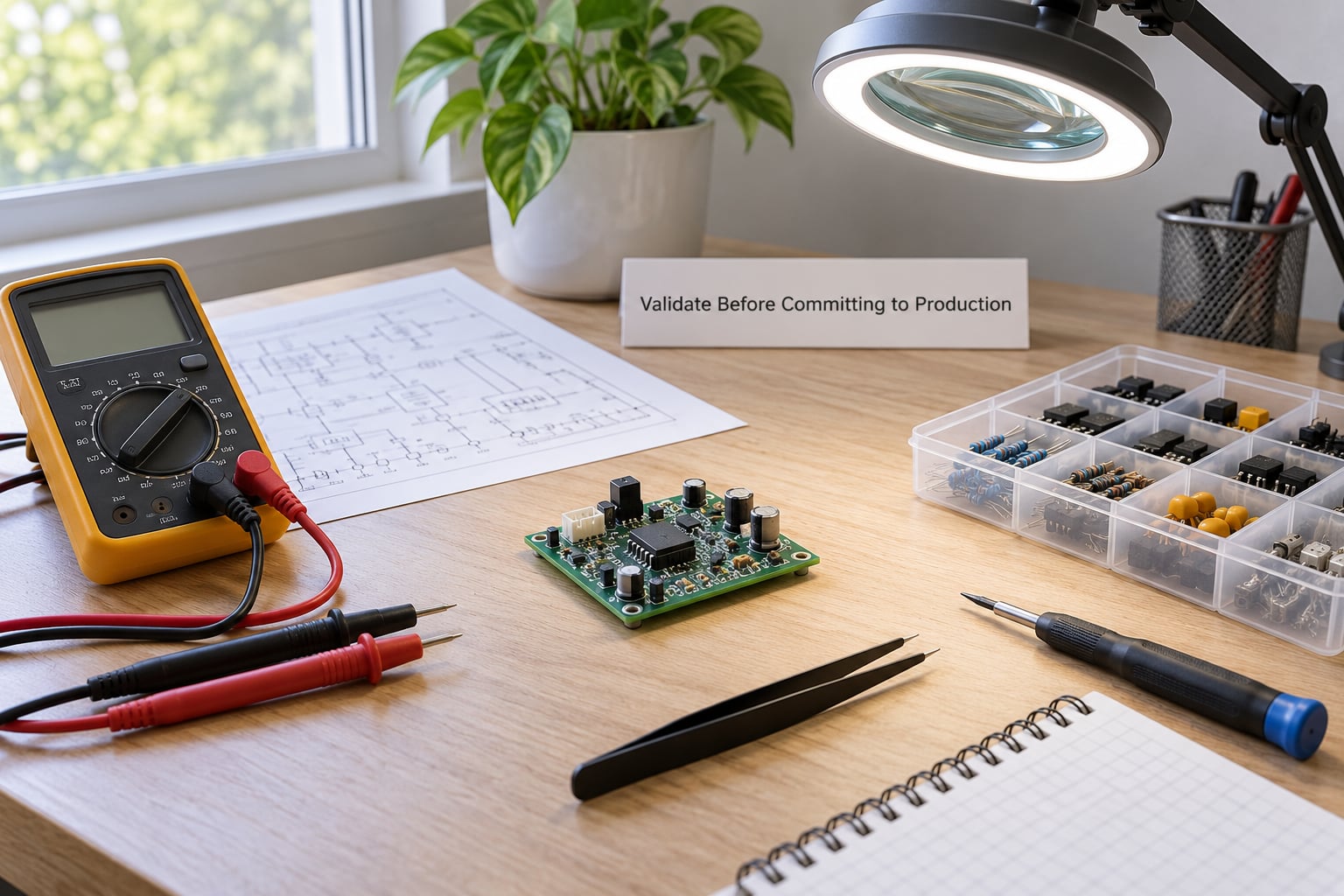
Validation runs from the datasheet outward. Read the part’s datasheet yourself and confirm the operating ranges match what your design assumes — minimum supply voltage, current limit behaviour, thermal derating, and the absolute maximum ratings you plan to lean on. Suppliers will happily quote a part whose worst-case spec does not cover your design.
Then order samples, test them on your own boards, and check the things that only show up on hardware: startup behaviour, tolerance stack-up, thermal rise in the intended enclosure, and whether the assembly process your factory uses handles the package. For anything in a harsh environment, run the reliability work your target market expects, and confirm what certification your assembly requires before you scale.
This step is complete when you hold a golden sample — a known-good unit you keep for the life of the product and compare against any future shipment.
7. Place a Controlled Pilot Order
Your first production order is a learning exercise, not a procurement exercise. Order representative quantities rather than the largest quantity the price break allows, and structure the order so you can learn something: receive the parts into a controlled area, record lot and date codes, sample-inspect against your criteria, and measure first-pass assembly yield at your EMS partner.
Compare what arrived against what was quoted — part marking, package, and any datasheet revisions. A part that ships with a different revision can behave differently in ways your schematic never accounted for. Record what the inspection found, because that record is what justifies tighter inspection on later runs, or its removal.
If yield is poor, fix the process before scaling. Scaling a defect multiplies it.
8. Prepare for Volume and Supply Disruptions
Lead times for mainstream microcontrollers have stretched into multi-quarter ranges in recent years, and that reshapes how you buy. Track quoted lead time per part as a standing field rather than a one-time discovery, and set buffer inventory by risk tier: high buffer on single-sourced, long-lead parts, near zero on commodity passives.
Qualify alternates before you need them. That means identifying a form-fit-function equivalent, confirming it is pin and specification compatible, and buying a small quantity to test on your own board. A substitute you have never assembled is a hope, not a second source.
Give suppliers rolling forecasts with confidence bands, watch lifecycle status on every line, and act quickly on last-time-buy notices. A mature approved vendor list with a per-supplier quality score is what lets a three-person team buy like an organisation with a procurement department.
Common Mistakes
- Vague specifications. The quote looks fine until the part arrives at the edge of its tolerance. Fix: write measurable requirements before the RFQ.
- Comparing unit price only. You ignore minimum order quantity, tooling, freight and switching cost. Fix: compare total landed cost per good unit.
- Ignoring lifecycle status. A part already flagged for end-of-life gets ordered at volume by mistake. Fix: store lifecycle status as a BOM field and review it quarterly.
- Buying outside the authorized channel by default. The lowest quote is sometimes cheap because it came from the spot market. Fix: authorized channels first, exceptions documented and inspected.
- Skipping sample validation. The datasheet passed, the board failed. Fix: test samples on your own hardware and keep a golden sample.
- An incomplete BOM. Missing alternates, package types or DNP flags cause surprises at quote time. Fix: require every line to carry a manufacturer part number and risk rating.
- Never planning alternates. When an allocation lands, you have no second source qualified. Fix: alternate the top single-sourced lines before you scale.
One more deserves separate mention: letting a factory spot-buy your integrated circuits on your behalf without specifying a channel. It keeps a build moving and quietly transfers your counterfeit and substitution risk to a partner you cannot audit.
Frequently Asked Questions
How many components should a hardware startup source first?
Start with the parts your prototype build actually needs, which for a first EVT run is usually a few dozen distinct line items once passives are consolidated. Do not source a full production BOM before the design works on the bench. What you do need before ordering is complete documentation for every line: part number, package, lifecycle status and an alternate.
Should a hardware startup buy electronic components directly from the manufacturer?
Rarely at the start. Manufacturers sell direct to accounts with forecasts and credit terms, which a pre-revenue hardware company does not have. Authorized distributors hold the same parts, carry smaller quantities and arrive with full traceability. Consider a direct relationship once a part reaches a volume where the manufacturer engages, and keep the distributor as backup.
What is the difference between an authorized distributor and an independent distributor?
An authorized distributor holds a franchise agreement with the manufacturer, buys through that channel and ships the traceability paperwork that proves it. An independent distributor or broker buys surplus, excess and off-market inventory, often at lower per-unit prices, with documentation that varies a lot by seller. The price gap is real; the counterfeit exposure gap is bigger.
How much inventory should a hardware startup keep for a first production run?
Buy the build plus a modest buffer on parts that are long-lead or single-sourced, and close to nothing extra on commodity passives where substitution takes minutes. Ordering far above your build quantity ties up cash you may need for tooling and certification, and the extra units do not become cheaper product. Revisit the buffer once you have real yield data from the pilot run.
When should a hardware startup choose an alternate component?
Choose an alternate before you need one if a line is single-sourced, long-lead or already flagged for end-of-life. A form-fit-function equivalent that you have bought, assembled and tested is a genuine second source; one that exists only in a spreadsheet is not. Plan the alternate as its own small validation run, with a schematic change and a re-test of the affected board.
Conclusion
Start with two documents, in this order: a written requirements spec, and a bill of materials where every line carries a manufacturer part number, a lifecycle status and a risk rating. Then pick channels deliberately, authorized distribution by default, and document every exception.
Your next concrete actions are short: qualify suppliers on paper before you need them, validate samples on your own boards, place one controlled pilot order with incoming inspection and lot records, and build alternates for the lines that would stop a build if they vanished. Do those five things and component sourcing basics stop being the thing that scares you in planning meetings.