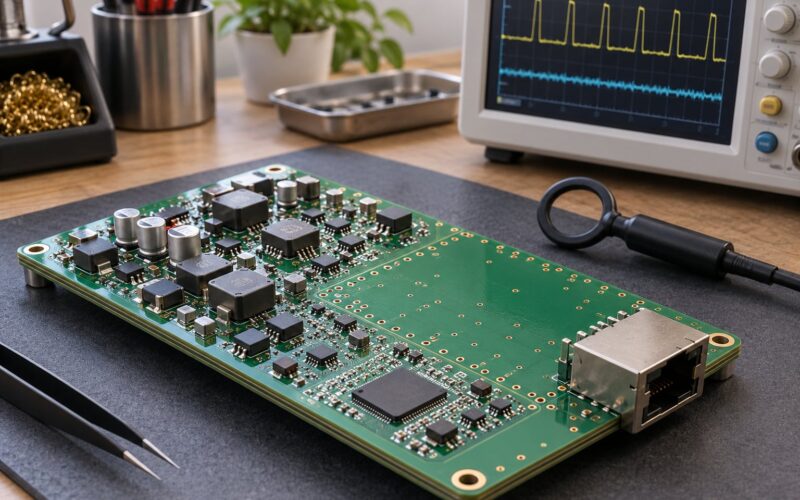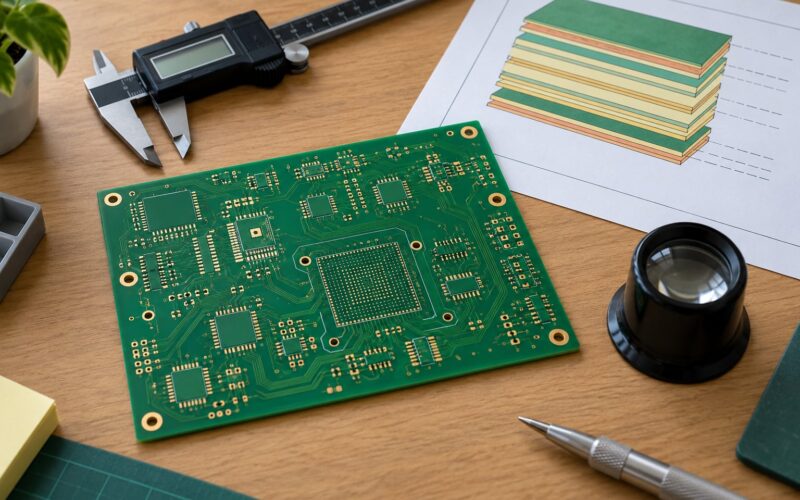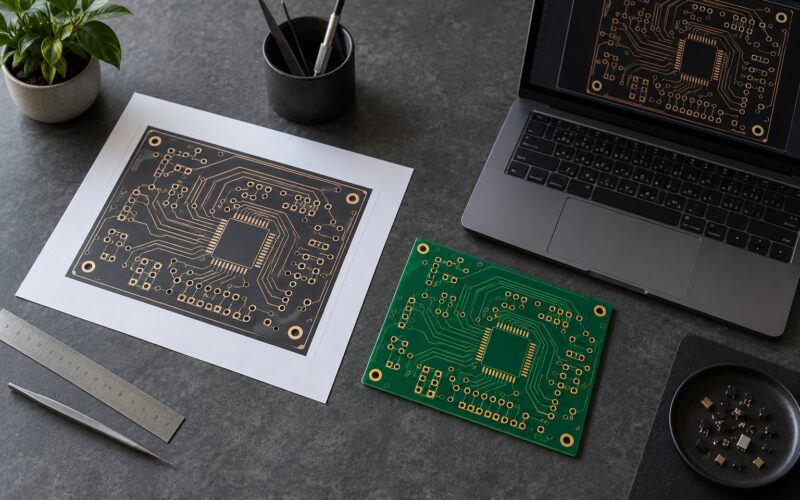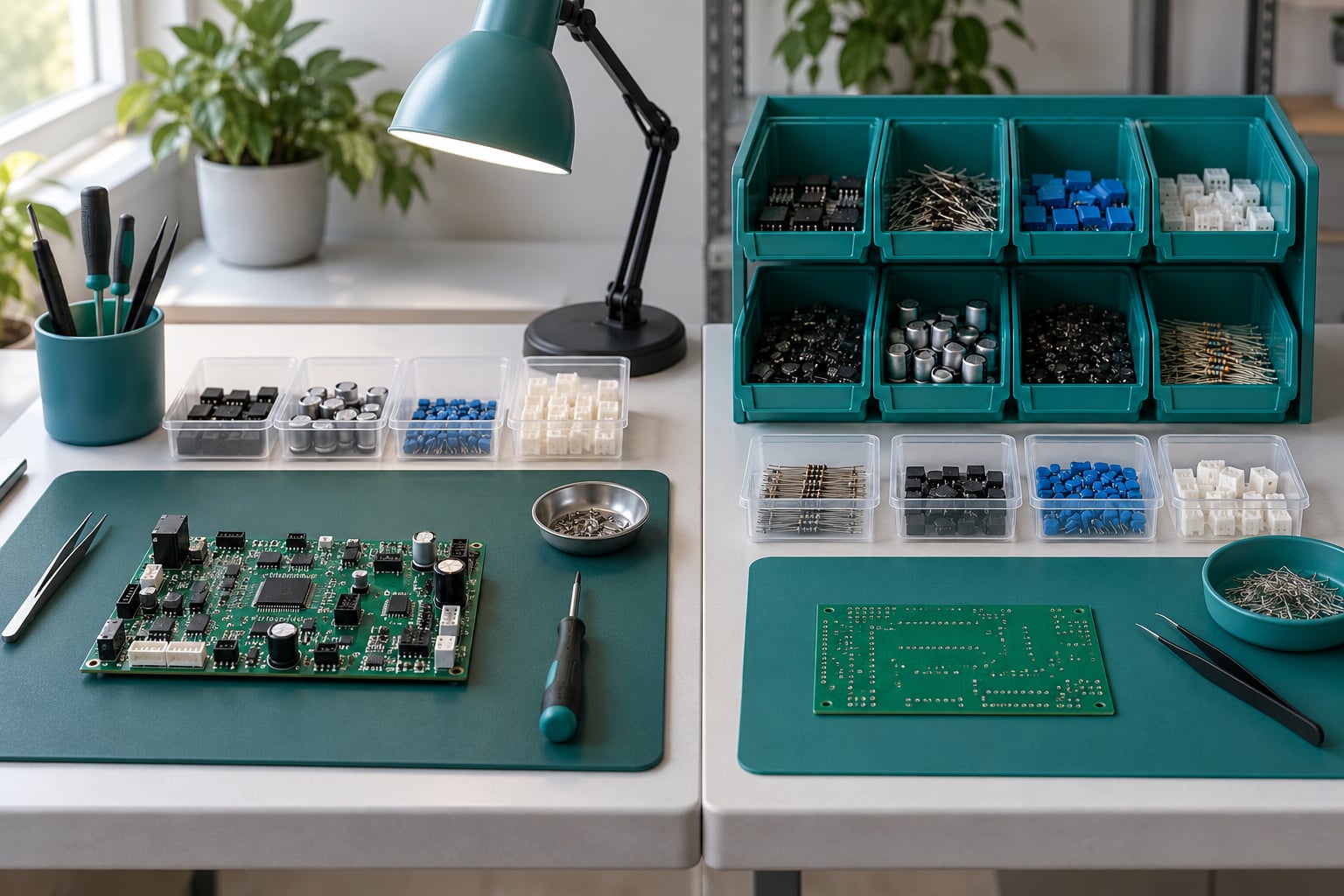
Turnkey PCB assembly is the model where the contract manufacturer buys the components, builds the boards, assembles, tests and ships finished units. Consigned, or kitted, assembly is the model where you buy and ship every component yourself and the assembler does only the build. Turnkey trades money for time and control. Consignment trades time and control for money and visibility.
The entire difference between the two is ownership of component procurement. Everything else – the pick and place, the reflow profile, AOI, testing, packaging – is the same machinery either way.
Getting that choice right early saves a lot of arguing later, because the model you request on your RFQ sets the terms of the contract, the lead time quote and the quality record you end up with. Below is how each one actually works, what it costs in practice, and the point at which the hybrid split is the better answer.
Table of Contents
- Turnkey PCB Assembly vs Consigned Explained at a Glance
- How Parts Sourcing Differs
- How Responsibility and Communication Are Split
- How Cost and Pricing Affect the Decision
- How Lead Times and Supply-Chain Risk Compare
- How Quality Control and Inspection Work
- When Each Model Wins
- Which Should You Choose?
- Frequently Asked Questions
- What is the difference between turnkey and consigned PCB assembly?
- Is turnkey or consigned assembly cheaper per unit?
- Which model gives a faster lead time?
- Can I mix consigned and turnkey parts on the same build?
- How do I keep counterfeit parts out of a turnkey build?
- What do I need to send with an RFQ for each model?
- The Decision in One Line
Turnkey PCB Assembly vs Consigned Explained at a Glance
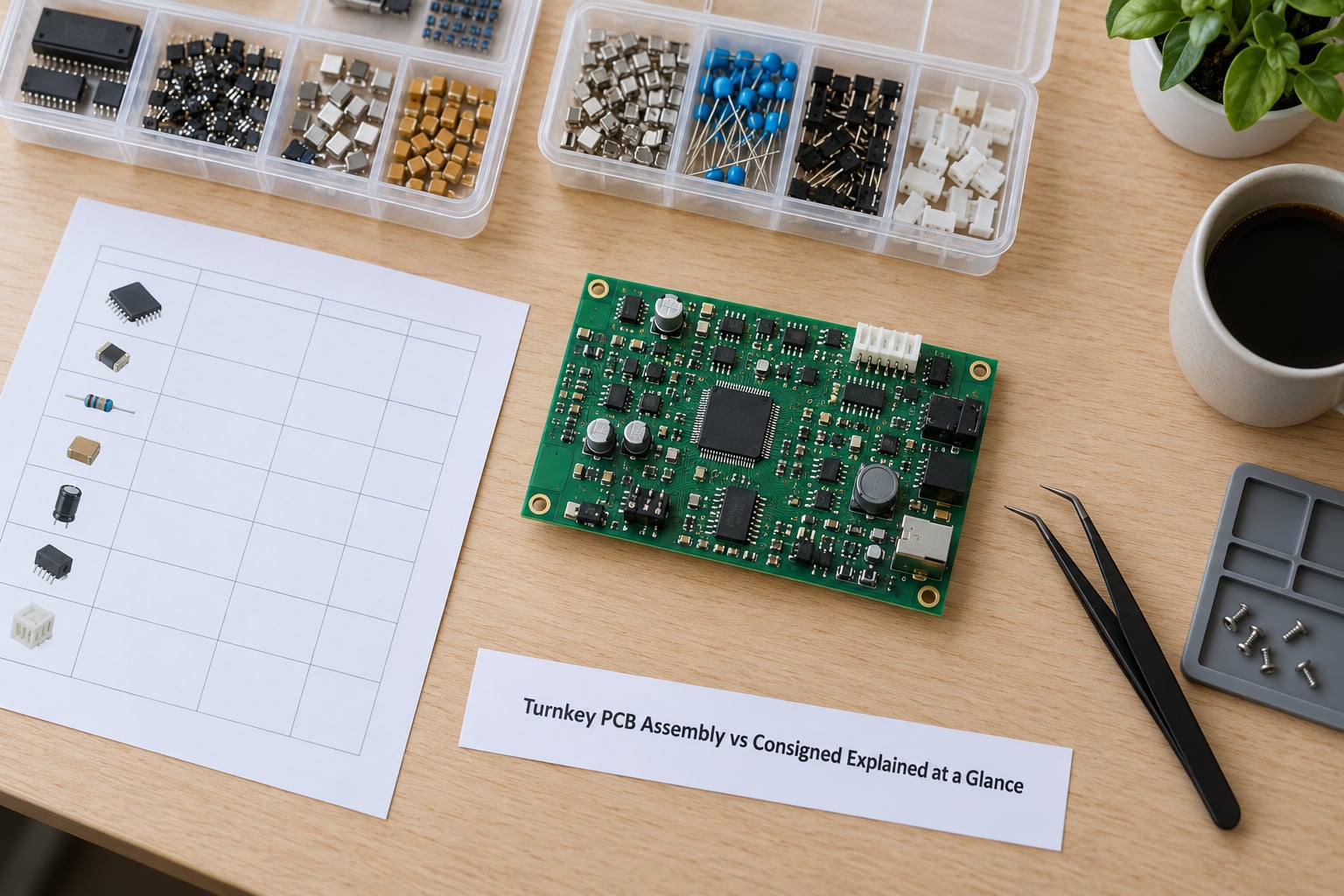
Here is the short version before the detail. In a turnkey build the assembler owns procurement, assembly, inspection and delivery. In a consigned build you own procurement and the kit; the assembler owns assembly, inspection and delivery.
| Criterion | Turnkey PCB assembly | Consigned (kitted) assembly |
|---|---|---|
| Who buys the components | The EMS provider | You, the customer |
| PCB fabrication | Included in the quote | Usually included, often separately priced |
| Assembly and testing | Included | Included |
| Cost structure | Labor plus parts plus a sourcing markup | Labor plus parts at your cost, plus freight |
| Per-unit cost | Higher | Lower |
| Coordination load on you | Low | High |
| Lead time | Driven by the slowest part | Driven by your slowest shipment |
| Substitution control | Assembler proposes, you approve | None needed; kit is yours |
| Traceability burden | Assembler reports lot codes | You supply the evidence |
| Cash tied up in inventory | Minimal for you | All of it sits with you |
| IP exposure | Assembler sees BOM and design intent | Still shared, but scoped to build data |
| Best fit | Prototypes, NPI, small batches | Volume production, stable designs |
One row deserves emphasis. Counterfeit and gray-market risk is not zero in either model, but it sits in a different place. Under consignment, a good EMS provider inspects what you send and will tell you if a reel looks wrong. Under turnkey, you are trusting a sourcing policy you may not be able to audit, which is why the written sourcing terms matter so much.
How Parts Sourcing Differs
Component sourcing is the whole argument. Under consignment you place the orders, pay the invoices, book the shipments and receive the material. The assembler opens boxes and builds what is inside them.
Under turnkey the assembler raises the purchase orders against your approved BOM, deals with backorders, and tells you when a part is on backorder or end-of-life. Nobody buys anything you have not signed off, which is the point most engineers care about.
Shortages behave very differently. On a consigned build, a missing part is your missing part – the line waits, and nobody at the assembly house can fix it for you. Practitioners describe short or late kits as the single most common cause of a stalled consigned schedule.
On a turnkey build, a backorder is the assembler’s problem to solve, usually by proposing an equivalent or alternate package. That is genuinely useful, and it is also where the process needs a hard rule: no substitution without written sign-off from a named person on your side. Engineers on practitioner forums keep hitting builds where a BOM change slipped through without anyone approving it.
Ask any turnkey quote for its sourcing policy in writing: authorized distributors only, or independent sourcing at your risk. Ask for certificates of conformance on the parts it bought. Those two answers tell you more than the rest of the proposal combined.
How Responsibility and Communication Are Split
The build itself runs the same in both models. Solder paste goes on through a stencil, components are placed, the assembly goes through reflow, then inspection and test. What changes is who is holding the baton before and after those steps.
Here is the split as it usually plays out:
- Design data package. Both models need Gerber files, drill files, a BOM with manufacturer part numbers, assembly drawings, and centroid data. Turnkey adds a request for approved alternates and lifecycle information.
- DFM and DFA review. The assembler flags things like panelization, test point access, polarity marks and courtyard overlap. Turnkey providers do this more often because they are also the ones who will have to buy the parts.
- Component procurement. Turnkey: assembler, against your approved BOM. Consigned: you, with a kit built and shipped to their dock.
- Incoming inspection. Consigned builds get a genuine incoming inspection, because the material came from outside and nobody vouched for it. Turnkey builds skip it or keep it light.
- Assembly and soldering. Identical. SMT placement, through-hole or PTH, reflow, wave or hand solder for the odd connector.
- Inspection. Identical. AOI after reflow, X-ray on BGA and QFN work, then visual under magnification.
- Test. Identical, and it is where your test points and fixtures pay off. ICT where the design supports it, FCT where it does not.
- Packaging and delivery. Identical, unless the product is a box build, where the assembler also handles the enclosure, cabling and final pack-out.
Put those duties in the contract rather than in email. The clauses that matter most are the no-substitution-without-signoff rule, the attrition policy, the sourcing policy, and who owns non-conforming material when a lot fails inspection.
How Cost and Pricing Affect the Decision
Consigned assembly is cheaper per unit. That is not an opinion, it is arithmetic: the assembler charges for labor, and you pay for parts at what you actually paid. Under turnkey the same parts sit inside a quote that includes a sourcing markup, and published guidance puts that markup anywhere from a few percent to double the part cost depending on part type and sourcing difficulty.
Small, commodity passives barely move the needle under turnkey sourcing. A hard-to-find RF or power part can carry a markup that doubles its cost. So a single blended markup figure tells you very little about a specific BOM.
Three costs sit outside the per-unit price and are where consignment quietly gets expensive:
- Attrition and over-buy. Both models need spares. Somebody pays for them and somebody has to say so. Under turnkey this is usually absorbed into the quote. Under consignment you may buy 5 percent extra and receive the leftovers back, or be charged a restocking fee for returning them.
- Freight and handling. In consignment you may pay inbound freight on several shipments from several distributors, plus a handling charge for receiving and kitting them. Under turnkey that is inside the quote, which is one of the reasons the real gap is usually narrower than it looks on paper.
- Working capital. Consignment ties your cash up in inventory you own: parts on order, parts in transit, parts sitting in an assembler warehouse awaiting a build slot, and parts left over when the design changes. Turnkey keeps that off your balance sheet.
NRE rarely decides this. Program and test-fixture engineering costs land on you under both models. The real cost driver is volume: at prototype quantities the coordination labor dominates and turnkey wins even at a higher unit price. At production volume the markup compounds across every unit and consignment usually wins.
How Lead Times and Supply-Chain Risk Compare
Turnkey lead time is one number on a quote: build plus the longest part lead time, because the assembler is managing procurement. Consignment lead time is something you build yourself, as the sum of your order lead times, your shipping time, and their queue.
The practical difference shows up when something goes wrong. A backordered part on a turnkey build gets worked around with an alternate. A short kit on a consigned build simply stops, and you learn about it when the line does not start.
Consignment also makes you the one absorbing expedite fees and obsolescence. If a line on your BOM goes end-of-life, that is your problem to solve, not the assembler’s. Turnkey providers handle notices and last-time buys as part of the service, though you should confirm in writing how far ahead they warn you.
On the other side, turnkey means less visibility. You learn a part is unavailable when the assembler tells you, and if you need supply chain visibility into a long-lead item for a launch date, consignment with your own purchase orders gives you more of it.
How Quality Control and Inspection Work
Assembly quality does not differ much between the models. The inspection stack is the same: AOI after reflow for solder and placement errors, X-ray for hidden joints on BGA and QFN, visual inspection under magnification, then ICT or FCT depending on the design.
What differs is where the risk enters and whose paperwork proves it came out clean.
Under consignment, incoming inspection is genuinely load-bearing. The assembler is handling material it did not buy from a supplier it did not choose, so it checks reels, labels and quantities before anything hits the line. You remain responsible for certificates of conformance and lot traceability, because nobody else is.
Under turnkey, traceability arrives as documentation from the sourcing chain: lot codes, certificates of conformance, serialized test reports on request. Demand lot-level records if your product is regulated.
Whichever model you pick, confirm the workmanship class in writing. IPC-A-610 Class 2 covers most commercial work; Class 3 applies to high-reliability builds, and aerospace and defense programs usually carry AS9100 and sometimes export-control obligations. Those are assembly-house qualifications, not model-specific, so ask for them either way.
When Each Model Wins
Turnkey fits a prototype or NPI build. A hardware startup with five boards to assemble, an FPGA in six-week lead time and no procurement hire picks turnkey. Someone places the order, someone chases the backorder, and the team stays on firmware. The per-unit premium is irrelevant at that quantity.
Turnkey also fits high-mix, low-volume work where each build pulls a different BOM and standing inventory of every part would be absurd.
Consignment fits a stable design in volume. A controller that has shipped the same revision for two years, at a few thousand units a year, has a BOM the buyer understands line by line. Buying direct removes a markup layer from every unit and keeps obsolescence risk where it belongs, with the team that made the engineering decisions.
Consignment fits hard-to-source and regulated parts. If your team already has authorized distributor relationships for the analog, power and RF parts that are expensive or risky to buy from the gray market, supplying them yourself protects the sourcing chain. It also protects the build: those are exactly the parts where the schedule slips.
The hybrid is often the honest answer. Consign the ten costly, long-lead, or supply-constrained line items – the MCU, the transceiver, the connectors, the power management – and let the assembler source the passives and the rest from its own channel. You protect the parts that matter and skip the kitting work that does not. Practitioner discussion keeps converging on this split, and it is what I would ask a partner to quote when the answer is not obvious.
Which Should You Choose?
Start with volume and stage, then narrow from there.
Below ten units and design is still moving: turnkey. Coordination cost swamps any markup, and you need speed more than margin.
NPI or first production run with an unsettled BOM: turnkey, or hybrid for the expensive parts. The BOM will change again and you do not want to rebuild a kit for a revision.
Volume production, design stable, procurement capability in place: consignment. The savings are real and repeatable, and your team can manage the inventory.
Regulated program or sensitive IP: either works, but turnkey demands a written sourcing policy and lot-level traceability. Consignment demands that your own supplier documentation is airtight, since you are the one vouching for it.
Two questions settle most debates. Does your team have the hours to manage several distributor orders, shipments and receipts for every build? And do you need a live view of lead times on your critical parts? Yes to the first, yes to the second, and consignment is right. No to either, and turnkey is.
Whatever you choose, send the same RFQ to three partners with the sourcing model stated explicitly in the request. Comparing a turnkey quote against a consigned quote is how people end up with an apples-to-oranges number and a bad decision.
Frequently Asked Questions
What is the difference between turnkey and consigned PCB assembly?
Turnkey is the model where the contract manufacturer buys the components, fabricates the boards, assembles, tests and ships finished units. Consigned, also called kitted, is the model where the customer buys and ships all components, and the assembler handles only fabrication, assembly, testing and packaging. The single structural difference is who owns component procurement.
Is turnkey or consigned assembly cheaper per unit?
Consigned is cheaper per unit because you pay for parts at what you actually paid and the assembler only charges for labor. Turnkey folds components into the quote along with a sourcing markup that can range from a few percent to double the part cost on hard-to-source items. At prototype quantities that premium is usually outweighed by the coordination effort you avoid.
Which model gives a faster lead time?
Turnkey usually wins on quoted lead time, because the assembler manages procurement and can work around a backorder with an approved alternate. Consignment lead time is the sum of your order lead times, inbound freight and their production queue. The real gap appears when a kit arrives short or late, which stops a consigned line entirely.
Can I mix consigned and turnkey parts on the same build?
Yes, and many programs do. This hybrid or partial turnkey model has you consigning the costly, long-lead or supply-constrained items such as the MCU, transceiver, connectors and power management, while the assembler sources passives from its own channel. It protects the parts that matter and skips the kitting work that does not.
How do I keep counterfeit parts out of a turnkey build?
Put the sourcing policy in writing before you sign: authorized distributors only, or independent sourcing at your risk. Require a certificate of conformance on parts the assembler purchased, and lot codes in the shipped documentation. Add a clause stating that no part may be substituted without written approval from a named person on your side.
What do I need to send with an RFQ for each model?
Both models need Gerber and drill files, a BOM with manufacturer part numbers, assembly drawings, centroid data and your test requirements. A consigned RFQ should add quantities and your proposed sourcing plan. A turnkey RFQ should add approved alternates, lifecycle status for each part, your target quantities, and the box-build or packaging scope if you need it.
The Decision in One Line
Ask for turnkey while the design is moving or the quantity is small, and switch to consignment – or the hybrid split – once the BOM is stable and volume justifies owning the parts yourself. State the model explicitly in every RFQ, put the sourcing and substitution terms in the contract, and never let a BOM change happen without a named person approving it.