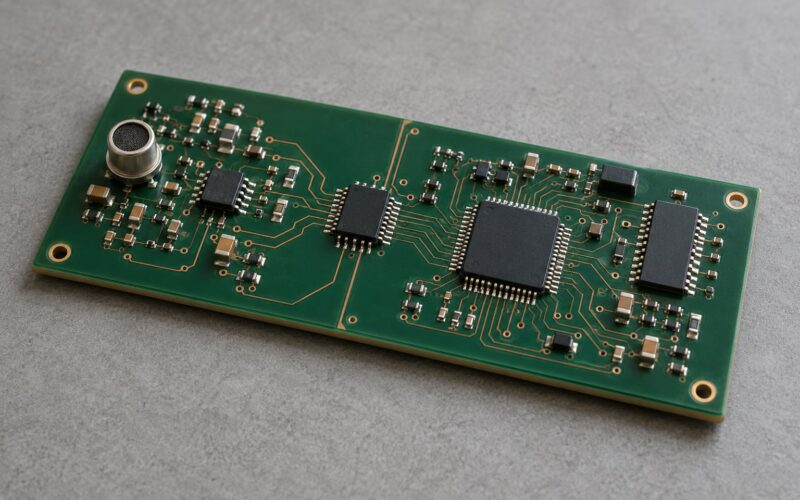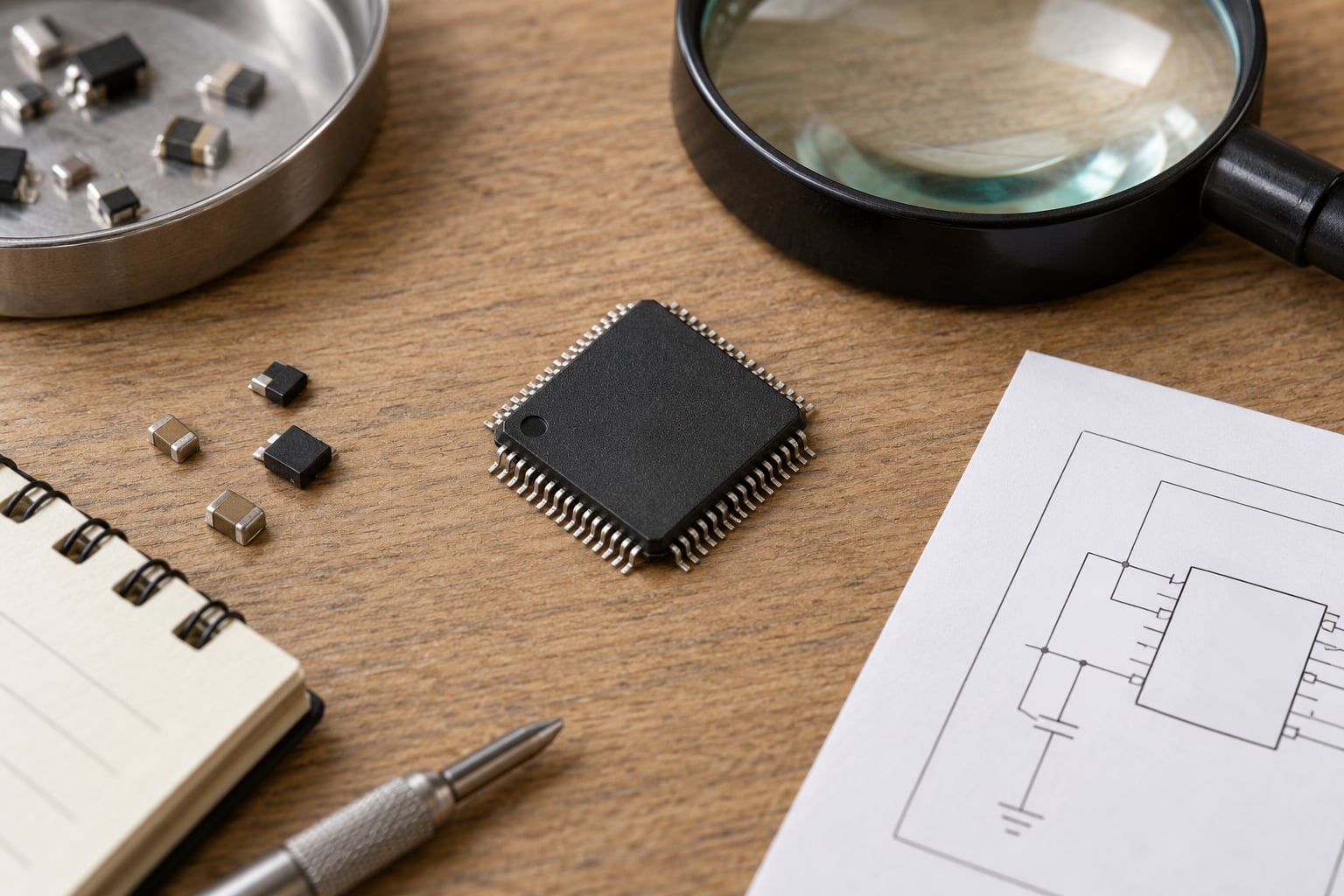
To decode a chip part number, you split the marking into a manufacturer prefix, a base device number, and a set of suffixes that describe the package, temperature grade, packing format and other ordering options. No universal decoder exists, because every maker codes those fields differently, so the only reliable method is to identify the manufacturer first and then read that manufacturer’s own ordering table.
The reason it matters is practical. Two parts can share the same base number and still be impossible to interchange, because one is a 14-pin through-hole DIP, the other a 16-pin surface-mount part, and one is rated 0 to 70C while the other is rated -40 to 85C. A board that mixes them up fails in the prototype, or worse, six months later in the field.
If you have never done this before, the how to decode a chip part number process below takes about five minutes per part once you know which fields to look at. The hard part is never the method, it is a marking that is worn, half removed by a previous repair, or reduced to a three-character code by the package size.
Who this is for: hardware engineers building a PCB library, repair technicians working from a board with no documentation, buyers checking a bill of materials, and anyone who has ever pulled a chip off a board and asked what it actually is.
Table of Contents
- What You Need
- Step-by-Step: How to Decode a Chip Part Number
- 1. Identify the Manufacturer
- 2. Separate the Part Number From the Marking
- 3. Identify the Product Family and Device Type
- 4. Read the Series, Speed, Capacity, and Variant Fields
- 5. Decode the Package and Pinout Suffix
- 6. Check Ordering, Temperature, and Compliance Codes
- 7. Verify With the Datasheet and Distributor Records
- Common Mistakes
- Frequently Asked Questions
- Can I decode a chip part number without knowing the manufacturer?
- What do the letters and numbers on a chip mean?
- Why does the same chip have different suffix codes?
- How can I tell the part number from the date or lot code?
- Is a chip with a similar part number always a drop-in replacement?
- Start With the Manufacturer and Verify the Full Ordering Code
What You Need
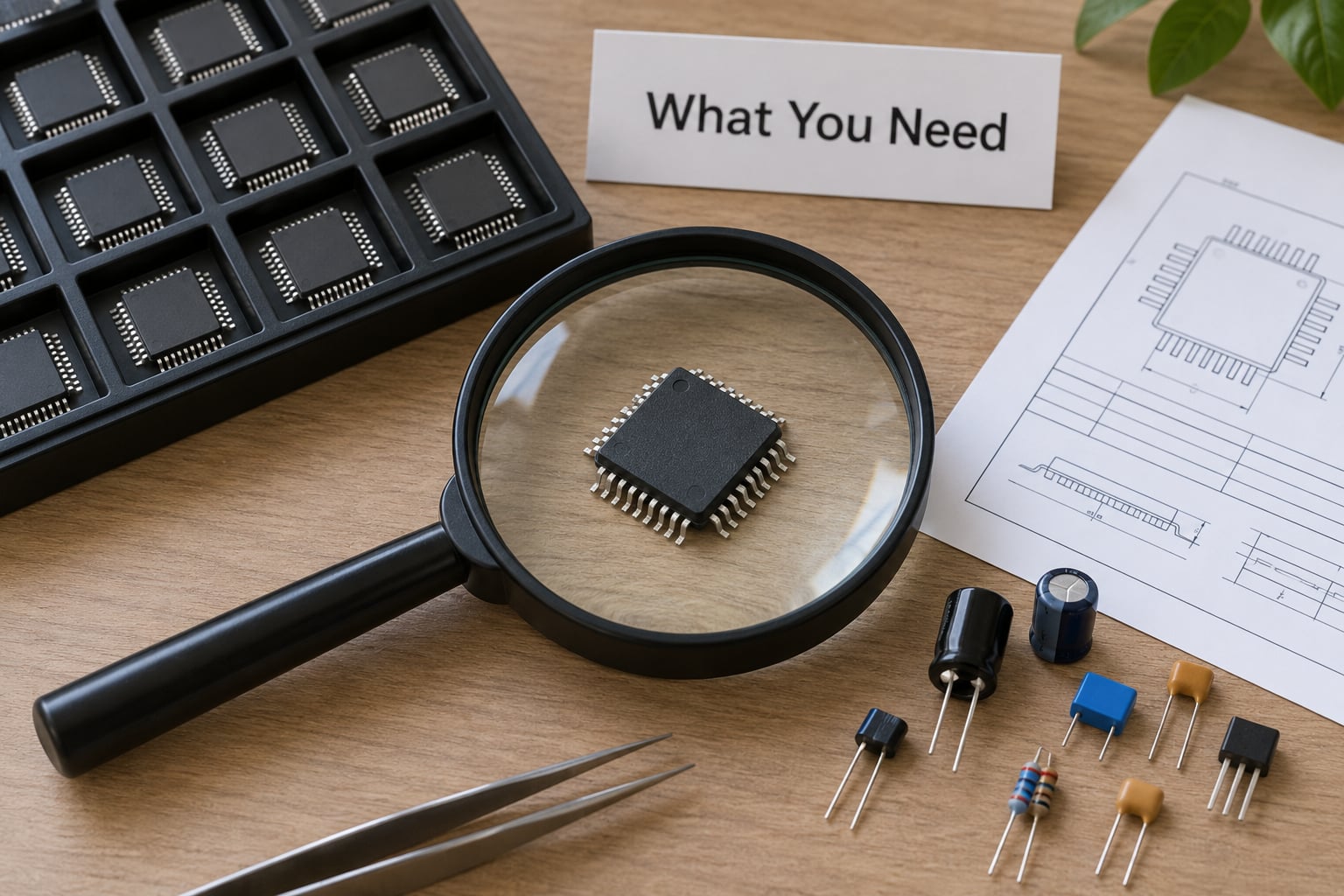
You need very little, and none of it is expensive. The only thing that matters is that you can read the marking cleanly.
- Magnification or a macro photo. A 10x loupe handles most SOIC and TSSOP parts. For QFN, BGA and anything laser-marked, take a photo with a phone at close range in even, shadow-free light and blow it up on screen.
- A clean chip. Flux residue and conformal coating hide markings. Clean the board area with isopropyl alcohol and a stiff brush before looking closely, and hold parts with plastic tweezers, never metal ones that scratch the mold compound.
- The datasheet or assembly documentation. A board-level schematic or BOM tells you what the part is supposed to be, which turns guesswork into verification.
- A manufacturer prefix reference. A printed list or an ECIA member database such as Ultra Librarian resolves the three-character manufacturer code used when no prefix is visible.
- A multimeter. Only needed when pin 1 is ambiguous, for example on a part that has been sanded or has its marking obscured.
- A notebook or a spare line in your BOM. Write down what the code proves and what it does not prove. Ambiguity that is not written down gets repeated.
That is the whole kit. No microscope, no decapsulation, no database subscription.
Step-by-Step: How to Decode a Chip Part Number
Work through these seven steps in order and you will end with either an exact orderable part number or a short, honest list of what you still cannot resolve. The order matters, because each step depends on the one before it.
1. Identify the Manufacturer
Identify the manufacturer first, because no other field in the code means anything until you know whose naming rules apply. Look for a logo on the package, then look for a prefix that matches a manufacturer you recognize.
Most brands keep their internal consistency here. A “SN” prefix almost always means Texas Instruments, an “AD” or “ADP” prefix points to Analog Devices, and an “ATmega” or “ATtiny” string means Microchip, which absorbed Atmel. The table below covers the prefixes you will meet most often.
| Prefix or series | Manufacturer | Typical devices |
|---|---|---|
| SN, LM, TL, CD, UL, TPS, OPA, AMC | Texas Instruments | Logic, amplifiers, regulators, comparators |
| AD, ADP, LT, LTC, MAX | Analog Devices and Maxim | Analog and mixed-signal ICs |
| ATmega, ATTiny, PIC, ATSAM, AT90 | Microchip | Microcontrollers |
| STM32, STM8, STM, L, ST | STMicroelectronics | Microcontrollers, power and analog |
| LPC, PCA, PCF, SC, MCP | NXP | Microcontrollers, interface and power |
| MC, NCP, MM | onsemi | Power, interface, analog |
| TLE, BTS, IR, IFX | Infineon | Power, gate drivers, optocouplers |
| ISL, R5, RL, HD74 | Renesas | Interface, logic, analog |
When there is no logo and no recognizable prefix, the marking may be a three-character manufacturer code registered with the EIA, now maintained by the ECIA. Those codes exist precisely for small packages where the full part number will not fit. Look the code up in a member database rather than guessing, because a wrong manufacturer assumption invalidates everything that follows.
A quick caution: package shape proves nothing about the maker. The same body style is used by dozens of firms.
2. Separate the Part Number From the Marking
Separate the orderable part number from everything else printed on the package, because the marking usually contains two or three unrelated fields that sit right next to the code you care about.
On a typical surface-mount part you will find the device marking, sometimes abbreviated to fit, plus a date code, a lot or assembly code, and a country-of-origin letter group. On older or larger parts, the full orderable part number may be printed with the packing suffix on a second line. Transcribe every line exactly, including anything in brackets, before you start splitting anything.
Date codes are usually four digits, most often year plus week. A lot code is alphanumeric and often encodes the wafer lot plus the assembly site, which is how manufacturers trace a defect back to a fab run. A country-of-origin group is often two or three letters such as PH, MY, TH or SG.
None of that belongs to the orderable part number. If you leave a lot code attached to the end of the base number, every distributor search you run will come back empty, which is the single most common reason a lookup fails.
3. Identify the Product Family and Device Type
Identify the product family next, because the family decides how every remaining character is parsed. The same letter means a pin count on one family and a temperature grade on another.
The category usually falls out of the prefix and the shape of the number that follows. Logic parts look like 74-series or 40-series strings. Memory is recognizable by density and speed-grade codes. Analog and mixed-signal parts usually carry an amplifier, comparator or regulator family name. Microcontrollers tend to have a long family name followed by several digits and letters. Power parts often carry a voltage, current rating or a stacked-die indicator in the family name.
Once you have a family, search the base number alone before going further. The result description should match the function you expect from the board position. If a search on the base number returns a part whose function has nothing to do with where the chip sits on the board, your manufacturer assumption is probably wrong, and it is cheaper to go back to step 1 than to keep decoding on a bad premise.
4. Read the Series, Speed, Capacity, and Variant Fields
Read the digits as family-specific fields for performance, density and configuration, because these groups are defined by the manufacturer and only make sense inside their own family.
On microcontrollers, digits usually encode the device, and letters around them encode pin count, memory size, package and temperature. The classic example is STM32F103C8T6. The F identifies the product line, 103 is the device, C means 48 pins, and 8 refers to 64 KB of flash. On an NXP part such as LPC1768FBD100, 1768 is the device, the F marks a flash-based rather than mask-ROM variant, BD is the package, and 100 is the pin count. On an ATmega328P, the 328 is the device group and the trailing P marks the low-power variant.
Memory is a different pattern again. On DRAM and flash packages, the density code, the organization or voltage letter and a speed-grade letter all appear as short groups, and the speed grade is usually a letter that gets faster as the alphabet advances.
The warning that matters here is short: these meanings come from the manufacturer’s code table for that family. A letter position that means a pin count in one family can mean a revision in another, and nothing in the marking itself tells you which.
5. Decode the Package and Pinout Suffix
The package suffix identifies the body style, and it decides whether the part physically fits the pads on your board.
Package letters cover lead style, body outline, pin count, lead pitch and sometimes an exposed thermal pad. In LM358APWR, taken from TI, LM358 is the amplifier family, A marks the automotive-qualified grade, P is the TSSOP-8 package, and W is the packing format.
| Manufacturer | Letters you will meet | What they usually mean |
|---|---|---|
| Texas Instruments | N, D, PW, DBV, DGN | DIP, SOIC, TSSOP, SOT-23-5, QFN |
| Microchip (Atmel parts) | -PU, -AU | 28-pin through-hole, 32-pin TQFP |
| STMicroelectronics | T in STM32 codes | LQFP, with the letter after it covering temperature |
| NXP | BD, and a trailing number | LQFP body style plus the pin count |
| Standard logic, most makers | N | DIP package, as in the 14-pin SN74HC595N |
Here is the trap that catches experienced engineers too. The same physical body style gets a different letter from each manufacturer, so a code you memorized for one brand means something else entirely on another. Compare the code against the datasheet footprint drawing, not against your memory.
Then confirm the pin count separately. Not every part states it in the code, and a footprint that is one pin short will not detect properly on the bench. Pin 1 is usually marked by a notch at one end of the package, a dot or dimple near one corner, a chamfered bevel, or an e-marker on the body. When the marking is obscured, put the meter in continuity or diode mode and check which corner connects to a known ground pad or a large nearby capacitor, since pin 1 is rarely the ground pin.
6. Check Ordering, Temperature, and Compliance Codes
The final suffixes carry the ordering options: temperature grade, qualification, compliance and packing. These are the fields that decide whether a part is a drop-in fit or a subtle downgrade.
| Grade | Ambient range | How it often appears |
|---|---|---|
| Commercial | 0 to 70C | Often no letter at all, or a plain device number |
| Industrial | -40 to 85C | A grade letter on many families |
| Extended industrial | -40 to 105C | A separate letter on parts that offer both |
| Automotive | -40 to 125C, AEC-Q100 | An A or Q in the suffix, for example the A in LM358A |
| Military | -55 to 125C | An M suffix on screened families |
None of those letters is universal. One manufacturer uses a suffix for industrial grade that another uses for RoHS compliance, so the only safe move is to read the ordering table in the datasheet for that specific device.
Packing follows the same pattern.
| Code | Packing | Notes |
|---|---|---|
| R or a trailing reel letter | Tape and reel | The default for pick-and-place assembly |
| T | Tube | Common for through-hole DIP parts |
| Tray | Jedec tray | Used for larger packages and BGA |
| Cut tape | Small quantities | Often has no code at all |
For logic parts, the family letters before the device number carry their own information. In SN74HC595N, SN is the TI standard-logic prefix, 74 places it in the CMOS-compatible logic range, HC is the CMOS family, 595 is the device, and N is the DIP package. HC parts run from about 2 V to 6 V, HCT adds TTL-compatible input thresholds for mixed 5 V and 3.3 V logic, LS is slower low-power Schottky TTL, and the F families are the faster CMOS variants. Pinning is usually consistent across a logic family, but the supply range and drive strength are not, so never assume a swap across families without checking.
Look for a revision letter too. Silicone or a product-change notice can move a part to a new revision with different errata, and the revision sometimes appears as a trailing letter or as a marking line of its own.
7. Verify With the Datasheet and Distributor Records
Verify the finished decode against the datasheet and authorized distributor records before you order anything, and write down anything you could not resolve rather than closing the gap with a guess.
The most useful search trick is to strip the suffixes and search the base number alone. That single move returns every package variant of the device at once, which tells you what the code fields actually control for that family and often reveals a variant that is available in the package you need.
On the datasheet page, confirm the description, the package outline drawing, the pin count, the pinout table, the absolute maximum ratings, the recommended operating range, the lifecycle status and the revision. Then check the same part on a manufacturer’s authorized distributor listing. If the two descriptions disagree on package or temperature, one of them is stale, and the current manufacturer document wins.
Two extra checks are worth doing on any expensive or hard-to-source part. Buy through an authorized distributor rather than a marketplace reseller, because traceability back to the original lot is what makes counterfeit screening possible at all. And when a part arrives, compare the date code and lot code across the reel. Genuine production lots carry consistent date codes, while re-marked parts usually carry markings that do not match the packaging or the assembly site.
If two candidate parts still fit the evidence equally well, do not choose. Order a sample of one, or ask the manufacturer or the authorized distributor to confirm the orderable code from the marking format they publish.
Common Mistakes
These are the errors I see most often, and each one has a simple fix.
Treating the date code as part of the part number. A trailing 2341 on the top of a chip is a date code, not a variant. Fix: strip all non-ordering fields before you search anything.
Assuming a letter means the same thing everywhere. The suffix alphabet is manufacturer-specific, and even the suffix order changes between brands. Fix: keep the ordering table from the datasheet open while you decode.
Judging the part by package appearance. Two visually identical chips can be entirely different devices, and counterfeit parts are often physically perfect. Fix: decode the marking first, confirm with the datasheet.
Ignoring the temperature grade. This is the failure that bites hardest in the field. A commercial-grade replacement in an industrial enclosure may work on the bench at room temperature and fail in a hot enclosure. Fix: check the ambient range against the worst-case enclosure temperature.
Assuming a similar part number is a drop-in replacement. A different package suffix, pin count or voltage rating makes it a redesign, not a swap. Fix: compare pinout tables line by line, and treat any pin that moves as a board change.
Treating a three-character marking as the orderable part number. On small packages the top marking is an abbreviation, and often a manufacturer code. Fix: search the marking in a component database to get candidates, then confirm the full orderable code.
Ignoring revision and product-change notices. A part can be superseded, and an older datasheet revision can carry different test conditions. Fix: check the datasheet revision date and any errata.
Verifying the marking but not the sourcing. Perfect laser marking proves very little about what is under the lid. Fix: source through authorized distributors, and use x-ray or decapsulation only when the value justifies it.
Frequently Asked Questions
Can I decode a chip part number without knowing the manufacturer?
Not reliably, because the same letter means different things at different companies. What you can usually do is narrow it: match the pin count and package, identify the device category from the number pattern, and look the marking up in a component database that indexes three-character manufacturer codes. Once candidates come back, confirm each one against its own datasheet. Treat the manufacturer as a hypothesis until a datasheet confirms it.
What do the letters and numbers on a chip mean?
The letters and numbers on a chip split into a manufacturer prefix, a base device number, and suffixes for package, temperature grade, qualification, compliance and packing. The digits usually describe the device and its density or performance, while the letters describe how it is built and shipped. Which letter means which field is set by the manufacturer, so the sequence only decodes correctly against that company’s ordering table.
Why does the same chip have different suffix codes?
Because the suffix fields describe ordering options that a customer selects, and each manufacturer invents its own alphabet. One maker uses P for TSSOP while another uses it for a through-hole variant, and a grade letter in one brand means something else in another. The underlying silicon may be identical, but the codes are not interchangeable, which is why swapping letters between manufacturers is the most common cause of a wrong part arriving on the bench.
How can I tell the part number from the date or lot code?
Look at how the marking is laid out. The orderable part number sits on the first line, or across two lines when it is long. A date code is usually a short run of digits, commonly four, and a lot or assembly code is alphanumeric and often carries a site letter. Country-of-origin codes are short letter groups. If you are unsure, search the base number alone: distributor results only populate for real orderable codes, not for date or lot strings.
Is a chip with a similar part number always a drop-in replacement?
No, and this is where most returns come from. A different package suffix means different body dimensions and lead pitch. A different letter can mean a narrower temperature range or a lower supply voltage. A different pin count or a moved pin breaks the footprint outright. Treat any suffix change as a redesign: compare the pinout table and the absolute maximum ratings against your design before you order, and prefer a second source over a guess.
Start With the Manufacturer and Verify the Full Ordering Code
If you do one thing differently after reading this, make it the first step. Read the manufacturer, find that company’s ordering table, and only then split the remaining characters. Everything after that step depends on getting the right one, and it takes seconds to confirm against a logo or a prefix list.
When you finish, make sure how to decode a chip part number ends with evidence rather than inference: the full orderable code, the package and pin count from the datasheet, the temperature grade you need, and a listing from an authorized distributor. If any of those do not line up, say so in your notes instead of closing the gap with a plausible guess. Most of the wrong parts that reach a bench were never ambiguous, they were just never written down.