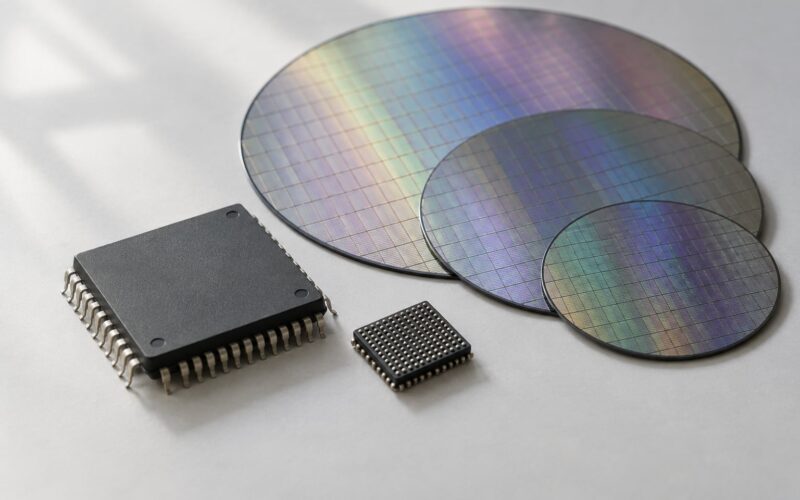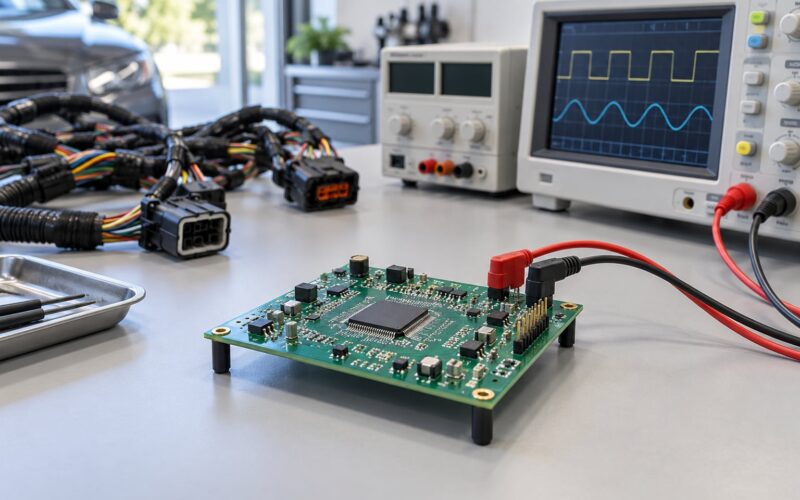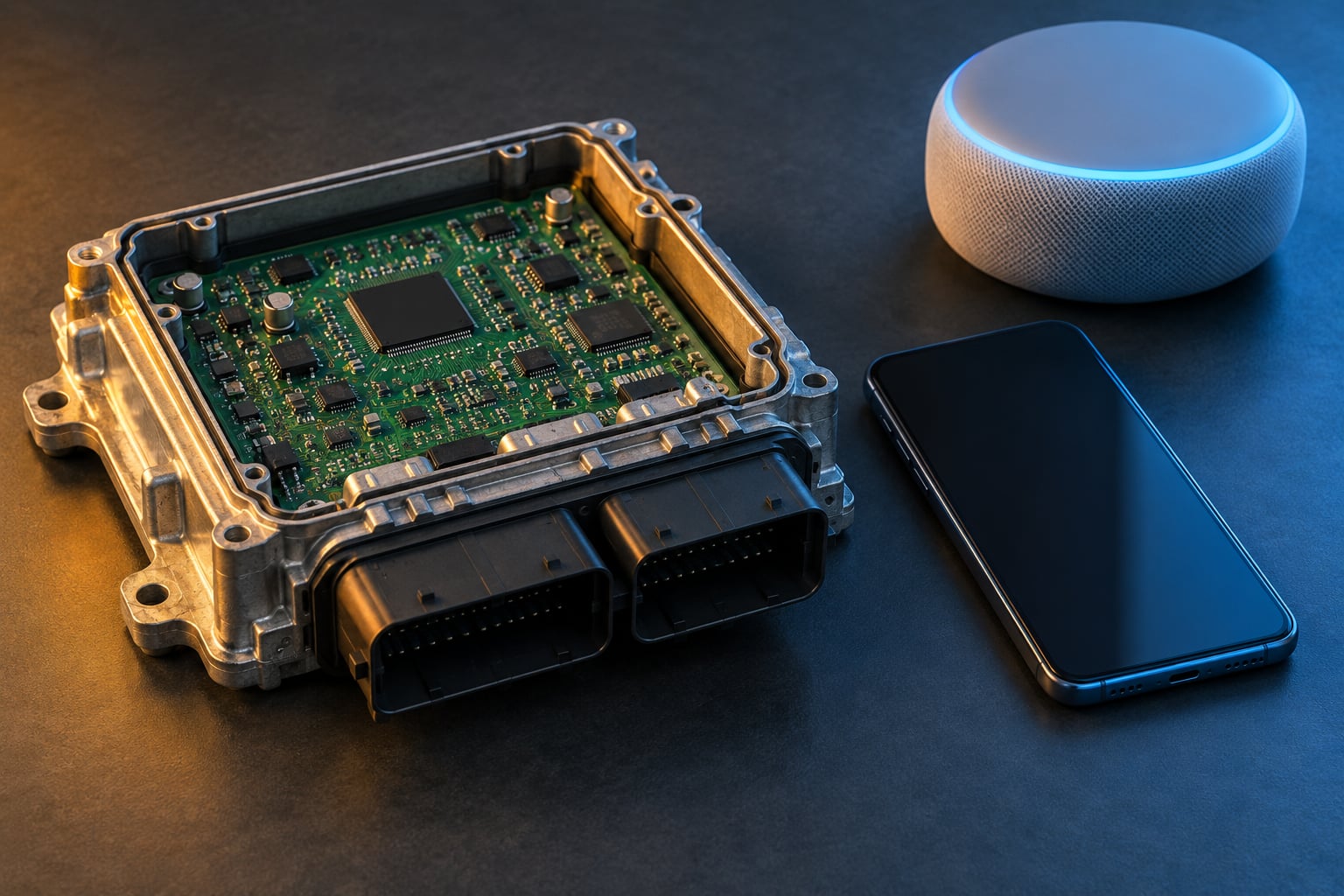
The automotive chips vs consumer chips differences come down to what each part has to survive. An automotive chip is qualified for roughly -40°C to +150°C, constant vibration, electrical transients and a 15-year service life. A consumer chip is built for a benign indoor environment of about 0°C to 70°C and a three-to-five year product cycle.
Same fabs, same processes, often the same transistor design. What changes is the testing, the documentation and the promise the supplier makes about supply ten years out.
For scale, a modern vehicle carries well over a thousand semiconductors: microcontrollers for the engine, transmission, brakes, airbags and body modules, plus an infotainment computer, a telematics unit and dozens of sensors. Almost none of them are visible, and all of them are graded differently depending on where they sit.
Quick answer: Automotive-grade chips are qualified to AEC-Q100 (or AEC-Q101 for discretes, AEC-Q200 for passives) and stress-tested for thousands of hours across temperature, humidity, vibration and voltage transients, then built under an IATF 16949 quality system with PPAP approval and a 15-year supply commitment. Consumer-grade chips follow JEDEC baselines, ship in volume, get replaced every few years, and cost far less per part. Consumer parts are perfectly workable in a head unit or a telematics box, and genuinely wrong under the hood.
Table of Contents
- Automotive Chips vs Consumer Chips at a Glance
- How Automotive Chips vs Consumer Chips Compare
- Reliability and Qualification Requirements
- Failure Rates and Product Lifetime
- Cost, Volume, and Supply Chain
- Performance, Power, and Processing Needs
- Safety, Security, and Software Support
- Which Should You Choose?
- Frequently Asked Questions
- Are automotive chips always better than consumer chips?
- Can you use a consumer-grade chip in a car?
- Is the difference between automotive and consumer chips only temperature?
- What are the AEC-Q100 grades?
- Why do automotive chips cost more than consumer chips?
- Is automotive grade the same as industrial grade?
- What to Choose First
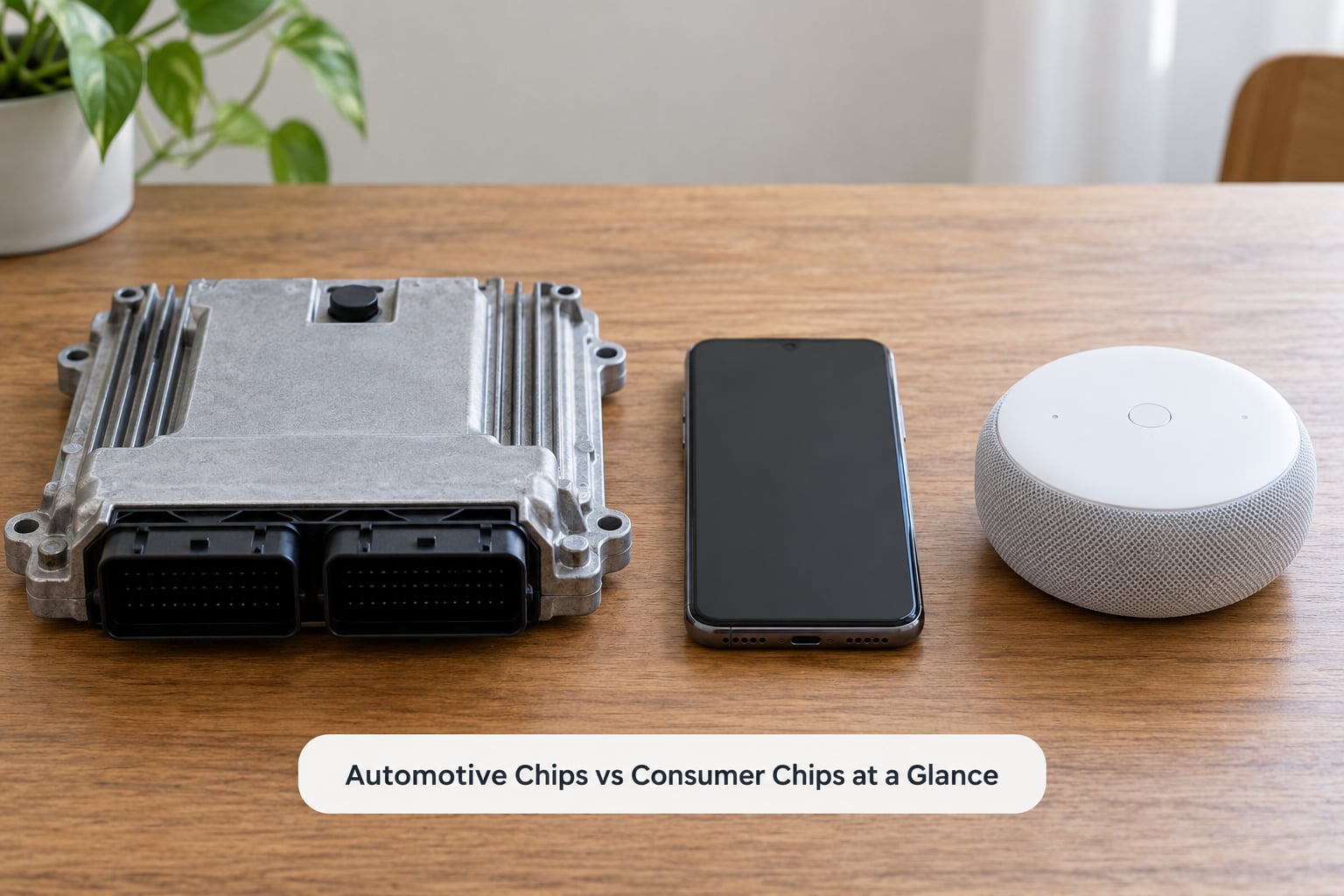
Automotive Chips vs Consumer Chips at a Glance
| Criterion | Automotive-grade chip | Consumer-grade chip |
|---|---|---|
| Typical operating range | -40°C to +150°C (Grade 0), -40°C to +125°C (Grade 1) | 0°C to +70°C (commercial), sometimes -40°C to +85°C (industrial) |
| Qualification standard | AEC-Q100 for integrated circuits, plus IATF 16949 and PPAP | JEDEC baseline qualification |
| Service life target | 15 years in the field, 10 to 15 years of supply | 3 to 5 years |
| Environment | Engine bay, under the hood, exterior body, vibration and salt spray | Indoor, handheld, climate-controlled, or a domestic appliance |
| Electrical transients | Load dump, reverse battery, jump-start, cranking dips | Steady regulated rail from an external adapter |
| Quality target | PPM-level defect control, often zero PPM on mature programs | Standard yield and screen level |
| Functional safety | ISO 26262 with ASIL A to ASIL D targets | No safety case |
| Hardware safeguards | ECC memory, lockstep cores, independent watchdog, diagnostic coverage | Basic parity check or none |
| Cost per part | Typically 2x to 5x a comparable consumer part | Baseline, driven by volume |
| Qualification time before first order | Roughly 12 to 18 months | Weeks |
| Lead time | Often 26 to 52 weeks | Often 8 to 16 weeks |
| Failure consequence | Safety event, warranty claim, recall, line shutdown | Device replaced, customer buys a new one |
| End-of-life notice | Years of notice plus a re-qualification path | Short or no notice |
How Automotive Chips vs Consumer Chips Compare
The two markets optimize for different things. Automotive suppliers are paid to make a part that still works in year fifteen, in a parked car at minus 30°C, and that will still be purchasable in year ten. Consumer suppliers are paid to ship the most capability per dollar in a product that will be replaced in three years.
That single difference explains most of the others. Longer life justifies a lower defect target. A lower defect target justifies more testing, which justifies a higher cost per part. A higher cost per part needs volume to work, which is why automotive parts get long-term supply commitments instead of spot pricing.
One terminology trap first, because it causes a lot of wrong part choices. “Consumer grade”, “commercial grade” and “industrial grade” are used interchangeably in conversation but are not the same thing. Commercial grade means the 0°C to +70°C JEDEC class found in a phone or a set-top box. Industrial grade means an extended range, commonly -40°C to +85°C or +105°C, with somewhat better screening. Automotive grade is a separate qualification, not just a wider temperature window.
Reliability and Qualification Requirements
Automotive qualification is a stress-test program, not a marketing label. AEC-Q100 is a qualification standard written by the Automotive Electronics Council, and that wording matters: a chip is qualified to AEC-Q100, never certified. It is a published set of test conditions, not a certificate that a vendor hands out. A part can be AEC-Q100 qualified and still come from a mediocre manufacturing line, because the standard tests the silicon, not the factory’s discipline.
| Standard | Component type | Scope |
|---|---|---|
| AEC-Q100 | Integrated circuits | Microcontrollers, analog and mixed-signal ICs, power management, logic, SoCs |
| AEC-Q101 | Discrete semiconductors | Transistors, diodes, thyristors, MOSFETs, IGBTs |
| AEC-Q200 | Passive components | Resistors, capacitors, inductors, crystal resonators |
| AEC-Q104 | Multichip modules | Multi-die modules and stacked assemblies |
Consumer parts are qualified against JEDEC baselines, which is a real standard, just a gentler one. Typical consumer-grade parts see a few hundred hours of high-temperature operating life, basic temperature cycling and a shorter humidity test. The automotive set adds power cycling, vibration and mechanical shock, severe electrical transients, a biased humidity test at 85°C and 85% relative humidity, electrostatic discharge immunity, and a strong EMC immunity requirement measured against ISO 11452 and CISPR 25 rather than the consumer limits.
Below the silicon, the process requirements change too. Automotive lines run under IATF 16949, the automotive version of the ISO 9001 quality system, and every new part goes through PPAP, the Production Part Approval Process. That means the buyer receives a full evidence package: control plans, process capability data, dimensional results, material certificates, and a defined reaction plan for anything that drifts. A consumer part arrives with a datasheet and a barcode.
Burn-in screening is where the cost starts to show. Some automotive programs screen every part at elevated temperature and voltage for several days, which catches the early failures a normal test misses. Component distributors quote this screening at a small per-part adder, and buyers routinely treat the number as higher than it needs to be when the failure consequence is modest.
Failure Rates and Product Lifetime
What physically kills a consumer chip in a vehicle is worth understanding, because the mechanisms are specific rather than general. Under the hood, temperature swings from a cold soak at dawn to a hot soak in traffic, and the mismatch in expansion between a die, its bond wires and its package produces the package cracking engineers call popcorn cracking. Humidity plus bias drives corrosion of bond wires and metal traces. Repeated long thermal exposure shifts device parameters, so a regulator drifts out of its dropout window and the ECU behind it starts resetting.
The nastiest failures come from the electrical side. A load dump from a jump start or a removed alternator puts a spike on the supply rail that a consumer part has never been asked to survive, and without protection that spike avalanches junctions and kills the die. That kind of damage is usually sudden and terminal rather than gradual, which is why transient protection is a system design requirement and not something a temperature rating can compensate for.
Lifetime assumptions differ just as sharply. A phone maker assumes three years of use before the device is replaced and assumes some early failures are acceptable because the customer can simply buy another phone. An automotive supplier assumes 15 years of service, 150,000 km or more, and has to model failure rates low enough that the predicted fleet failures do not turn into a recall. That is a different order of consequence, and it flows backwards into the test plan.
Supply longevity is the other half of the story. An approved part that goes end-of-life triggers a re-qualification cycle commonly quoted at 18 to 24 months, and the new part may not be a drop-in replacement even if the package matches. A lot of the difficulty in the pandemic-era automotive chip shortage came from this: a large share of powertrain, body and chassis silicon sits on mature nodes, and there was no unqualified consumer substitute waiting on the other side of the shortage.
Traceability comes with the same territory. Automotive parts are laser-marked and lot-traceable so a suspect population can be bounded, and counterfeit screening is a real cost line because a suspect part in a braking controller is a liability that cannot be priced by its invoice value. Buying through authorized distributors is the boring answer that keeps coming up for good reason.
Cost, Volume, and Supply Chain
The cost premium is real and it is usually quoted as a range. Component buyers commonly see an automotive-qualified part cost two to five times a functionally similar consumer part at volume, and grade choice moves within that: Grade 0 parts carry a noticeably higher price than Grade 1 because the die and package work harder at +150°C. Any comparison of automotive chips vs consumer chips differences lands on that ratio first, and it is the least useful number in the set.
| Cost element | Typical effect on an automotive program |
|---|---|
| Silicon and packaging | Larger die, more robust package, better materials |
| Qualification | 12 to 18 months of testing per component family |
| Quality system | IATF 16949 line, PPAP approval, lot traceability |
| Screening | Optional burn-in and enhanced test coverage |
| Supply commitment | Capacity reserved years ahead, long-term agreements |
| Admin burden | Document handling, audits, change control, requalification after any part change |
| Offset | Lower field failure rate, no recall exposure from that component |
What the premium buys is not a better chip in the laboratory sense. It is a documented probability distribution over fifteen years, plus a supplier who is contractually still there when you need to build the same vehicle in year twelve. Automotive programs are also usually structured through Tier 1 and Tier 2 suppliers, where the Tier 1 builds the module for an OEM and owns a large share of the qualification burden and the liability.
Consumer supply runs the opposite way. Short cycles, frequent process migrations, product refreshes every year or two. That is efficient for a phone and awkward for a vehicle program, which is why lead times of 26 to 52 weeks for automotive parts against 8 to 16 weeks for consumer parts is the kind of planning difference that shapes a whole sourcing strategy.
Some of the newest automakers have pushed back by designing more silicon in-house, which compresses the design cycle and gives better control of the supply relationship. It does not change the qualification math, but it does move who carries it.
Performance, Power, and Processing Needs
Neither category is simply faster than the other, because they are optimized for opposite workloads. An engine control unit needs deterministic real-time control: fixed interrupt latency, tight loop timing, fast and predictable I/O, and a part that behaves identically hot and cold. Infotainment and ADAS need a different animal entirely: an application processor or SoC with a large GPU, big memory bandwidth and a rich software stack, closer to what ships in a phone than to a powertrain MCU.
That difference in workload shows up in the memory. Automotive MCUs for safety-critical paths increasingly carry ECC on every memory array, lockstep cores for ASIL D designs, an independent watchdog with a question-and-answer protocol, and voltage and clock monitors. The overhead is real in silicon area and clock budget, and it buys diagnostic coverage that lets a safety case argue a single fault will be detected in time.
Power and thermal budgets are also different shapes. A phone is a power problem with a cooling solution attached; a battery management system is a power problem where the chip sits next to a pack that can thermally runaway. In an EV the numbers get harder: 400V and now 800V architectures push traction inverter design toward silicon carbide devices, and current sensing in the battery management system has to hold accuracy across a wide temperature range while something physical depends on it.
One thing surprises people coming from consumer electronics: a lot of automotive silicon is built on mature process nodes rather than the newest ones. Automotive programs favor predictable, long-lived processes over leading-edge density, and that is a deliberate reliability and supply decision, not a technical failure.
Safety, Security, and Software Support
Functional safety and cybersecurity are often treated as one topic and they are not. Functional safety under ISO 26262 is about preventing or controlling hazards from a system failure, graded ASIL A through ASIL D by how severe the hazard and how often the vehicle is exposed to it. An airbag controller, a brake-by-wire system and a seat heater relay do not carry the same ASIL, and the hardware measures differ accordingly. A frequently repeated claim that ASIL D is stricter than aerospace is not something to lean on; the standard is specific about what it requires, and that is the part worth reading.
Cybersecurity under ISO 21434, the SOTIF standard and UNECE R155 and R156 address a different failure mode: a system behaving exactly as designed while something outside compromises it. Secure boot, signed firmware, encrypted communication and hardware root of trust are the usual controls. Consumer chips increasingly have some of these, because phones and routers need them, but the automotive expectation is that they are validated, documented and updatable over the vehicle’s life.
Software support is the difference most often overlooked. A car built this year will still be on the road fifteen years from now, and it needs security patches, bootloader fixes and driver support for that whole window. A consumer platform is expected to receive updates for a few years and then to be replaced. That obligation shapes which silicon you can use, and it is one of the strongest technical arguments against putting an unbranded, unsupported part in a safety-adjacent module.
Which Should You Choose?

Start from the consequence of failure and work backwards. That single question resolves most cases faster than any datasheet comparison.
Automotive-grade is mandatory for engine and transmission control, brake-by-wire and ABS, airbag and restraint systems, battery management, traction inverters, emissions sensors, ADAS safety paths, and anything mounted in the engine bay or exposed to the weather. If a failure can injure someone or trigger a recall, the cost of the part is the smallest number in the equation.
Automotive-grade is optional in a real and defensible gray zone. Infotainment head units, telematics connectivity, USB and ambient lighting electronics, seat and window convenience modules and body comfort controllers are usually fine with commercial or industrial parts, because the failure is a dead screen or a lost connection rather than a hazard. Many volume vehicles do exactly this deliberately, with different grades in one box. Two caveats keep it honest: the temperature inside a parked car in summer still runs high, so pick the grade from the measured environment rather than the label on the box, and confirm the supplier will support the part for the life of the program.
Industrial grade is the middle answer for industrial control, building and energy equipment, and test instrumentation, and it is genuinely the right call for low-risk automotive functions that sit in the cabin and need more temperature headroom than a consumer part offers.
Automotive grade outside cars makes sense for medical-adjacent, mobility, agricultural and heavy-equipment products where a long supply window and a documented safety argument are worth paying for, even where the industry does not demand the qualification.
One habit worth adopting: compare datasheets rather than trusting the grade word. As practitioners on engineering forums repeatedly point out, the label tells you little about a specific part’s transient tolerance or its data retention behavior, and the datasheet tells you everything. A forum thread on industrial versus automotive parts reached exactly that conclusion from engineers with the parts on the bench.
Frequently Asked Questions
Are automotive chips always better than consumer chips?
No. Automotive-grade chips are built for harsher environments, longer life and documented safety, which is exactly what you want in an engine control unit and mostly unnecessary in a head unit. For an infotainment or telematics module, a commercial or industrial part with a verified temperature range is a legitimate choice. Judge each part on the consequence of it failing, not on its grade label.
Can you use a consumer-grade chip in a car?
You can, in the right places. Cabin electronics, connectivity, lighting and comfort modules are frequently built with consumer or commercial parts. You should not, in an ECU, transmission controller, brake system, airbag module, battery management system or any engine-bay part, because those need extended temperature, transient immunity, safety diagnostics and a 15-year supply commitment.
Is the difference between automotive and consumer chips only temperature?
No, temperature is the most visible difference and the least important on its own. Automotive qualification also adds power cycling, vibration and shock testing, biased humidity at 85C and 85 percent relative humidity, severe transient immunity including load dump, stricter EMC targets, functional safety hardware, burn-in screening and a documented PPAP quality package.
What are the AEC-Q100 grades?
AEC-Q100 grades are ambient temperature grades for integrated circuits. Grade 0 covers -40C to +150C for engine bay and harsh under-hood locations, Grade 1 covers -40C to +125C for most under-hood ECUs, Grade 2 covers -40C to +105C for cabin and body modules, and Grade 3 covers -40C to +85C for less demanding cabin positions.
Why do automotive chips cost more than consumer chips?
The premium buys testing, documentation and supply. A comparable consumer part is typically two to five times cheaper per unit, and the difference covers larger die and more robust packaging, 12 to 18 months of qualification, IATF 16949 production controls, PPAP approval, lot traceability, optional burn-in screening, and a long-term supply commitment with end-of-life notice.
Is automotive grade the same as industrial grade?
No, they are different qualifications. Industrial parts are usually screened and rated for an extended commercial range such as -40C to +85C or +105C, while automotive parts are qualified to AEC-Q100 with harsher transients, functional safety development, PPAP and a 15-year lifecycle. Industrial parts are not automatically acceptable in a safety-critical vehicle module.
What to Choose First
Define the constraints before you compare anything: what is the worst consequence of this part failing, what is the hottest and coldest environment it sits in, how long must the product live, and can you still source the part in ten years. Once those four are written down, the automotive chips vs consumer chips differences collapse to a single grade decision, and the remaining work is performance and cost.
Only then is the cost premium interesting. It is a small number next to a recall, and an expensive one next to a cabin light that is never safety critical. The engineers who get this right are rarely the ones with the strictest specification; they are the ones who asked the failure question before anyone else did.