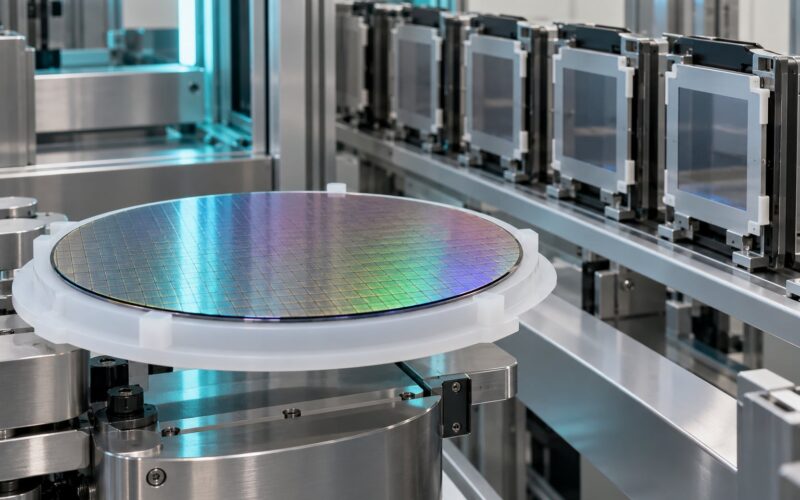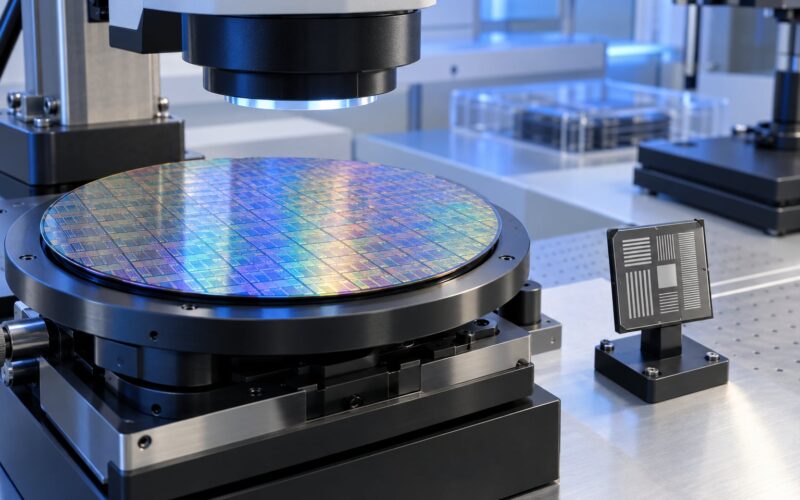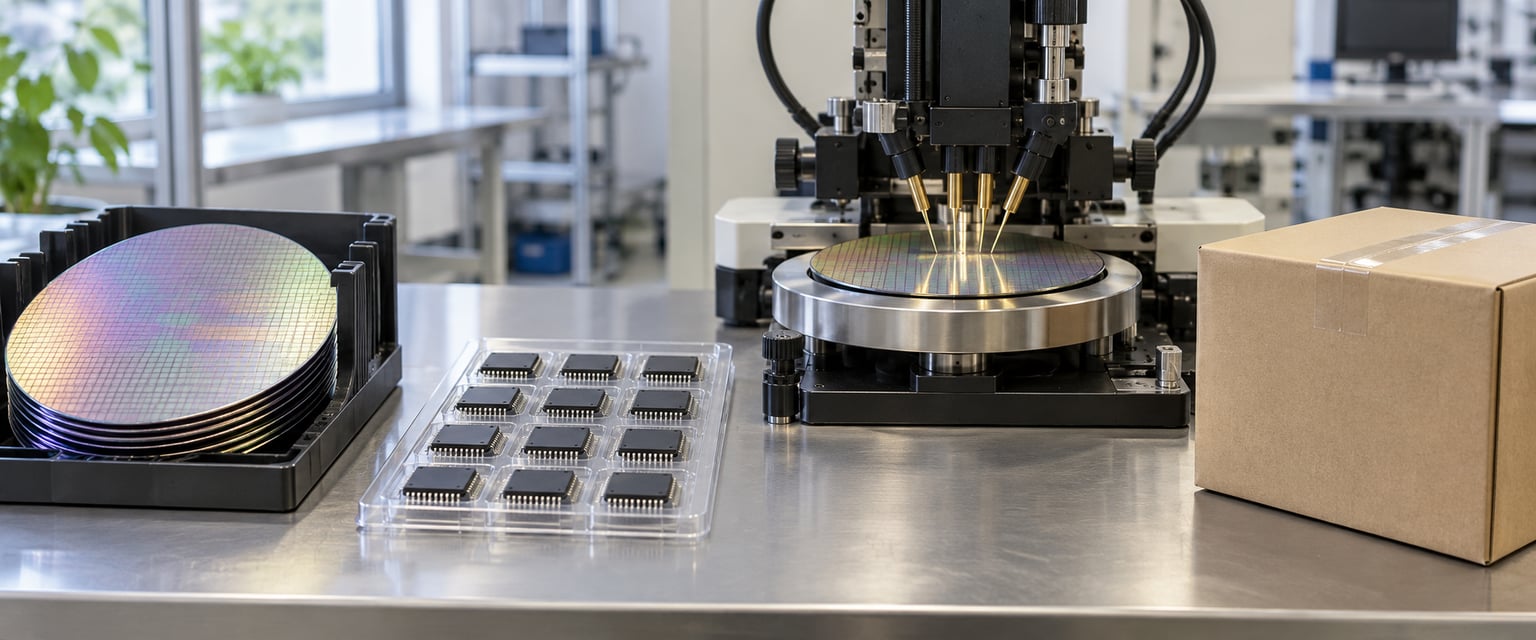
Chip lead times are long because semiconductor capacity is built years in advance and cannot be expanded on demand, and because every chip passes through several separate layers — fabrication, packaging, test, board assembly, distribution — where each layer has its own queue. When demand rises faster than capacity, the slowest layer sets your delivery date.
If you have ever watched a confirmed purchase order for a microcontroller sit for months with a supplier repeatedly quoting a new date, this is not your purchasing team’s problem. It is how the industry is built.
The rest of this guide breaks the delay down layer by layer, from mask preparation to the shipment leaving the distributor’s dock, and finishes with what you can actually control. Figures reflect market conditions in 2026; the numbers move, the structure behind them does not.
Table of Contents
- What Are Chip Lead Times?
- Why Do Chip Lead Times Get So Long?
- Which Semiconductor Supply Chain Stages Create the Biggest Delays?
- How Does Limited Foundry Capacity Affect Lead Times?
- How Do Equipment and Materials Shortages Slow Production?
- What Makes Advanced Chips Take Longer to Manufacture?
- How Does Packaging and Testing Create Lead-Time Bottlenecks?
- How Do Demand Spikes and Forecasting Errors Affect Lead Times?
- How Do Logistics, Export Controls, and Geopolitics Add Delay?
- How Can Companies Reduce or Manage Long Lead Times?
- Frequently Asked Questions
- What does a 4 week lead time mean?
- What is the expected lead time for semiconductors in 2026?
- Is there going to be a chip shortage in 2026?
- How difficult is chip manufacturing?
- How long does a semiconductor last?
- Is the semiconductor industry declining?
- Conclusion: Start With the Bottleneck, Not the Delivery Date
What Are Chip Lead Times?
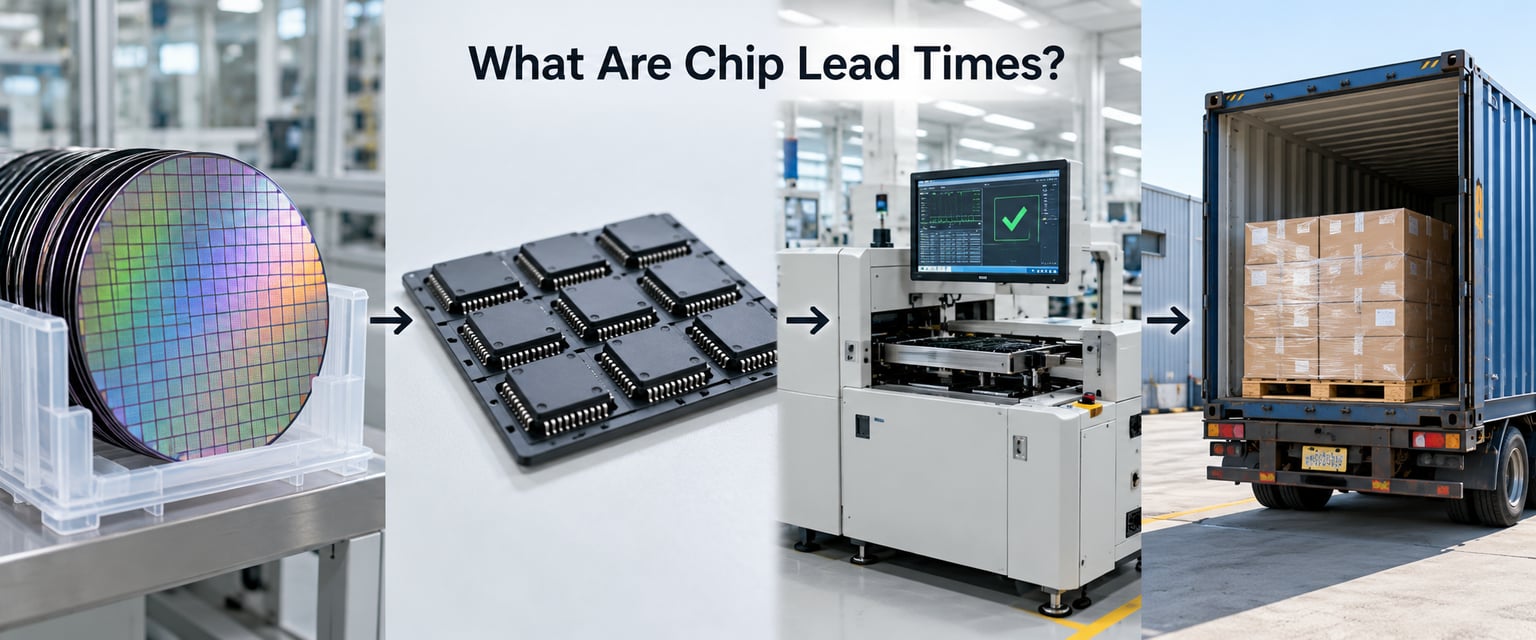
A chip lead time is the elapsed time between placing an order and receiving the finished part, ready to put on a board. For a mature analog part sold through distribution it might be a handful of weeks. For an advanced AI accelerator or an automotive-grade memory device it can exceed nine months.
The term covers four different clock times that buyers often confuse:
- Wafer fabrication — the foundry growing silicon through hundreds of process steps in a clean room.
- Assembly and packaging — an OSAT (assembly, packaging and test) house cutting the wafer, attaching the die to a substrate, and moulding the package.
- Test — wafer probe, final test, and burn-in on finished parts.
- Delivery — test results, packaging, customs, and ground transport to your dock.
These run partly in parallel and partly in series, which is where the confusion starts. A wafer that finished fabrication three months ago may still be sitting in an OSAT queue with no substrate allocated. On paper the chip exists; in practice it is not orderable.
There is a second distinction worth nailing down early: quoted lead time versus delivered lead time. The first is what a distributor or factory sales team tells you. The second is what actually arrives. Under allocation those two numbers can diverge by months.
Why Do Chip Lead Times Get So Long?
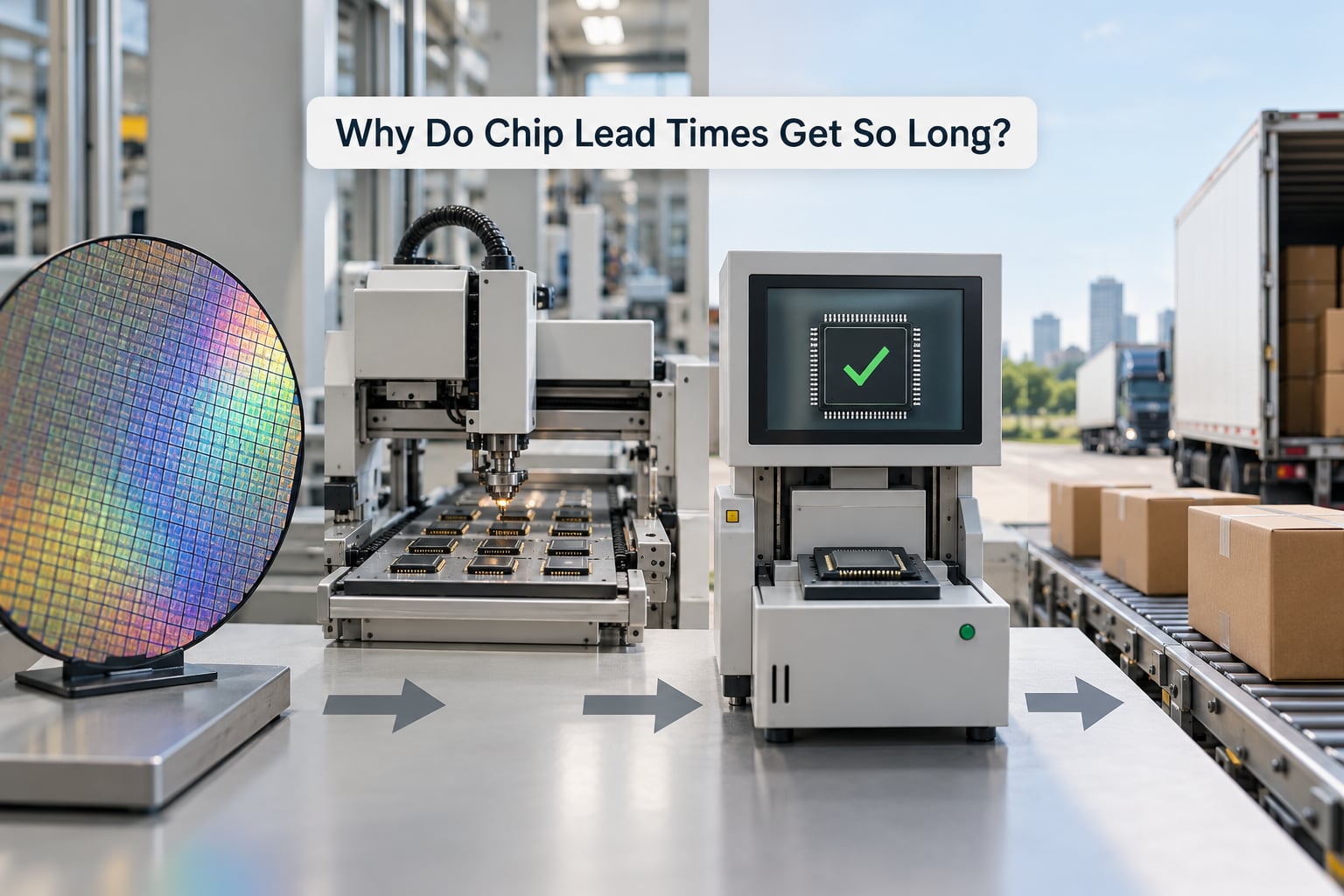
Chip lead times get so long because the industry runs lean on purpose, capital projects take three to five years to complete, and demand moves in weeks. Eight causes account for nearly all of the delay you will see:
- Capacity is built years ahead. A greenfield fab takes three to five years from groundbreaking to qualified volume production, and the tools inside it are ordered 12 to 18 months before installation.
- Only a handful of companies can make leading-edge chips. TSMC, Samsung Foundry and Intel Foundry dominate advanced nodes, and their capacity is sold out well beyond the current quarter.
- One slow step holds the whole flow. Lithography, deposition and etch tools run in sequence; if one is down for maintenance or waiting on a spare part, wafers queue behind it.
- Mature nodes have no new capacity coming. The tools used on older processes are no longer manufactured, and few fabs are being built for them.
- Packaging and test are their own bottleneck. Substrates, advanced packaging for HBM, and final test capacity are often more constrained than wafer supply.
- Forecasting fails in both directions. Double ordering and panic buying cancel real orders later and still consume capacity now.
- Allocation reorders the queue. When supply is short, foundries and distributors ship by contract priority and customer size, not by order date.
- Design freeze locks you in. Changing a part means requalification, firmware and tooling work, so a “readily available” substitute may be months away in engineering time.
Which Semiconductor Supply Chain Stages Create the Biggest Delays?
Practitioners on r/sysadmin and electronics Stack Exchange keep asking the same question — is the delay at the fab, the packaging house, or the distributor — and the honest answer is that it varies. This table is the one I would give a new planner on day one.
| Stage | Typical delay contribution | How controllable it is for a buyer |
|---|---|---|
| Design, mask and product qualification | Weeks to months, mostly in-house | High, but only before design freeze |
| Wafer fabrication (advanced node) | Several months of cycle time plus queue time | Very low; you do not own the queue |
| Wafer fabrication (mature or legacy node) | Shorter cycle, but very little spare capacity | Low; few qualified fabs exist |
| Specialty materials and substrates | Weeks to months of qualification and supply churn | Low; usually invisible to the buyer |
| Assembly and packaging (OSAT) | Weeks to months in queue | Low to medium with a capacity reservation |
| Test, burn-in and test program development | Days to weeks, longer for new programs | Medium; test programs can be prepared early |
| Board build and final logistics | Weeks, longer across customs or disruption | Medium; dual sites and stocked parts help |
The pattern in that table is what surprises people. The stages you control are small and early. The stages that dominate the schedule are late, opaque and mostly owned by someone else.
How Does Limited Foundry Capacity Affect Lead Times?
A modern fab is a queue of several hundred process steps. A wafer moves through deposition, lithography, etch, implant and metrology repeatedly, and each pass takes minutes to hours — but the waiting between steps, for a tool that is busy, in maintenance, or holding material, often exceeds the processing itself.
That queueing effect is why cycle time does not scale with wafer starts. Double the number of wafers in a fab and you do not halve the time per wafer; you lengthen the wait at every step.
Leading-edge capacity is limited by tool count rather than floor space. Each EUV lithography tool is a single-source purchase from ASML, and Applied Materials and Lam Research supply much of the deposition and etch capacity. If a fab has nine lithography tools, it can process nine wafers through that step at a time, and every extra layer added to the process consumes another pass.
Mature nodes face a different constraint. A 180 nm or 90 nm process may run on tools that exited the market years ago. Spare parts come from salvage suppliers, and no new greenfield fab is being designed for that node. That is why an “old” chip can be harder to get than a brand-new one, and why automotive and industrial buyers on legacy nodes often wait longest.
Adding capacity does not rescue a shortage quickly. A new fab runs three to five years from groundbreaking to volume, and the equipment inside it was ordered a year or more before it arrived.
How Do Equipment and Materials Shortages Slow Production?
Tool lead times have been cited at up to 18 months from equipment OEM order to a tool reaching the fab, and installation adds more. When the tool arrives it does not simply switch on: it is unpacked, moved through clean-room interfaces, powered up, run on dummy wafers, and qualified against the process recipe.
Material shortages bite in quieter ways. Specialty gases, high-purity chemicals, photoresists and raw silicon wafers all have their own supply chains and qualification cycles. A new gas supplier usually needs months of testing before a fab will accept it in a critical step, so the approved vendor list is short and switching is slow.
The amplifier is that a fab is a serial line, not a parallel one. When a single tool goes down and the spare is not on the floor, the wafers behind it stop moving. A maintenance part that normally arrives in a day can idle a tool for weeks if the vendor is off-shored or the part is obsolete.
Buyers feel this indirectly: a single unavailable part can move your delivery date by a month without anything changing on your end.
What Makes Advanced Chips Take Longer to Manufacture?
Each process node shrink adds process steps. Going from one node to the next means more masks, tighter overlay control, and more chances to lose a wafer to a defect — so a 3 nm wafer can take considerably longer through the fab than a 28 nm wafer on the same equipment set.
Yields make it worse at the start. A new product on a new node typically yields poorly for the first months of production, which means more wafer starts to get the same number of good dies. Capacity measured in wafers is not capacity measured in shippable parts.
Then add qualification. A new part has to be characterised electrically, tested across temperature and voltage corners, and often run through a customer-specific PPAP process. That work happens after the wafers exist and before you can order production quantities, so it lands directly in your schedule.
HBM stacks push this further. Multiple DRAM dies are bonded vertically with advanced packaging, which adds a bonding and stacking step and depends on a specialised packaging supply chain that sits upstream of assembly.
How Does Packaging and Testing Create Lead-Time Bottlenecks?
This is the stage that produces the most confusing conversations, because the wafer is finished and the part still does not exist. After a wafer leaves the fab it goes to an OSAT, where it is diced, die-attached to a substrate, wire-bonded or flipped, moulded, and tested.
Substrate supply is often the hidden constraint. Organic substrates and interposers come from a small number of qualified manufacturers, and a package is not buildable without one. Advanced packaging capacity for AI parts is even narrower, and it is sold on allocation.
Test adds its own queue. Final test needs a tester, a handler, and a test program written and debugged for your part. A test program for a brand-new device is real engineering work, and it cannot be skipped. Burn-in screening takes additional days per lot for parts where early-life failure matters, such as automotive and medical devices.
So a “wafer available” status update means very little. Ask where the wafers are in the assembly and test flow before you update your build plan.
How Do Demand Spikes and Forecasting Errors Affect Lead Times?
The industry’s planning failure is a well-documented cycle. Fab investment lags demand by years, so every shortage invites an over-build, and every over-build produces a glut that stops the next round of capacity orders. The result is boom-bust capacity, and buyers see the edge of it as sudden, unexplained lead-time jumps.
Demand-side behaviour makes it worse. When lead times stretch, buyers order more than they need and order from more suppliers — the classic double order. Those duplicate orders consume real capacity that other customers then wait for, even though the duplicates get cancelled weeks later.
Lean inventory policies amplify the swing. Companies that ran just-in-time to cut carrying cost have no buffer when a line stops, and panic buying in that moment pushes the recovery further out.
Segment demand also reshuffles capacity. AI and data-centre work pulls leading-edge wafers, advanced packaging and HBM away from automotive and industrial buyers who are then told to wait. In 2026, lead time variation across categories is wide enough that treating every component the same way is a planning mistake.
How Do Logistics, Export Controls, and Geopolitics Add Delay?
Wafers, packaged parts and finished boards all cross borders, usually more than once. Ocean freight, port congestion and customs review add days or weeks that appear nowhere on a factory quote. A shipment held for document inspection does not generate a new production date; it simply stops.
Export controls add a planning layer of their own. Restrictions on advanced logic, memory and equipment to certain destinations require licences and end-use screening, and they can affect what a supplier is even allowed to quote you.
Geographic concentration is the deeper issue. Advanced logic is heavily concentrated in Taiwan, and the equipment supply chain itself is concentrated in a handful of European and US suppliers. A disruption at one site, one port, or one vendor propagates worldwide because there is no immediate substitute.
The usual response is redundancy — a second fab, a second assembly house, a second logistics route — and it works, but it is expensive. Most buyers pay for redundancy only after an outage teaches them the lesson.
How Can Companies Reduce or Manage Long Lead Times?
You cannot make a fab appear, but you can stop being the weakest link in someone else’s queue. These are the moves that consistently work:
- Forecast honestly and share it. Suppliers prioritise customers who give usable demand signals. Cancelled forecasts destroy trust and push you down the priority list.
- Qualify alternates before you need them. A second source is only real once it has passed PPAP and your firmware supports it. Start during schematic design, not during a shortage.
- Design for flexibility. Pin-compatible alternates, jumpered footprints and firmware-selectable variants turn a supply crisis into a configuration change.
- Reserve capacity where it is offered. Long-term agreements and capacity reservations cost money and buy queue position.
- Hold buffer stock where the maths works. A few extra weeks of cover on long-lead, low-volume, high-consequence parts is cheap; the same buffer on commodity passives is waste.
- Know your critical path. Track where each long-lead part actually sits — fab, OSAT, test program, or freight. Practitioners on electronics Stack Exchange report that the layer is often not the one assumed.
- Prepare test programs early. Test engineering is your own bottleneck and it is one you can remove.
If you are a small company with no leverage, focus on the first two. You will rarely win allocation priority, but you can make sure a substitution does not cost a quarter.
Frequently Asked Questions
What does a 4 week lead time mean?
A 4 week quoted lead time usually means four weeks from when the supplier confirms the order to shipment, assuming no allocation and no custom test program. In practice it describes the quote, not the delivery date, so confirm whether the clock starts at purchase order, at confirmation, or at allocation, and whether it is quoted or delivered lead time.
What is the expected lead time for semiconductors in 2026?
It depends on the category, and the spread is wide: memory such as DRAM has been quoted beyond 40 weeks, with DDR4 devices in the 26 to 34 week range and automotive or industrial DRAM longer at 30 to 42 weeks. Passives have run around 34 weeks and sensors around 31 weeks, while mature analog and discrete parts have typically sat closer to 26 weeks.
Is there going to be a chip shortage in 2026?
Not the indiscriminate 2021 style shortage, but supply remains tight in specific segments. Memory, advanced packaging and leading-edge logic are the pressure points, while mature-node analog and discrete parts can stay constrained for different reasons, such as limited legacy capacity and few qualified fabs. Expect continued volatility rather than a clean recovery.
How difficult is chip manufacturing?
Extremely capital and process intensive. A leading-edge fab takes three to five years to build and qualify, the tools inside it are ordered 12 to 18 months ahead, and advanced nodes need more process steps than the node before. New products also spend months ramping yield before output is economic, which is why capacity takes years to add rather than months.
How long does a semiconductor last?
Product lifetime is a different question from lead time. Industrial and automotive parts are commonly specified for 10 to 15 years of supply, consumer parts far less, and a device may be sold for a decade after a fab stops supporting it. Always confirm the stated longevity and end-of-life notice period before designing a part into a long-lived product.
Is the semiconductor industry declining?
No. Demand has grown structurally for decades, driven by more electronics per product, electrification, cloud and AI workloads. Individual segments cycle hard, and a mature product line can be discontinued, but industry volume has followed a long upward trend. Lead times are long because demand keeps rising into a supply base that expands over years, not because the market is shrinking.
Conclusion: Start With the Bottleneck, Not the Delivery Date
Chip lead times are long for structural reasons: capacity takes three to five years to add, tools take over a year to arrive, mature nodes have no new fabs coming, packaging and test have their own queues, and allocation decides who ships first. None of that changes quickly.
So start one layer deeper than the delivery date. Find out whether your part is waiting on a wafer, an OSAT slot, a substrate, a test program, or a customs hold, then fix that specific constraint. Confirm what your supplier’s lead-time number actually measures, and build the contingency into your schedule before the purchase order goes in.