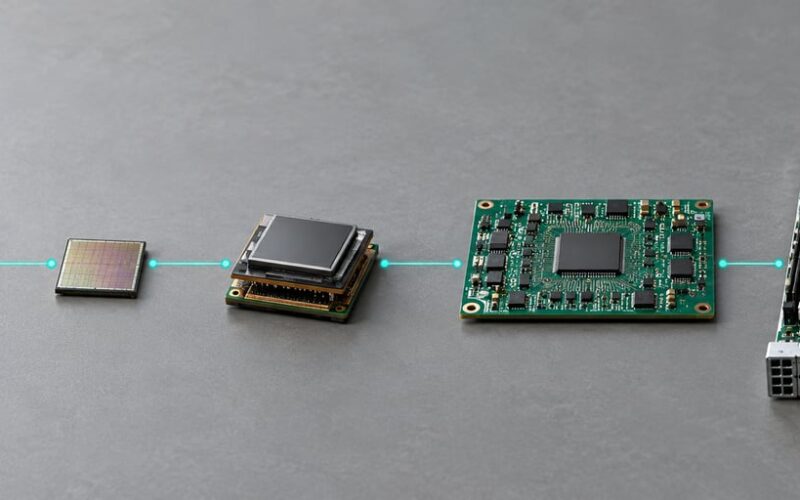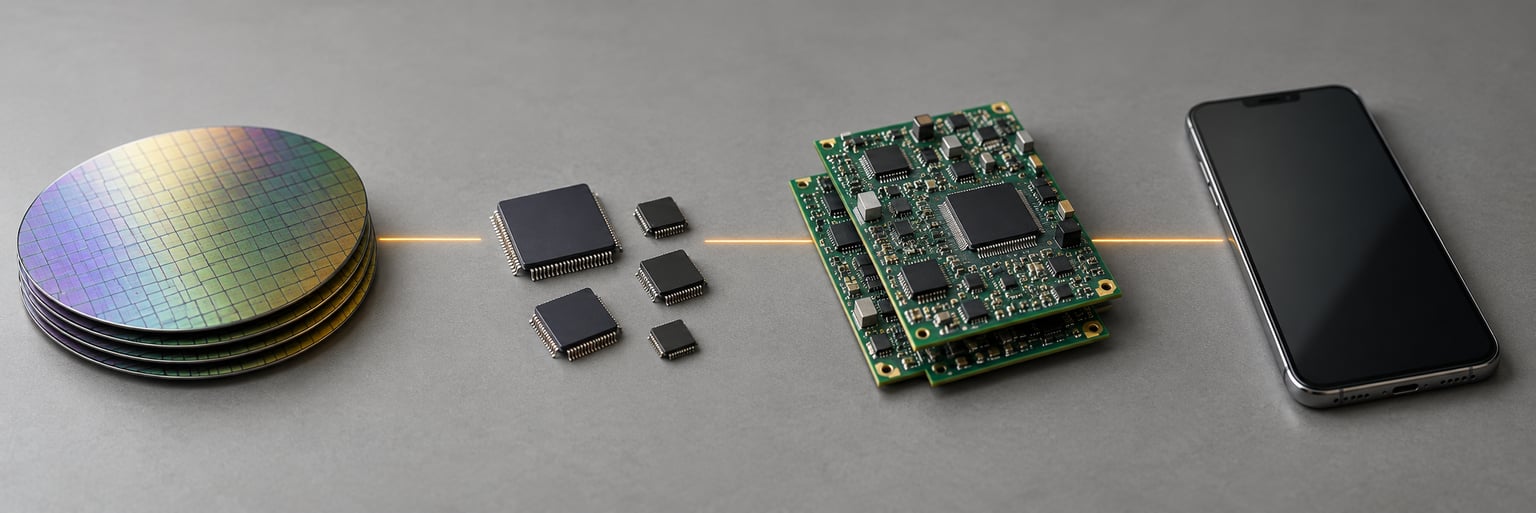
How chip tariffs affect electronics prices comes down to a chain, not a single step. The duty lands on imported chips at the border, chips are one line in the bill of materials of a phone, laptop, console, TV, server or car, and how much of that cost reaches the shelf depends on who absorbs it, how much inventory a company already holds, and where the device is assembled and sold.
Last updated: October 2026. Policy details in this area change often, so treat the framework below as durable and the rates as current at publication.
Table of Contents
- How Chip Tariffs Affect Electronics Prices: The Short Answer
- What Is a Chip Tariff?
- How the Cost Moves Through the Supply Chain
- Step 1: The duty is charged at the border
- Step 2: The distributor reprices the part
- Step 3: The device maker’s bill of materials changes
- Step 4: The device maker sets a retail or contract price
- Step 5: Retailers and distributors decide the shelf price
- What the arithmetic looks like
- Why Chip Tariffs Do Not Always Raise Retail Prices
- Which Electronics Are Most Likely to See Price Changes?
- How Chip Tariffs Affect Electronics Prices Beyond the Product
- Launches slip and product plans move
- Parts get substituted, and sometimes requalified
- Inventory swings in both directions
- Hardware demand and software capacity shift
- Uncertainty itself carries a price
- Why chip tariffs affect electronics prices even when no duty is collected
- What Would Make Price Increases Larger or Faster?
- What Should Buyers, Makers, and Consumers Do Next?
- If you are a consumer or a small buyer
- If you are a design, packaging or procurement team
- How to tell a tariff price rise from other cost pressure
- What to monitor
- Frequently Asked Questions
- Who pays import tariffs, the exporter or the importer?
- Will chip tariffs make phones and laptops more expensive?
- Do tariffs affect digital products?
- How much of a phone’s price is actually the chip?
- How can I tell if a price increase is caused by tariffs?
- Conclusion: What to Watch First
How Chip Tariffs Affect Electronics Prices: The Short Answer
A chip tariff is a duty charged on imported semiconductors when they cross into the US. The importer pays it to Customs at the border, and chips feed into the bill of materials of nearly every electronic device. The importer then chooses how much of that duty to absorb and how much to add to what it charges its customer, so the tariff raises landed cost immediately but raises retail price only partially, later, or not at all.
Key takeaways
- Legal payment and economic burden are different questions. The importer of record pays Customs; that cost can be absorbed, passed on, or split.
- Chips are a small share of a finished device’s cost, so a large duty on a chip is a modest number on a retail tag.
- Inventory bought before a duty took effect is the main reason a price rise is delayed rather than immediate.
- Where a device is assembled changes the exposure, and so does whether a duty applies to the chip, the device, or both.
- Domestic fab capacity cannot expand fast enough to replace imported advanced chips, so the cost arrives well before any local supply does.
- Published price estimates for finished devices vary enormously, which is a reason to watch actual shelf prices rather than forecasts.
What Is a Chip Tariff?
A chip tariff is an import duty on semiconductors, meaning wafers, dies, packaged chips and often the manufacturing equipment used to make them. It is normally levied under national security authority such as Section 232 of the Trade Expansion of 1962, which lets the government impose duties on imports deemed to threaten national security after an investigation and a public comment period.
The distinction people miss is between a duty on the chip and a duty on the finished device. A phone imported into the US can be treated under its own classification, separate from any duty on the processor inside it. Both can apply, they can be changed independently, and exemptions for one do not automatically cover the other.
Chip or not, a tariff applies to goods crossing a border. Streaming video, software licences, cloud services and any other digital purchase delivered from abroad are not goods crossing a border, so tariffs do not apply to them directly. What does reach them is second-hand: a service running on hardware that got more expensive to import.
Two more terms matter. The importer of record is the party that formally presents the entry to Customs and pays the duty, and for most chip purchases that is a distributor or the manufacturer’s US entity rather than the foreign fab. The HTS code is the classification that decides which rate applies, so whether a component is treated as a chip, as equipment, or as part of a finished product comes down to how it is classified on entry.
How the Cost Moves Through the Supply Chain
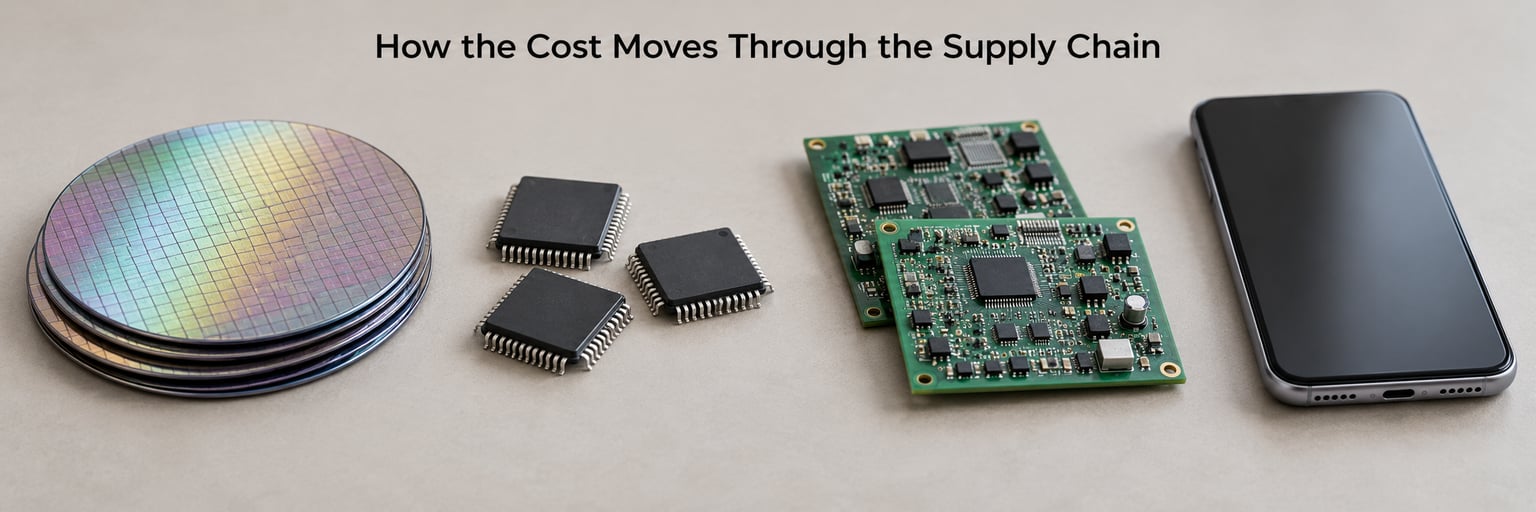
The cost moves in a predictable order, and each stage decides whether the next one feels it. Here is the chain from wafer to shelf price.
Step 1: The duty is charged at the border
The importer of record files the entry, US Customs assesses the duty against the declared value, and the money leaves the importer’s account on the spot. Nothing downstream has happened yet at this point, which is why announcements move markets immediately.
Step 2: The distributor reprices the part
Wafer and packaged-chip inventory is usually bought through a distributor, and the distributor holds the duty cost from the moment of entry. It can set a new list price, refuse to quote on a fixed price, or quietly reclassify the transaction to a different rate or an exemption that applies.
Step 3: The device maker’s bill of materials changes
Engineers cost a device line by line, so a higher part cost shows up as a higher cost of goods before anything is sold. A duty on a chip that costs the device a small amount on every unit produces a small line item, repeated millions of times.
Step 4: The device maker sets a retail or contract price
Here is the fork. A maker facing a thin margin, a new product launch, or a competitor who has not raised prices may absorb the increase and take less profit. A maker with a backlog, a sold-out launch, or a new generation to move next quarter passes it straight through.
Step 5: Retailers and distributors decide the shelf price
The last layer belongs to whoever sets the price you pay. Promo budgets, competitor pricing, seasonal discount calendars and the volume of inventory on hand all sit in that decision.
What the arithmetic looks like
Take a hypothetical example with an index rather than a currency. Price an imported logic chip at 100 on a cost index, and memory and other silicon adds another 60. A 25% duty on the logic chip adds 25, so the silicon content moves from 160 to 185, a 15.6% rise in silicon cost. If that silicon is 25% of the device’s cost of goods, the device’s cost base rises about 3.9%.
Now the part people get wrong. A 3.9% rise in cost of goods is not a 3.9% rise in shelf price. A phone whose cost of goods is 300 and whose shelf price is 700 has plenty of room: a 12-unit cost increase is under 2% of the shelf price. Absorb it and the price does not move at all. Pass it on and the price rises a fraction of what the headline rate suggests.
That is the honest version of the pass-through math, and it is also why the loudest forecasts and the price you see in a shop rarely match.
| Stage of the chain | Where a chip tariff bites | Type of exposure |
|---|---|---|
| Border entry of wafers or packaged chips | Duty paid by the importer of record on the declared value | Direct |
| Distributor inventory and quoting | Repricing of parts already in the channel | Direct |
| Device bill of materials | Higher cost of goods for every unit built | Direct |
| Contract pricing between makers and buyers | Cost pass-through clauses, renegotiated terms | Direct |
| Retail shelf price | Margin absorbed, promo budget cut, or price raised | Indirect |
| Demand and order volumes | Buyers defer purchases, slowing unit growth | Indirect |
| Fab construction and assembly location | Long-term capacity decisions driven by the policy | Indirect |
| Server and data centre deployment | Duty cost multiplied across large hardware orders | Direct and multiplied |
Why Chip Tariffs Do Not Always Raise Retail Prices
Nothing in the mechanism forces a shelf price to move. The importer of record has three options, and most real decisions are a blend of all three.
Absorb. The company eats the duty out of margin. This is common for a firm protecting a launch, holding a price match against a competitor, or sitting on a large enough profit pool to bridge a year of policy.
Pass on. The duty goes into the price charged to the next buyer and eventually to the consumer. It happens fastest where demand exceeds supply or where the product is new and priced on a value basis rather than a cost basis.
Split. The cost is shared between the importer and its customer through a negotiated contract, a temporary price cap, or a surcharge that applies to new orders only.
Several ordinary business conditions can absorb or delay the increase before anyone has to decide anything dramatic.
- Inventory timing. Parts bought and shipped before a duty took effect can be sold at the old economics for weeks or months. This is the single biggest reason a tariff announcement and a price change rarely land on the same day.
- Existing supply contracts. Fixed-price or fixed-rate agreements shield both sides for their term, and buyers with long-term agreements are insulated until renewal.
- Domestic production. A policy that exempts chips made in the US, or that ties duty-free allowances to domestic investment commitments, changes the exposure of a specific company rather than of a whole category.
- Margins. A product with a large margin can absorb a cost increase quietly. A thin-margin product cannot, so it reprices sooner.
- Product mix. A company that shifts buyers toward a higher-priced model can hold the entry price while the average price rises.
- Demand. When buyers pull back, a maker can protect volume by trimming margin instead of raising price, and the cost stays inside the company.
Channel partners add their own layer, and the per-item fee is where it gets interesting. A flat charge levied on each unit in a shipment is negligible on a full container and punishing on a small order, so the two effects pull in opposite directions. If a batch of hobbyist modules went from a few thousand to something like five times that once a high percentage rate and a per-item fee were combined, the percentage alone cannot explain it. That is an extreme case, but it shows why a small buyer should read the fee schedule before reading the headline rate.
Which Electronics Are Most Likely to See Price Changes?
Exposure tracks two things: how much silicon sits in the product, and how close the product is to being a chip purchase rather than a chip user. A server is bought as hardware with a duty attached. A refrigerator is bought as a finished appliance and feels the duty only indirectly.
| Product category | What the duty acts on | What mainly drives the price |
|---|---|---|
| Smartphones | Processor, memory, modem; often the finished device as a separate line | Component cost, product cycle, channel inventory |
| Laptops and tablets | Processor, memory, storage, display controller | Component cost and refresh timing |
| Gaming consoles | Custom SoC, memory, storage; the unit is usually built in one country | Component cost, launch pricing, a single assembly site |
| TVs and appliances | Main SoC, memory, power and control semiconductors | Panel and display cycles, freight, retailer margin |
| Servers and AI accelerators | The accelerator or CPU is the largest single line in the build | Duty multiplied across high-value, high-volume hardware |
| Automotive electronics | MCUs, power devices, sensors; long requalification cycles | Qualification cost and multi-year supply agreements |
| Networking and industrial equipment | Network processors, FPGAs, specialty analog | Long-lead parts, single-source foundries |
| Defence and aerospace hardware | Radiation-hardened and long-lead components | Qualification, traceability, contract structure |
On the consumer side, the numbers most people quote come from a Consumer Technology Association model that was widely reported when a proposed duty was under discussion. It estimated laptops and tablets rising about 46%, smartphones about 26%, and consoles about 40% under that specific proposal, applied to finished devices rather than to chips alone. Treat those as one modeled scenario with its own assumptions, not as a forecast of what happens to a product on a shelf, and note the date it was published.
Why the gap? A device’s chip content is real but bounded, while these figures describe a duty large enough to dominate the entire bill of materials. Chip-only duties on finished products are the same mechanism at a much smaller scale.
Two structural facts limit how far domestic supply can respond. Taiwan produces the large majority of leading-edge chips, and the most advanced US fab under construction is expected to reach only about 30% of advanced capacity after a full build-out. The US share of global semiconductor production was around 10% in 2022 with a projection near 14% by 2032. None of that changes a price in the current quarter.
How Chip Tariffs Affect Electronics Prices Beyond the Product
The price tag is only the visible part. The larger effects sit in how, and whether, products get built.
Launches slip and product plans move
When a duty changes mid-cycle, a company can decide to delay a launch until the new cost base is known, pull a model forward, or drop a variant entirely. Delays cost money without showing up as a price increase, so a tariff episode can look quiet at retail while the product roadmaps change completely.
Parts get substituted, and sometimes requalified
A buyer whose cost just moved will look for a cheaper part that still fits. For commodity memory that is a straightforward swap. For a controller in an automotive or aerospace program, changing supplier or foundry means documentation, testing and customer requalification, and that work usually costs far more than the duty that prompted it. Where a design team is weighing that trade-off, the practical constraint is almost always qualification schedule rather than the duty line on the quote.
Inventory swings in both directions
Panic prebuying ahead of an announced duty pulls demand forward and empties the channel; buyers then pause and orders crater afterwards. The result is a boom-bust pattern in component orders that has nothing to do with how many units people ultimately want.
Hardware demand and software capacity shift
Data centre operators running thousands of accelerators feel a per-chip duty multiplied across every unit in a build, and the same pressure slows the deployment of capacity that developers depend on. That is a cost to services and software pricing that never appears on a hardware price list.
Uncertainty itself carries a price
The clearest framing of the problem is that uncertainty alone is enough to change pricing and procurement behaviour before any rate takes effect. Long-term agreements get shorter, buffer inventories get bigger, and both of those raise the cost of doing business whether or not a duty is ever collected.
Why chip tariffs affect electronics prices even when no duty is collected
Because a policy that cannot be planned around is expensive even at a zero rate. Buyers who cannot commit to a price for six months hold more inventory than they need, sign cost pass-through clauses they would rather not have, and delay launches that would otherwise be cheap to run. The duty is the visible cost; the uncertainty is the one that never leaves the spreadsheet.
What Would Make Price Increases Larger or Faster?
If you want to predict a specific product’s price, these are the variables that decide the answer.
Tariff scope. A duty on chips alone and a duty on the finished device containing them are very different numbers. Scope decides the size of the base the duty applies to.
Duty rate. A low single-digit rate on imported logic is a rounding error in a device bill. A high rate is a product-pricing event. The rate also matters less than the exemptions, which is why carve-outs move markets harder than the headline number.
Chip share of the bill of materials. The same duty produces a bigger relative hit on a device that is mostly silicon than on one that is mostly mechanical parts, assembly labour and logistics.
Inventory on hand. This sets the delay. A company with ninety days of components has a quarter of protection no matter what the rate says.
Bargaining power. A large buyer with committed volume negotiates the duty away or shares it. A small buyer ordering one part at a time absorbs the full percentage plus any per-item fee.
Currency. A stronger dollar against the exporting country’s currency can offset part of a duty, and a weaker one can turn a modest duty into a meaningful one. This is the quietest variable and the one most people forget.
Demand in that product cycle. When a category is sold out, the maker passes costs on. When a category is losing to a successor generation, the maker protects volume and eats it.
Timing relative to the buying cycle. Enterprises and public buyers often bid hardware on a fiscal or contract calendar. A duty that takes effect between two bidding rounds barely matters.
What Should Buyers, Makers, and Consumers Do Next?
If you are a consumer or a small buyer
Watch the shelf price of the specific product you want, not the tariff rate. Tariff headlines move constantly and forecasts disagree with each other by tens of percentage points, so a headline is a weak signal about one product. If you are replacing hardware for work, compare the cost of waiting against the cost of buying early, and put a real number on the second option.
For small and enthusiast builds, the per-item fee matters more than the percentage. Grouping parts into fewer shipments, buying in volume, or shifting to a stocked distributor can beat hunting for an exemption.
If you are a design, packaging or procurement team
Get the classification right for every part, because classification drives the rate and exemptions are usually written against categories. Track duty and exemption notices at entry, and keep a list of which parts are single-source and which need requalification, since those are the ones where a duty is almost never cheaper to solve than to absorb.
Model the duty against the whole cost of a switch. A 10% duty on a part you can requalify in six weeks and save 30% is not a problem. A 10% duty on a part that takes a year to requalify across automotive or defence customers is a scheduling event. Ask your suppliers in writing which classification they are using, and get the answer in the quote rather than the invoice.
How to tell a tariff price rise from other cost pressure
Electronics prices move for several reasons at once, and a price increase in a tariff period is not automatically a tariff effect. Work through these before concluding anything.
- Did a tariff or exemption notice take effect shortly before the change, and does it cover the part category in that product?
- Did the move come with a stated component or material cost, or did it come with a margin story instead?
- Are memory prices moving across the whole market at the same time? A memory cycle affects every brand and every category at once, which is the opposite of a tariff effect.
- Is the price change across a whole category or only one product line? Tariff exposure varies by bill of materials, so a targeted move suggests a product decision.
- Did the currency move? Exchange rate swings can produce a price change with no policy event at all.
- Did the maker mention production cost, freight or a plant move? Those show up in a price increase too.
- Is the change permanent, or a promo reduction ending? A shelf price returning to normal is not a price increase.
What to monitor
Official tariff and exemption notices first, because scope and carve-outs change more often than headline rates. Then company guidance, since a maker telling you it is absorbing the cost is worth more than any estimate. Then inventory conditions, since they set the delay between a duty and a price. Then the actual price of the product you care about, which is the only measure that matters to you.
Frequently Asked Questions
Who pays import tariffs, the exporter or the importer?
The importer of record pays the duty, and for most semiconductor purchases that is the US distributor or manufacturer entity that files the entry with Customs, not the foreign fab that made the chip. After paying, that company decides whether to absorb the cost from its own margin, pass it into the component price it charges its customer, or split the difference. The exporter is not charged by Customs, though a weak negotiating position can lead an exporter to discount so the burden is shared.
Will chip tariffs make phones and laptops more expensive?
They can, but the increase is usually smaller and later than the headline rate suggests. The duty lands on chips, chips are one line in a device’s bill of materials, and the importer absorbs part of it. Inventory bought before the effective date, existing supply contracts and product margin all delay or reduce the effect. Expect the first visible changes in devices with tight supply or a new generation launch, not across an entire category on one day.
Do tariffs affect digital products?
Not directly. Tariffs apply to goods crossing a border, and streaming, software licences, app subscriptions and cloud services are not goods in that sense, so no duty is collected on them. The indirect effect is real: a service running on servers and network gear that became more expensive to import can carry higher operating costs. So digital pricing can move, but the mechanism is hardware cost reaching a subscription, not a duty on a download.
How much of a phone’s price is actually the chip?
The processor, memory and supporting silicon together usually represent a meaningful but limited share of a finished phone’s retail price, with the largest single line often being the memory rather than the application processor. That is why a large percentage duty on imported chips translates into a small percentage change at retail. It also depends on the product: a data centre accelerator is mostly silicon, so the same duty hits a much larger share of the unit’s cost.
How can I tell if a price increase is caused by tariffs?
Check four things. Confirm a tariff or exemption notice took effect close to the change and that it covers the part category in that product. Compare against the whole category, since a memory cycle moves every brand at once while a tariff moves selected products. Check whether the maker named a component, freight or production cost instead. And rule out currency and promo effects, which produce similar-looking price moves with no policy event behind them.
Conclusion: What to Watch First
How chip tariffs affect electronics prices comes down to four things to watch: the scope of the duty and its exemptions, the guidance a company gives about absorbing it, the inventory conditions that set the delay, and the actual shelf price of the product in front of you. A large percentage on a chip is not a large percentage on a device, and a headline rate is not a forecast.
Check the official notices for scope, watch what the maker says rather than what a commentator guesses, and compare the price of the one product you actually want. That is where the answer actually is.