Moisture sensitivity level ratings explained in the IPC/JEDEC standard J-STD-020 are time budgets: how long a non-hermetic surface-mount package can sit in factory air after its sealed dry pack is opened before it has to be baked before reflow. Ratings run from MSL 1 through MSL 6, and the higher the number, the shorter the permitted exposure.
The rating exists because molded plastic packages breathe. They take on water vapor from the air, and when a reflow profile drags the package above 200C, that moisture flashes to steam inside a body that cannot vent. The pressure cracks the die attach and the mold compound interface, and the damage can sit dormant until the board reaches a customer.
Below is the practical version: what each level means, how floor life is counted, and what you do when the clock runs out.
Table of Contents
- Moisture Sensitivity Level Ratings Explained at a Glance
- What Is a Moisture Sensitivity Level?
- How Do the MSL Ratings Differ?
- Moisture Sensitivity Level Ratings Explained by Packaging Risk
- What Happens When a Component Absorbs Moisture?
- How Do Floor Life and Environmental Conditions Affect MSL?
- How to Handle MSL-Rated ICs Safely
- What Does Baking an IC Do?
- How to Check a Component’s MSL and Shelf Life
- Common MSL Handling Mistakes
- Frequently Asked Questions
- What does MSL 3 mean?
- What does moisture sensitivity level 1 mean?
- How do I find the MSL rating for a part number?
- Does a dry cabinet reset floor life or just pause it?
- Can I bake components that are still in tape and reel?
- Does an MSL rating tell me how long the component will last?
- Conclusion
Moisture Sensitivity Level Ratings Explained at a Glance
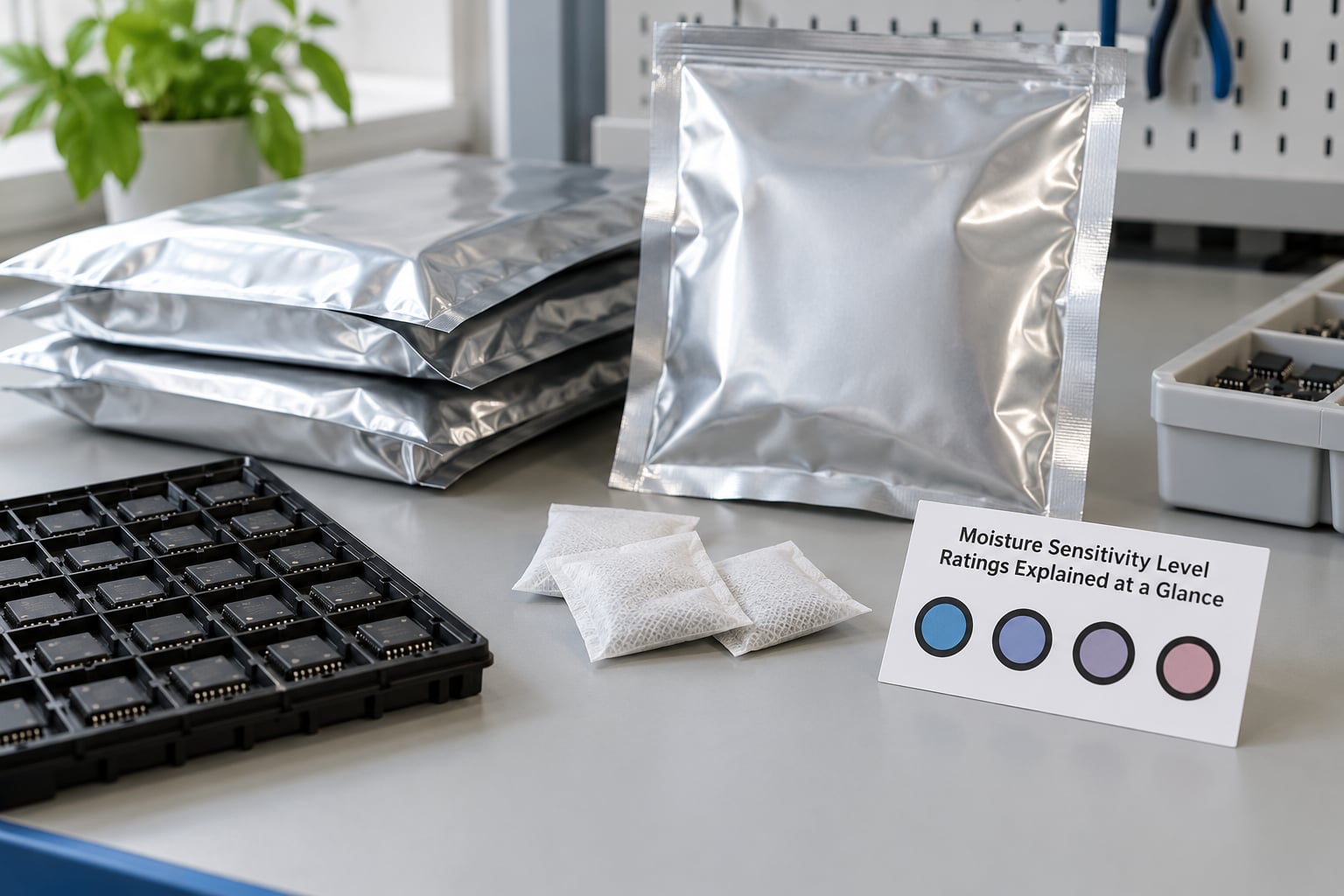
| MSL rating | Floor life out of the bag | Reference conditions | What it means for assembly |
|---|---|---|---|
| MSL 1 | Unlimited | 30C and 85% RH | No bake required for normal handling |
| MSL 2 | 1 year | 30C and 60% RH | Bake only after a very long open exposure |
| MSL 2a | 4 weeks | 30C and 60% RH | Treat as a short-dated part; plan staging carefully |
| MSL 3 | 168 hours (7 days) | 30C and 60% RH | Track out-of-bag time and bake before reflow |
| MSL 4 | 72 hours (3 days) | 30C and 60% RH | Bake if exposure passes 72 hours |
| MSL 5 | 48 hours (2 days) | 30C and 60% RH | Bake if exposure passes 48 hours |
| MSL 5a | 24 hours | 30C and 60% RH | Tightest common production window |
| MSL 6 | Not applicable | Mandatory bake before use | No exposure window at all; bake out of the bag |
MSL 1 is the odd one out. Its unlimited rating is measured against 85% relative humidity rather than the 60% used for every other level, so the same part number can look more forgiving than it really is in a genuinely humid receiving area.
What Is a Moisture Sensitivity Level?
An MSL rating is a statement about a package, not about the circuit inside it. It answers one question: how much time does this molded body have between leaving controlled dry storage and going through a reflow oven.
Three things set the rating. The molding compound absorbs water at a rate that depends on its chemistry. The diffusion path through that compound scales roughly with the square of the distance moisture has to travel, so package thickness drives exposure time more strongly than anything else. And the temperature of the reflow profile decides how much steam gets generated when the moisture finally flashes.
Floor life is the clock that follows from those numbers. It starts when the moisture barrier bag is opened or the part is removed from dry storage, and it runs in factory ambient conditions. Shelf life is something else entirely: the sealed storage window before you even open the bag. Two separate clocks, and mixing them up is the single most common misunderstanding on this topic.
Nobody assigns the rating to a die. The package assembler qualifies the assembled part, which is why a foundry die delivered inside a third-party package carries that assembler’s rating rather than anything the fab decided.
How Do the MSL Ratings Differ?
The hierarchy is straightforward. MSL 1 and MSL 2 give you months or a year of open-bag time. The 2a and 5a tiers exist as intermediate classifications for packages that fall between two categories rather than cleanly inside one. MSL 3 through MSL 5a compress the window from a week down to a single day, and MSL 6 removes the option entirely.
Note what the ratings do not say. A higher number does not mean a worse part, a cheaper part, or a shorter service life. It means the package is more demanding in the twenty-four hours before reflow, and that is the whole of the claim.
Every level above MSL 1 also carries a classification temperature under J-STD-020: the peak the part was qualified against, typically 245C, 250C, or 260C depending on package thickness and volume. That is a qualification parameter, not a recommended board profile. The reflow temperature you actually run is a separate decision.
Moisture Sensitivity Level Ratings Explained by Packaging Risk
Risk follows construction. Thin packages with small die and short bond paths give moisture a short route in and out, which is why large QFN bodies and BGAs with organic substrates tend to sit higher on the scale than small leadframe parts. Packages with copper wire bonds and certain die-attach adhesives are more sensitive again, because the moisture-driven stress concentrates right where the bonds are.
Lead-free made this tighter. A lead-free SAC profile peaks well above a tin-lead profile, and that extra thermal budget produces more steam from the same absorbed moisture. Parts that carried comfortable ratings under tin-lead were reclassified when lines moved to lead-free, which is why an older datasheet and a current one can disagree about the same part number.
Not every part is rated at all. Ceramic and hermetic packages, solid polymer capacitors, and most chip resistors and inductors are treated as MSL-exempt because they either do not absorb moisture in a meaningful way or are sealed. If a bag arrives without a rating, check whether the part is exempt before assuming something was missed.
What Happens When a Component Absorbs Moisture?
Moisture soaks into the mold compound during storage and exposure. Nothing visible happens yet. The board assembles, passes AOI, passes ICT, passes functional test, and ships.
Then reflow arrives. Above the glass transition point of the compound, absorbed water converts to steam at a volume expansion the package cannot relieve. That expansion produces internal stress at every bonded interface.
What you see next depends on where the weak interface sits. Voids at the die attach show up as delamination that scanning acoustic microscopy will find. Cracked solder joints that never fused correctly show up as head-in-pillow under a cross-section. A bond wire lifted off its pad shows up as an open circuit. In rougher cases the package body itself splits, which is the popcorn effect people picture when they hear the word moisture.
The nasty part is timing. Weak joints often pass a room-temperature test and only open up later, after the board has been through thermal cycling in the field. That is why moisture damage is treated as a latent reliability problem rather than a line defect, and why the handling record matters as much as the reflow profile.
How Do Floor Life and Environmental Conditions Affect MSL?
Floor life is a budget, and it only drains when the part is in unprotected air. Time sealed in a moisture barrier bag with desiccant and a humidity indicator card does not count. Time in a dry cabinet below 10% RH is handled separately again.
| Condition | MSL 2, 2a, 3 | MSL 4, 5, 5a |
|---|---|---|
| Dry cabinet at or below 10% RH | Clock paused; reset possible after 12 hours with at least 5x the exposure time | Not enough; needs 5% RH or below |
| Dry cabinet at or below 5% RH | Clock paused | Clock paused; reset possible after 8 hours with at least 10x the exposure time |
| Open factory floor at or below 30C and 60% RH | Full rated floor life drains | Full rated floor life drains |
That table is why the same MSL 3 part behaves differently in two plants. One runs a 5% RH cabinet and effectively multiplies the clock; the other has a staging tray by the oven, and the seven days start at the tray, not at the reel.
Temperature swings the drain rate too. Warm humid days shorten a window that a mild week would have absorbed comfortably. And an excursion above the reference conditions has no published allowance at all, which is why a night in a hot un-air-conditioned storeroom is treated as an event that needs engineering sign-off rather than a footnote in a log.
How to Handle MSL-Rated ICs Safely
Most moisture damage happens before the part ever reaches the oven. A workable assembly workflow looks like this.
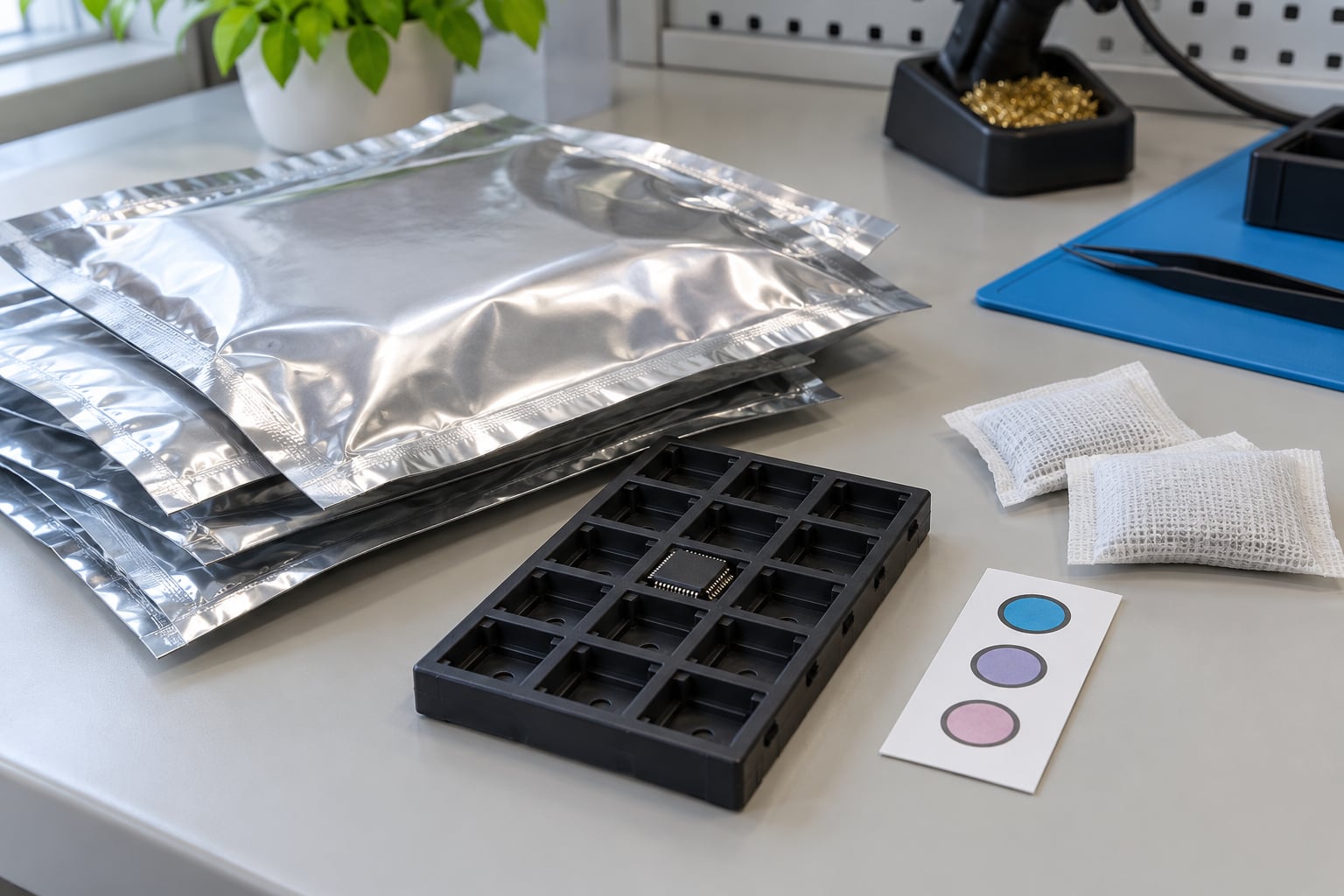
At receiving. Inspect the bag before anything else. Look for a vacuum seal or an intact seal strip, check the humidity indicator card against its threshold spots at 5%, 10%, and 60% RH, and record the open date printed on the JEP113 caution label along with the MSL, floor life, and reflow classification.
In storage. Keep sealed bags in the original packaging until you need them. If humidity runs high in the storeroom, move rated parts into a dry cabinet and log the cabinet’s RH. Do not open a full reel to pull one part when a second reel is sitting sealed.
At staging. Open bags only as the line consumes them, and record the open time on the bag and in your system. Give each reel a life budget and a decision date rather than hoping the line runs fast enough.
At reflow. If the budget is spent, the part gets baked before it goes on the board. No exceptions based on how thick the package looks.
After reflow. Once soldered, the package is sealed by the board and MSL stops applying. J-STD-033 also excludes manual soldering and rework from the standard’s normal handling rules, which is a frequent point of confusion in lab work.
What Does Baking an IC Do?
Baking drives absorbed moisture out of the molding compound before it can turn to steam. It is a controlled dry-out, not a repair step, and the standard gives you three temperature tiers with times that scale by package thickness.
- 125C tier for parts that are dry or only lightly exposed, where you want the moisture gone quickly.
- 90C tier for the common case of a part that has exceeded its floor life.
- 40C tier for parts that cannot tolerate heat, including anything where the carrier or the part itself has a low limit.
Two limits matter. Cumulative bake time above 90C is capped at 96 hours, and the limit is cumulative across the part’s history, not per bake cycle. Repeated cycling also promotes intermetallic growth on terminations and can degrade solderability, so a part that has been baked four times deserves a conversation rather than another oven run.
Put parts in dry bags with fresh desiccant and, where the standard calls for it, a humidity indicator card immediately after the bake. Tape and reel carriers have their own temperature ceiling, usually around 40C, which is why baking bulk material at 125C means removing parts from their packaging first.
How to Check a Component’s MSL and Shelf Life
Work down this list in order, because the earlier sources are more authoritative than the later ones.
- The bag label. The JEP113 caution label carries the MSL, the floor life, the reflow classification temperature, and the date the bag was opened. This is the primary record.
- The humidity indicator card. If a threshold spot has turned past its rating, the contents are treated as having exceeded floor life regardless of what the date says.
- The datasheet. Look for a moisture or reflow sensitivity section. It often states the level and the classification temperature.
- The supplier’s own documentation. Their assembly and handling notes are the manufacturer position for that package.
- Distributor records. Useful for orientation, and sometimes wrong. Practitioners hit real conflicts here, with a distributor listing a part as MSL 1 while the manufacturer confirms MSL 4 for the same number. When the two disagree, treat the manufacturer as authoritative and correct the record internally.
If nothing anywhere gives a rating, ask the manufacturer directly rather than assuming MSL 1. Absence of data is not the same as an unlimited floor life, and plenty of forum threads exist purely because engineers got no answer from a distributor listing.
Whichever source you use, write down how long the part has already been exposed. Remaining life is only meaningful when you know where the clock started.
Common MSL Handling Mistakes
Leaving bags open on the line. A reel opened at the start of a shift has burned most of its budget by lunch. Stage in sealed bags and open one reel at a time.
Resealing a bag without a new desiccant. Moisture accumulates regardless of how good the seal looks. An opened bag needs fresh desiccant, an HIC, and a new open date.
Tracking by bag seal date instead of open date. Shelf life and floor life are different clocks. Only the open date starts the exposure budget.
Ignoring excursions. Time spent above 30C and 60% RH is not covered by the published rating. Log it and route it to engineering.
Baking without a record. A bake is a process step with a specification behind it. Record the temperature, duration, package thickness, and the standard revision you followed. Citing the classification standard on a bake record is the wrong document; the handling standard is the right one.
Treating an MSL rating as a full handling specification. The level tells you a window. It does not tell you the bake profile, the exposure reset rules, or the documentation requirements.
Mixing unverified material with known stock. Brokered parts and repackaged reels arrive with no trustworthy history. Keep them segregated and never let them share a reel with verified inventory.
Frequently Asked Questions
What does MSL 3 mean?
MSL 3 means the package may sit in factory air for up to 168 hours, or seven days, at or below 30C and 60% relative humidity after its moisture barrier bag is opened. Once that window is spent, the part must be baked before reflow soldering under J-STD-033D. In practice it is the most common rating on fine-pitch parts such as QFN and BGA packages, and it is manageable with dry cabinet storage and a logged out-of-bag time on each reel.
What does moisture sensitivity level 1 mean?
MSL 1 means unlimited floor life, so the part can sit in open air for as long as needed without baking. It is measured against a reference environment of 30C and 85% relative humidity, which is more permissive than the 30C and 60% RH reference used for every other level. MSL 1 does not mean the part is sealed or waterproof. It means the package tolerates normal reflow exposure without a prior bake.
How do I find the MSL rating for a part number?
Check the JEP113 caution label on the bag first, since it lists the MSL, floor life, reflow classification, and the bag open date. Then check the humidity indicator card, the manufacturer datasheet, and the supplier’s handling documentation. Distributor listings are useful for orientation but occasionally conflict with the manufacturer, and when they do, the manufacturer is the authority. If no source gives a rating, ask the manufacturer rather than assuming MSL 1.
Does a dry cabinet reset floor life or just pause it?
Both, depending on humidity and duration. At or below 10% RH, the floor-life clock pauses for MSL 2, 2a, and 3 parts, and after at least 12 hours in that condition with at least five times the exposure time, the clock can be reset. MSL 4, 5, and 5a parts need 5% RH or lower, at least 8 hours, and at least ten times the exposure time. Keep logging the cabinet readings so the reset is defensible.
Can I bake components that are still in tape and reel?
Only at low temperature. Tape and reel carriers are typically rated to around 40C, so bulk material cannot go through a 90C or 125C bake in its packaging. Either bake at the 40C tier with the manufacturer agreement, which takes considerably longer, or remove parts from the carrier first and bake them loose in dry bags with fresh desiccant. Cheaper carrier plastics can deform well before the component reaches its limit.
Does an MSL rating tell me how long the component will last?
No. MSL describes package sensitivity to moisture during reflow, nothing about device quality, reliability in service, or usable lifetime. A high-MSL part can be a perfectly good part and a low-MSL part can still fail early for unrelated reasons. Minimum useful life for a component is counted from its delivery date rather than its manufacturing date, and storage history matters more for solderability than the MSL level does.
Conclusion
Moisture sensitivity level ratings explained properly come down to three habits. Identify the specified MSL for the exact part number and package from the bag label, the datasheet, or the manufacturer. Record the exposure history so the remaining floor life is a known quantity rather than a guess. Then follow the manufacturer’s handling and baking requirements from J-STD-033D before the part goes through reflow.
None of that is complicated. It just has to happen before the oven, because once the package has been reflowed, there is no way to inspect for the damage that may have formed inside it.